

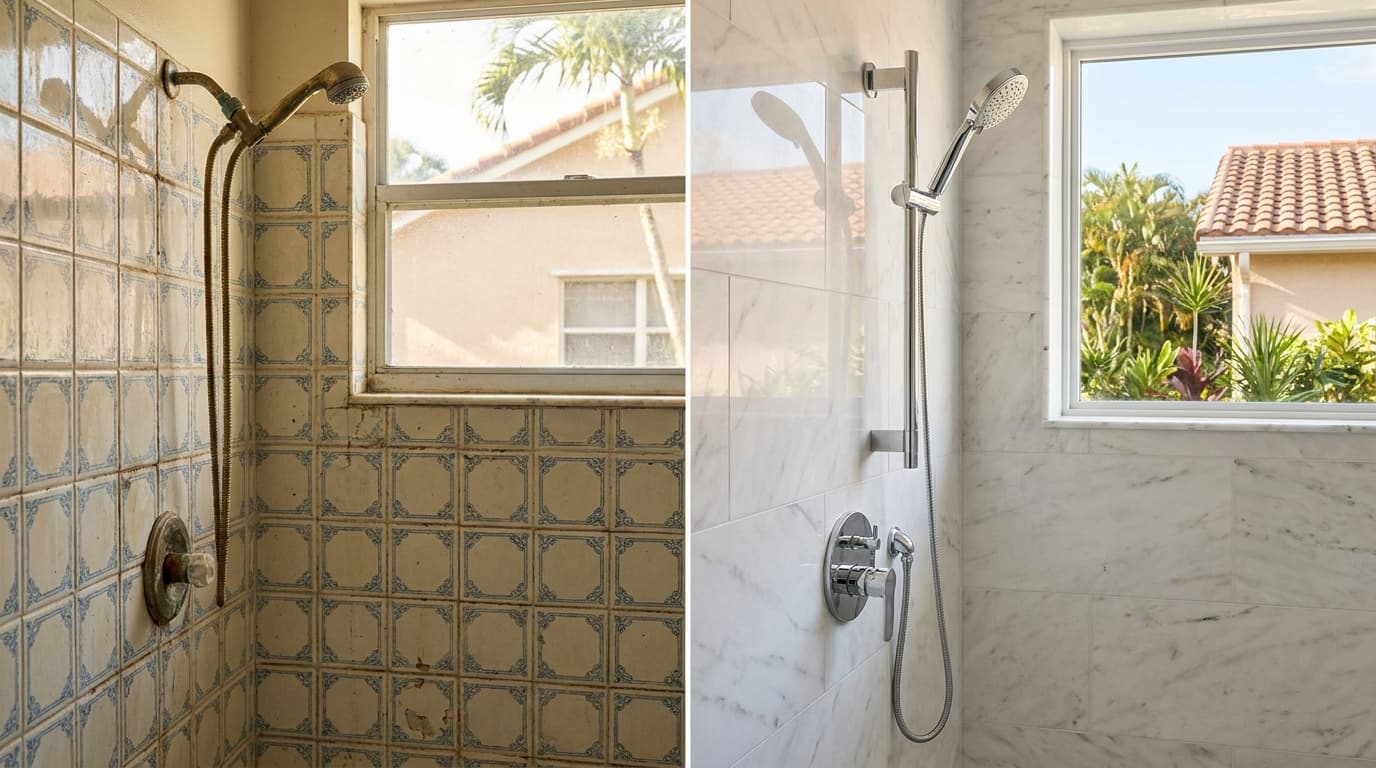

A convincing bathroom before and after often shows less demolition than homeowners expect. Houzz reporting says 82% of renovated bathrooms keep roughly the same footprint, while only 7% significantly expand, yet much of the popular reveal content focuses on dramatic additions. Houzz's bathroom photo gallery contains 1,488,134 bathroom photos, creating an enormous visual reference library, but the strongest examples still answer practical questions: what was wrong, what changed, what stayed, and how can someone verify the result?
The seven resources below work as renovation references and documentation models. Homeowners can compare layout decisions, finish choices, and scope. Contractors can study how each platform presents constraints, photographs completed work, and turns a finished bathroom into evidence that supports trust and lead generation. The visual reveal matters, but so do matching angles, clear project context, and proof that the polished image represents real work. For professionals building a portfolio, stunning bathroom transformations for homes can provide further inspiration for presenting results with a strong visual narrative.
zz For Local Portfolios And Material Research](#4-houzz-for-local-portfolios-and-material-research)
- Read the caption as carefully as the image
- What to copy for your own proof
- Where the resource is limited
- Compare packages by decisions, not labels
1. AI Before and After Generator Turn Job Photos Into Proof
A renovation portfolio usually starts with scattered phone photos. One image shows the cramped shower before demolition, another captures exposed plumbing, and a third shows the finished vanity from an entirely different angle. HomeProBadge's AI Before and After Generator is designed to turn that unfinished collection into a usable proof-of-work asset.
Upload job images and the system classifies them as before or after, pairs matching shots, and creates side-by-side comparisons. It also generates captions in the native style of Facebook, X, LinkedIn, Instagram, and TikTok. That matters because a contractor shouldn't have to rewrite the same project explanation for every channel or spend time manually editing every comparison image.

Why it works for renovation documentation
The strongest use case is consistency. A contractor can use one upload to create a client-ready AI Job Report, social content, and a visual record that connects the completed bathroom to a verified professional profile. Homeowners see more than a final room. They can see the change, read the work summary, and associate the images with an identifiable business.
That workflow also supports content about less dramatic projects. A tub-to-shower conversion, improved ventilation setup, vanity replacement, or storage upgrade may not produce a cinematic reveal, but a properly paired comparison makes the functional change obvious. Contractors can add the constraint, such as keeping the existing footprint or working around fixed plumbing, rather than presenting the result as a generic makeover.
Practical rule: Review every automated pairing before publication. Clear, consistent photos help the system match images, but poor lighting, different angles, or unrelated job photos can create an imperfect comparison.
Trade-offs for busy crews
The main advantage is speed at scale. One upload can produce platform-ready posts and reports, helping crews spend less time on content administration. The broader HomeProBadge platform can also connect the images with verified profiles, structured reviews, invoicing, and secure payments, so the marketing record supports the wider customer journey.
The limitation is that advanced automation and heavier usage may require AI credits or a Pro subscription. Automation also doesn't replace judgment. A contractor still needs to confirm that the before and after show the same location, remove private information from the frame, and obtain permission before publishing.
For more documentation ideas, the before-and-after cleaning photo guide illustrates why consistent evidence can make ordinary service work easier for customers to understand.
2. This Old House For Scope And Construction Context
A polished bathroom reveal can hide the decisions that made it work. This Old House is useful because its bathroom before-and-after coverage tends to connect the visual change with space planning, materials, construction choices, and practical problem solving.
The resource suits homeowners who need to define scope before contacting a contractor. A dated bathroom may need a cosmetic refresh, a fixture replacement, or a more involved reconfiguration. Photo-rich case studies help readers distinguish those levels instead of treating every attractive result as a full gut remodel.
What professionals can borrow
The strongest documentation pattern is the explanation beside the image. A contractor showing a new vanity should explain what problem it solved. If a shower became more accessible, the project record should identify the relevant design decision. If a layout stayed fixed, that constraint belongs in the caption because it gives the homeowner a realistic comparison point.
This Old House also gives professionals a useful editorial standard. The best project story doesn't just list attractive finishes. It explains why the team chose them, how the room functions now, and which conditions shaped the work. That makes a portfolio more credible than a gallery of isolated final photographs.
A before photo establishes the problem. The after photo earns attention. The written scope explains why the result deserves trust.
Where it falls short
The articles are primarily static editorial pieces, not interactive comparison tools. Readers won't necessarily find a contractor directory or a direct path from inspiration to a verified local professional. A homeowner still has to source, vet, and compare contractors separately.
Contractors can compensate by building that missing layer into their own project records. Add the original condition, the agreed scope, the completed work, and consistent photos. A short note about what wasn't changed can be just as valuable as a list of new fixtures. It prevents the reveal from implying work that never happened.
Technical planning also benefits from understanding hidden components. A homeowner considering a vanity change can review this practical guide to the bathroom sink drain pipe before assuming that every replacement is purely cosmetic. The lesson is simple: use visual inspiration to start the conversation, then document the construction reality.
3. HGTV For Fast Visual Direction
HGTV is useful when a bathroom project needs visual direction before anyone discusses materials or pricing. Its bathroom makeover gallery lets homeowners scan layouts, finish combinations, small-bath solutions, and different levels of renovation intensity. The collection includes 40 featured bathroom remodel examples, plus multiple small-bathroom transformations, which makes recurring choices easy to compare.
The examples highlight moves such as walk-in showers, brighter tile schemes, double vanities, and frameless glass. They also show a broader shift from enclosed, utilitarian rooms toward lighter, more spa-like spaces. Use those patterns to form a brief, not to copy a finished room.
Use the gallery as a brief, not a specification
Save examples that match a real constraint, not only a preferred color palette. Compare window position, ceiling height, plumbing arrangement, room width, storage needs, and the amount of work the existing room can support. The useful question is, “Could this strategy work here?” A visually appealing image cannot answer that on its own.
A contractor can apply the same discipline to project documentation. Place the before image first, keep camera height and angle consistent, and style the after photo lightly enough that fixtures, tile work, and storage remain visible. Add a short scope note identifying what changed, what stayed in place, and which constraint shaped the decision.
That record serves two purposes. It helps a prospective client verify the work, and it turns a completed bathroom into a proof-of-work asset that can generate qualified enquiries. A small refresh can demonstrate careful execution just as clearly as a full rebuild when the original problem remains visible.
Best use: Scan HGTV for visual direction, then verify the scope, site conditions, and product choices before treating an image as a plan.
The limits of visual inspiration
HGTV shows less construction detail than a usable project record requires. Permits, waterproofing, ventilation, substrate condition, and code requirements may not appear in the photographs. Product availability and suitability can also vary, so a pictured fixture or finish should be checked against the room and local requirements.
The visual range remains useful because it shows how clearly a bathroom before and after can communicate the result of limited work. Contractors should document projects that do not involve demolition, including refreshes where the main proof is improved function, cleaner detailing, or better use of space.
Before pricing a major change, homeowners can review the practical questions behind bathroom demolition cost. The finished image shows the outcome. The estimate depends on what must be removed, what can remain, and which hidden conditions may affect the work.
4. Houzz For Local Portfolios And Material Research
Houzz is strongest when inspiration needs to become a shortlist. Its bathroom makeover ideabooks combine editorial collections with professional portfolio pages, making it easier to compare how remodelers present completed work.
The platform's searchable tags and filters help users narrow results by location, style, budget, material, fixture, and finish. That changes the research task from browsing attractive rooms to finding examples with relevant conditions. A homeowner who wants a compact shower, a specific tile treatment, or a particular vanity style can search for evidence closer to the intended project.
Read the caption as carefully as the image
A strong professional portfolio explains the design problem and the intervention. It identifies whether the team changed the layout, replaced fixtures, improved storage, or updated finishes within the existing footprint. Those details let a prospective client compare the project's scope with their own bathroom instead of assuming that every result required the same level of work.
Houzz also reveals how contractors compete visually. Consistent photography, clear project descriptions, and a recognizable design point of view help a portfolio feel deliberate. A gallery with random angles and no context may contain excellent work but still leave the viewer uncertain about what the contractor delivered.
The main weakness is marketplace noise. Sponsored listings can crowd results, and professional pricing isn't fully public on many pages because quotes vary by scope and location. Homeowners should treat the gallery as an initial screening tool, then verify identity, licensing, insurance, reviews, and project evidence through direct conversations and reliable records.
What to copy for your own proof
Contractors don't need a large editorial platform to apply the same principles. Create a project title that names the transformation, such as a tub-to-shower conversion or fixed-footprint storage upgrade. Pair the before and after, add a concise scope summary, and identify the constraints that influenced the result.
A verified project record makes that portfolio stronger. The photo shows the work, while the record connects it to the business and the customer experience. That combination helps a homeowner evaluate credibility before requesting a quote.
5. Apartment Therapy For Realistic Constraints
Apartment Therapy's bathroom before-and-after features are useful when the room isn't a blank canvas and the budget isn't unlimited. Reader-submitted and editor-curated projects often focus on small spaces, older homes, attainable updates, and the compromises that shape a real renovation.
That makes the platform a good corrective to overly dramatic inspiration. The most useful example may keep the existing floor, work around an awkward wall, or solve a storage problem without changing the plumbing. Those limitations are not defects in the story. They show homeowners how a contractor or DIY renovator prioritizes decisions.
Look for the trade-off
A relatable project explains what the owner chose not to replace. It may retain a usable bath, keep existing tile, repaint a vanity, or add lighting instead of expanding the room. Those choices help readers understand that improvement doesn't always require maximum scope.
Material source lists are another practical strength. Paint, tile, lighting, mirrors, and storage products can give homeowners a starting point for a conversation with a designer or contractor. They still need to check suitability for a wet environment, installation requirements, and local availability.
The most persuasive reveal often shows a better routine, not the most expensive finish.
The platform's limitation is technical depth. It isn't a construction manual, and project documentation quality varies by submission. A beautiful after photo may not reveal waterproofing details, ventilation performance, electrical work, or the condition beneath an old surface.
Contractors should use that gap as a documentation opportunity. Photograph the room before work begins, capture concealed conditions only when appropriate and permitted, and record the completed scope in plain language. Show storage, lighting, shower access, and cleaning surfaces in use. That turns an appealing image into a more useful sales asset.
For homeowners, the practical filter is whether the project solves the same problem as yours. A compact bathroom that gained better storage may be more relevant than a luxury suite with a completely different footprint.
6. Remodelista For Durable Design Decisions
Remodelista takes a more restrained approach to the bathroom reveal. Its before-and-after archive emphasizes enduring materials, careful space planning, restrained palettes, and the reasons behind a design decision.
This is valuable for clients who want a bathroom to age well rather than follow every visible trend. A portfolio influenced by Remodelista tends to make the room's proportions, storage, lighting, and material relationships easy to study. The final image feels considered because the design doesn't rely solely on decorative novelty.
Study what remains quiet
A useful Remodelista-style comparison highlights the elements that improved without demanding attention. A better vanity configuration may reduce clutter. A revised lighting plan may make the mirror more functional. A simpler tile scheme may create visual continuity and make future maintenance easier.
That approach gives contractors a strong way to discuss value. Instead of selling a list of premium products, explain which decisions improve daily use and which choices protect the room from looking dated quickly. Clients can then separate personal preference from practical performance.
The editorial standard also raises the bar for photography. Straight lines, controlled lighting, and uncluttered surfaces make it easier to compare the original and completed conditions. Contractors should photograph the same viewpoint before demolition and after completion, then capture detail shots for waterproofing-adjacent finishes, storage, hardware, and accessibility features where permission allows.
Where the resource is limited
Remodelista leans toward design narrative rather than line-item cost breakdowns. It also contains fewer projects than mass-inspiration platforms, so it may not provide an immediate match for every local style or room configuration.
Use it to refine the design brief, not to estimate the job. A homeowner can identify a preference for durable tile, a quiet palette, or integrated storage, then ask a contractor how those choices affect labor, maintenance, lead times, and the existing room. A contractor can use the same conversation to establish clear expectations before work starts.
A verified before-and-after record completes the story. Design quality earns attention, but accurate documentation helps the client judge whether the finished result matches the agreed scope.
7. Block Renovation For Comparing Defined Scope
Block Renovation is useful for homeowners who want to understand what a defined project package may include. Its bathroom renovation platform presents before-and-after showcases and guides that connect finishes with scope, including tub-to-shower conversions and small-bathroom optimization.
The platform's price-assurance positioning also gives readers a useful lens. A bathroom project becomes easier to compare when the scope states what is included, what depends on site conditions, and which choices may create change orders. The visual reveal supports the conversation, but the scope carries the commercial meaning.
Compare packages by decisions, not labels
A homeowner should ask whether a package includes demolition, disposal, plumbing changes, electrical work, waterproofing, tile installation, fixtures, painting, and final cleanup. The exact inclusions depend on the provider and location, but the principle is consistent: a phrase such as “bathroom remodel” doesn't define the work by itself.
Block's case-study approach helps illustrate different levels of intensity. A tub-to-shower conversion has a different set of constraints from a full layout change. A small-bath storage improvement may require careful measurement and custom decisions even when the room's footprint remains fixed.
The online intake and consultation workflow can make early planning more structured. It also sets an expectation that the homeowner should communicate priorities before selecting finishes. That reduces the risk of choosing products first and discovering later that the room can't support the desired layout.
Important limitations
Geographic availability is limited to certain U.S. markets, and pricing remains proposal-based. Scope and location can change the final proposal, so a gallery image shouldn't be treated as a universal price promise.
Contractors outside the platform can still borrow the communication model. Provide a written scope, identify assumptions, document exclusions, and photograph the completed result against the original condition. If a constraint forced a compromise, explain it rather than hiding it. Prospective clients generally make better decisions when they understand the boundaries of the work.
The best proof-of-work record brings those elements together. It shows the starting condition, the agreed work, the completed room, and the professional responsible for delivering it.
Bathroom Before & After, Top 7 Comparison
| Source | 🔄 Implementation Complexity | ⚡ Resource Requirements | 📊 Expected Outcomes | 💡 Ideal Use Cases | ⭐ Key Advantages |
|---|---|---|---|---|---|
| AI Before/After Generator, Turn Job Photos Into Proof | Low user effort; platform handles classification, pairing and captioning | Requires AI credits/Pro subscription for heavy use; good-quality photos recommended | Tamper-proof side-by-sides + native social captions; faster sales & scalable social proof | Contractors wanting automated marketing, quick client reports, multi-channel posting | Automates end-to-end content creation and publishing; integrates trust features (⭐⭐⭐⭐) |
| This Old House | Very low, read-only articles and case studies | Free access; time to read and apply guidance | Practical, code-aware step-by-step guidance for planning and execution | Homeowners planning scope and pros needing credible how-to examples | Trusted editorial standards and detailed construction tips (⭐⭐⭐) |
| HGTV | Very low, browse large visual galleries | Free; fast visual scanning for ideas | Rapid style direction across budgets; many before/after frames | Users seeking quick inspiration or many finish-pairing examples | Large, frequently updated galleries for broad inspiration (⭐⭐⭐) |
| Houzz | Low–medium, browsing portfolios and filters; some account use | Free account recommended; time to vet contractors; sponsored results exist | High-quality portfolios tied to local pros; find contractors and before/after sets | Homeowners searching local professionals by style, budget, or material | Searchable tags and contractor portfolios with location filters (⭐⭐⭐⭐) |
| Apartment Therapy | Very low, reader-submitted, editor-curated posts | Free; variable photo/documentation quality | Relatable, budget-aware before/afters with candid budgets and sources | Homeowners seeking realistic, small-space or modest-budget solutions | Relatable projects with sourcing links and trade-off narratives (⭐⭐⭐) |
| Remodelista | Low, curated editorial features with deep design rationale | Free; fewer projects but high editorial curation | Timeless, restrained design guidance emphasizing longevity | Clients aiming for enduring materials and restrained palettes | High editorial bar and emphasis on trend-proof details (⭐⭐⭐⭐) |
| Block Renovation | Medium, service engagement and scoped packages | Paid service; geographic limits; proposal-based pricing | Clear scope-based before/afters and expectations; reduces change-order risk | Homeowners comparing fixed-scope packages; pros benchmarking scopes | Standardized scopes with price-assurance positioning (⭐⭐⭐) |
Turn Finished Work Into Verifiable Demand
A bathroom before and after becomes persuasive when the evidence is easy to follow. Homeowners want to know whether the contractor understood the original problem, completed the promised scope, and delivered a room that works better in daily use. Contractors need the same clarity because a polished reveal without context can attract attention while still leaving prospects uncertain.
Start with photography. Capture the same angles before and after, including a wide view and useful details. Keep the camera height and position as consistent as possible. Photograph the room before tools and materials arrive, during key stages when appropriate, and after final cleaning. Don't stage the after image so aggressively that storage, access, fixture placement, or workmanship disappears.
Record the project context while it's fresh.
The broader renovation pattern supports this practical approach. Houzz coverage cited by Forbes reports that 49% of renovations include shower enlargement, wet rooms account for 18% of renovated bathrooms, and double-sink installations reached 64% in 2026. Those figures describe targeted functional changes as much as visual style, so a contractor's documentation should show how the upgrade affects use, not only how it looks.
Wellness and accessibility deserve the same scrutiny. Real Simple's coverage of Houzz bathroom trends notes that more than a third of renovated bathrooms include wellness-oriented elements. Heated floors, steam showers, bidets, lighting controls, and larger vanities may improve comfort, but each can bring maintenance, installation, energy, or cleaning considerations. A credible project story explains the choice and its trade-offs instead of presenting every feature as automatically valuable.
HomeProBadge can turn this documentation into a repeatable marketing workflow. A contractor uploads before-and-after images, then uses AI Job Reports to produce side-by-side comparisons and an AI-written summary of the completed work. The platform can also generate social posts in the native style of Facebook, X, LinkedIn, Instagram, and TikTok, while connecting the images to a public profile, verified proof-of-work, and structured reviews tied to real projects.
That connection matters for lead generation. A homeowner can assess the visual result, understand the scope, and see the business identity behind the work. Contractors can build a permanent reputation asset instead of relying only on rented visibility or a feed that quickly buries older projects.
Judge every transformation by clarity, credibility, and usefulness, not visual drama alone. The strongest bathroom before and after proves what changed, respects what constrained the work, and gives the next homeowner enough information to make a confident decision.
HomeProBadge helps home service professionals turn bathroom photos into AI Job Reports, platform-ready social posts, verified proof-of-work, structured reviews, and a public professional profile. Upload your next project, connect the evidence to your business, and visit HomeProBadge to start building demand from work you've already completed.