

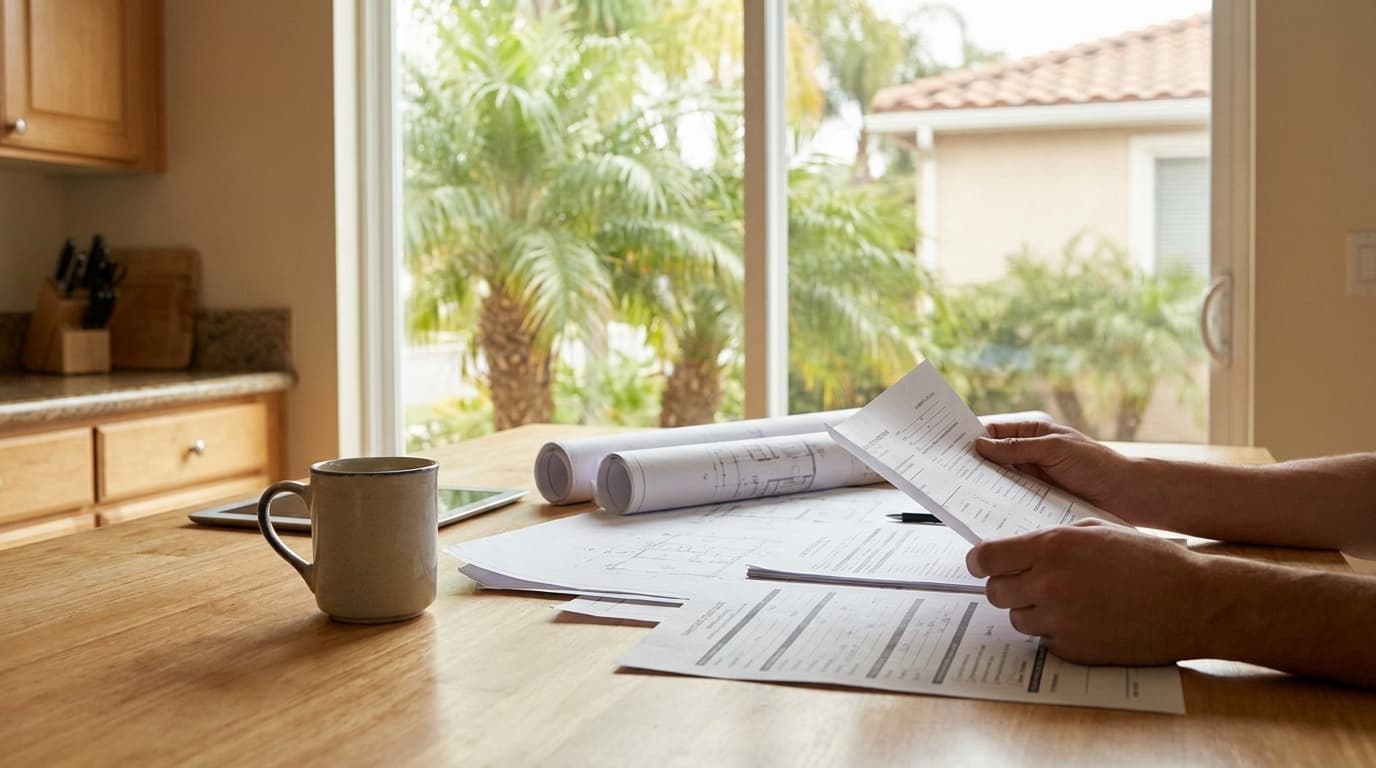

Hiring someone to work on your home is one of the highest-stakes, lowest-information decisions most people make. You're inviting a stranger onto your property, handing over a deposit, and trusting that the work will be done safely and to code. So how do homeowners actually make that call in 2026 — and where does it go wrong?
This is the Statistics Edition of the homeowner decision guide: a data-first walkthrough of how Americans research, compare, trust, and ultimately hire home service professionals, grounded entirely in published research from sources like BrightLocal, Angi, the Better Business Bureau, the Federal Trade Commission, and Harvard's Joint Center for Housing Studies. Every number below is cited at the bottom, and you can download the full dataset as a spreadsheet.
The decision at a glance
Before we go deep, here are the four numbers that frame the entire homeowner journey.
Stage 1: Research — homeowners start on a screen
The modern hiring journey begins long before a phone call. According to BrightLocal's 2025 Local Consumer Review Survey, 93% of consumers read online reviews before choosing a local business, and a homeowner-specific survey reported by ACHR News found 91% of homeowners rely on online reviews before picking a contractor.
But not every platform carries equal weight. Google has become the default front door for contractor research.
The practical lesson for homeowners: if you're only checking one source, you're seeing a sliver of the picture. The practical lesson for pros: your Google Business Profile is no longer optional. (We break the platform mechanics down in our home renovation cost statistics report and across the HomeProBadge statistics hubs.)
Stage 2: Trust — reviews still rule, but the floor is shifting
Here's the most important trend in the entire dataset. For years, online reviews were treated as gospel — but that faith is eroding.
In 2020, 79% of consumers said they trusted online reviews as much as a personal recommendation. By 2025 that figure had collapsed to 42%. Fake reviews, AI-generated text, and review-gating have made consumers more skeptical of star ratings alone.
That skepticism is exactly why HomeProBadge exists: an identity-verified, background-checked badge gives homeowners a signal that can't be faked with a five-star burst. The reputation research is consistent — homeowners reward proof. In Housecall Pro's 2025 survey of 1,040 U.S. homeowners, 70% said they'd pay more for a pro with a better service reputation.
Stage 3: Compare — what tips the decision
Once a homeowner has a shortlist, what actually closes the deal? The 2025 Housecall Pro data shows the modern buyer expects a digital, transparent, proof-rich experience.
A few patterns jump out:
Stage 4: Spend — what's actually at stake
Home services is not a small-ticket category. Homeowners are spending serious money, and the macro market is enormous.
After a dip in 2024, average spend ticked back up to $12,472 in 2025 (a 3.5% increase), with households completing an average of 10 projects for the year. Maintenance spending climbed to $2,041 per household, while the average emergency repair cost $1,143 — and emergencies are exactly the moments when homeowners hire fastest and vet least.
Zoom out and the stakes are staggering: Harvard's Joint Center for Housing Studies puts the U.S. home remodeling market at roughly $509 billion in 2025, projected to reach a record $524 billion in early 2026.
⬇ Download every figure on this page (.xlsx)Stage 5: Risk — where the decision goes wrong
For all the research homeowners do, a lot of money still ends up in the wrong hands. The data on fraud is sobering.
The FTC's Consumer Sentinel Network logged more than $12.5 billion in reported fraud losses in 2024 — up 25% year over year. Home-improvement contractor scams ranked as the fifth-riskiest scam category in the BBB's 2024 Scam Tracker Risk Report, with a median loss of $1,800 per victim. The classic playbook: a too-good deposit, "found" problems that inflate the price, or a contractor who vanishes after the check clears.
This risk is compounded by a labor squeeze. The Associated Builders and Contractors estimates the construction industry is short roughly 500,000 skilled workers and needs to attract 439,000 new workers in 2025 alone. When qualified pros are scarce, unqualified and unlicensed operators rush to fill the gap — raising the premium on verified, trustworthy professionals.
Watch Related Videos on YouTube
how to vet and hire a contractor avoid scams homeowner guide
Putting it together: a homeowner's data-backed checklist
The statistics converge on a simple, repeatable process:
Hiring a pro — or trying to become the obvious choice?
HomeProBadge gives homeowners verified, background-checked professionals and gives pros the trust signals that win jobs. Identity-verified. Background-checked. $9.95/year.
Get Started Free →Frequently asked questions
What percentage of homeowners read reviews before hiring a contractor?
Do homeowners still trust online reviews?
How much does the average homeowner spend on home projects?
How common are home-improvement scams?
What's the best way to avoid hiring the wrong contractor?
Methodology & sources
All figures on this page are drawn from published, primary research and are attributed below. Survey figures from Housecall Pro reflect a survey of 1,040 U.S. homeowners conducted October 23, 2025. Spending figures are from Angi's State of Home Spending reports. Market-size figures are from Harvard JCHS's Leading Indicator of Remodeling Activity (LIRA). Nothing on this page is estimated or invented; where a single survey is the source of multiple data points, it is cited once.
Download the data
This is a living statistics page. Every figure above is available as a structured spreadsheet, with each row carrying its primary source for independent verification.
⬇ Download the underlying data (.xlsx)