



A professional lawn aeration service typically costs roughly $75 to $250 for a standard residential visit, with most homeowners paying around $130 to $180. That price should include a pre-service assessment, proper mechanical aeration, and a written record showing what the crew did.
You're probably reading this after seeing thin grass, puddles that linger after watering, or a quote that says little more than “aeration, starting at” followed by a price. That wording isn't enough. A legitimate visit should leave you with visible soil cores, a clear treatment scope, and proof you can compare with the lawn's condition later.
What You're Actually Paying For
The price of a single professional visit matters, but it isn't the best first question. Ask what the visit includes. A credible lawn aeration service should deliver three distinct things.
The three-part service standard
A quote that only promises “lawn aeration” leaves too much unresolved. Does it include one pass or multiple passes? Will the crew remove cores? Will they avoid irrigation heads? Will they reschedule if the soil is saturated? If the provider won't answer those questions, the low price may reflect missing work rather than efficiency.
The market is crowded. The U.S. landscaping-services industry was estimated at approximately $176.7 billion in 2026, with about 556,000 businesses, and roughly 80% of North American landscape companies offered yard-maintenance services in 2023, according to IBISWorld's landscaping-services industry overview. Those figures describe the broader landscaping market, not aeration revenue specifically, but they explain why homeowners see such a wide range of quotes.
Practical rule: Don't compare prices until you compare the deliverables attached to each price.
A yard plan can also help you separate turf work from broader yard changes. If you're redesigning beds or rethinking planting zones, a guide to the best free garden design software can help you map the property before hiring anyone. Aeration remains a soil treatment, not a substitute for fixing a poor yard layout.
What Aeration Actually Does to Your Soil
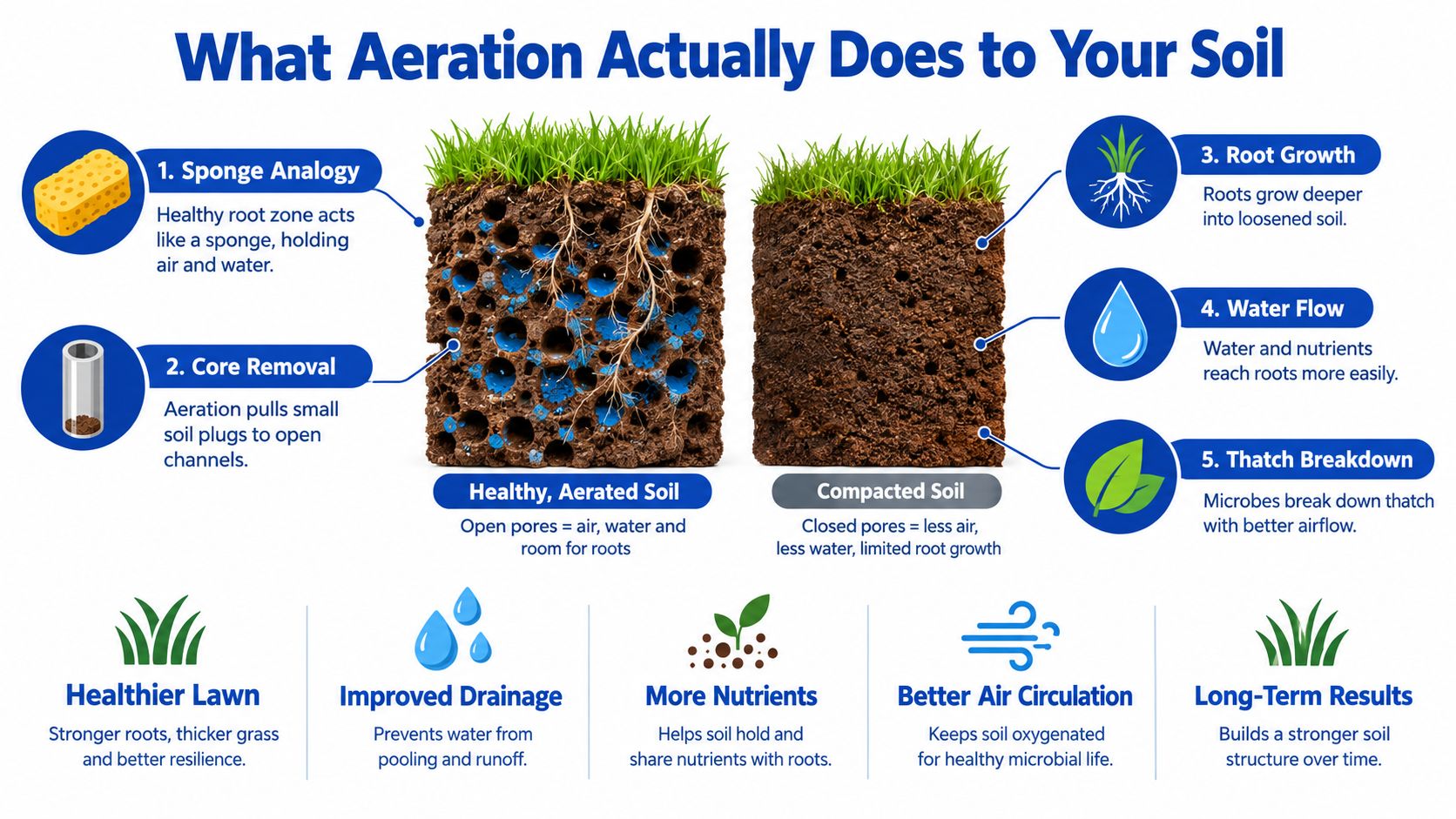
A healthy root zone behaves like a loose, damp sponge. It holds water, but it also contains open pockets where oxygen can move. Compacted soil is that same sponge after someone has stood on it. The pores close, water struggles to enter, and grass roots have less room to grow.
That is the problem a proper aeration treatment addresses. Hollow-tine core aeration removes small cylinders of soil from the lawn, leaving open channels through the upper root zone. Solid-tine or spike aeration punches into the soil without removing material. It can create temporary openings, but it doesn't relieve compaction as effectively when the soil profile is already dense.
University of Massachusetts guidance identifies coring as the most effective cultivation method for improving aeration and alleviating compaction. Its practical specification calls for cores roughly 0.75 inches in diameter and 3 inches deep, with approximately 20 to 40 holes per square foot. Those are useful service-report details, not merely technical trivia. You should be able to ask what the crew targeted and why, as explained in the University of Massachusetts compaction and cultivation guidance.
What the research tells you
A replicated field experiment compared aerated and non-aerated turf under compacted and non-compacted conditions. Aeration significantly improved plant density, root depth, active-root development, and soil infiltration. In the strongest combination, aeration without compaction, the experiment reported an average plant density of 640 plants per square meter, root depth of 53.00 centimeters, and soil infiltration of 1.08 centimeters, as documented in the published turfgrass field experiment.
Those measurements don't guarantee the same result in every lawn. Grass species, soil texture, weather, moisture, and treatment quality all matter. They do establish the central point: aeration changes the physical growing environment beneath the grass. It isn't just a cosmetic treatment that makes temporary holes in the surface.
The Benefits a Homeowner Will Actually Notice
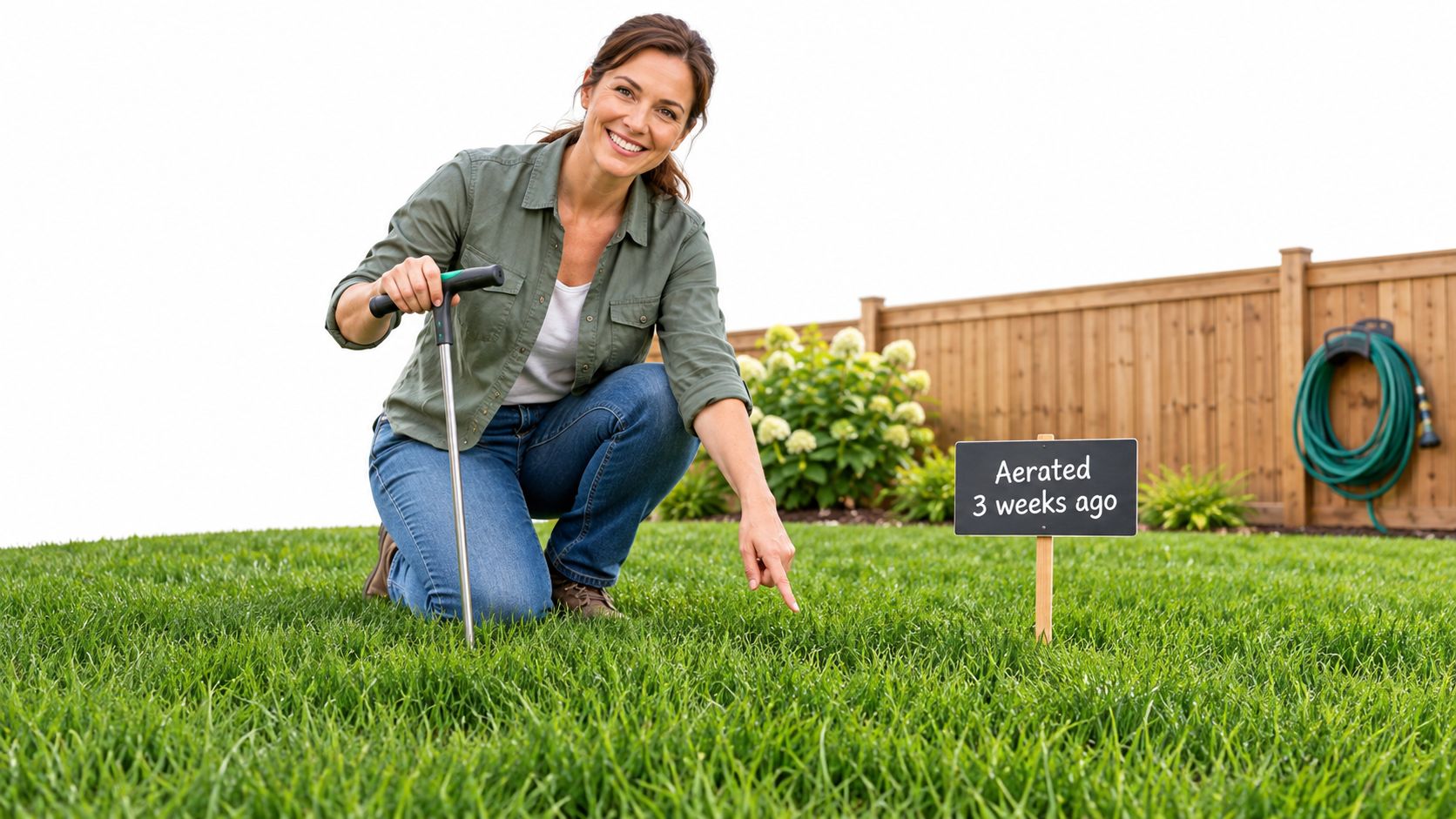
Good aeration shows up in the way the lawn handles water and traffic, not just in a photograph taken immediately after the machine leaves. Expect changes that you can inspect, record, and compare.
Five checks that matter
For homeowners dealing with heat-stressed turf, aeration is only one part of the diagnosis. A practical guide on how to revive brown grass in Atlanta can help separate drought, irrigation, disease, and soil problems before you assume compaction is the sole cause.
University of Massachusetts recommends roughly 20 to 40 holes per square foot and cores around 3 inches deep, so those figures give you a concrete benchmark for the work report. The report should also identify the treated area, because a crew that aerates only the front strip shouldn't describe the visit as a whole-property treatment.
The visual result may look rough at first. That is normal when cores are left on the lawn to dry and break down. The meaningful question is whether the soil and turf recover under suitable conditions, not whether the surface looks polished immediately after the machine passes.
How Often You Really Need Aeration
“Once a year” is a convenient sales rule, not a universal lawn-care rule. University of Wisconsin guidance indicates that many lawns benefit from aeration every 1 to 5 years, with the interval determined by compaction and thatch production, as described in its lawn aeration and topdressing guidance.
Let the lawn set the interval
Move toward the shorter end of that range when the same routes receive constant foot traffic, children or dogs repeatedly cross the turf, soil is heavy and dense, construction disturbed the topsoil, or water regularly pools in specific areas. A lawn with moderate use, open soil, and strong growth may not need an automatic annual visit.
Timing matters just as much as frequency. Cool-season lawns generally favor active growth in early autumn, and Iowa State University lists September and April as favorable windows. Warm-season grasses generally need late spring or early summer. In either case, the grass needs roughly three to four weeks of active growth to recover, according to the university and extension guidance linked above.
Don't schedule by calendar alone. Very dry soil can resist tine penetration, while saturated soil can smear and compact the profile. Heat, drought, dormancy, and seasonal weed pressure can all make a technically correct machine pass a poor service decision.
Run the one-minute test
Walk the lawn and check three things:
If all three checks look healthy, ask the provider to justify aeration rather than accepting an automatic package. If the lawn has obvious traffic compaction and poor infiltration, a site-specific plan makes sense.
The service report should record grass type, soil moisture, compaction source, method, depth, and follow-up care. That information turns the next scheduling decision into an evidence-based one instead of a recurring upsell.
DIY Rental vs Hiring a Professional
DIY can be the right choice, but only for the right lawn. A small, flat property with accessible soil is manageable if you can transport the machine, control the timing, and make enough passes to cover the area. Larger lawns, slopes, dense compaction, and combined aeration and overseeding work justify professional equipment and labor.
The biggest DIY mistake is treating the rental price as the whole cost. You also have to collect and transport a heavy machine, protect irrigation heads, judge soil moisture, make consistent passes, and clean up the logistics afterward. A professional crew should bring a commercial-grade core aerator and know how to adjust the work to the lawn rather than forcing the same pattern everywhere.
| Factor | DIY Rental | Professional Lawn Aeration Service |
|---|---|---|
| Best fit | Small, flat lawn with easy access | Larger, sloped, compacted, or complex lawn |
| Equipment | Rental machine, transport, loading effort | Commercial machine brought to the property |
| Control | You choose the passes and timing | Crew supplies operating experience and coverage |
| Risk | Higher chance of working soil that is too dry or wet | Provider should inspect moisture and reschedule when needed |
| Documentation | You create your own photos and notes | Quote and report should record the treatment |
| Follow-up | You manage watering, seed, and recovery | Provider should explain aftercare |
A homeowner with a small, level lawn and the right vehicle can reasonably choose DIY. That doesn't mean using a spike tool once and calling the job complete. Core removal, consistent coverage, and suitable soil moisture still matter.
For bigger or more complicated work, hire out and compare the service like any other home project. The distinction between a handyman and a contractor is useful here because responsibility, equipment, documentation, and scope should be clear before work begins.
Never aerate bone-dry soil because the tines may fail to penetrate properly. Never run heavy equipment over saturated soil because the machine can smear the soil walls and worsen compaction. The correct choice depends on the lawn's condition, not on the lowest quote alone.
What a Real Service Call Should Look Like
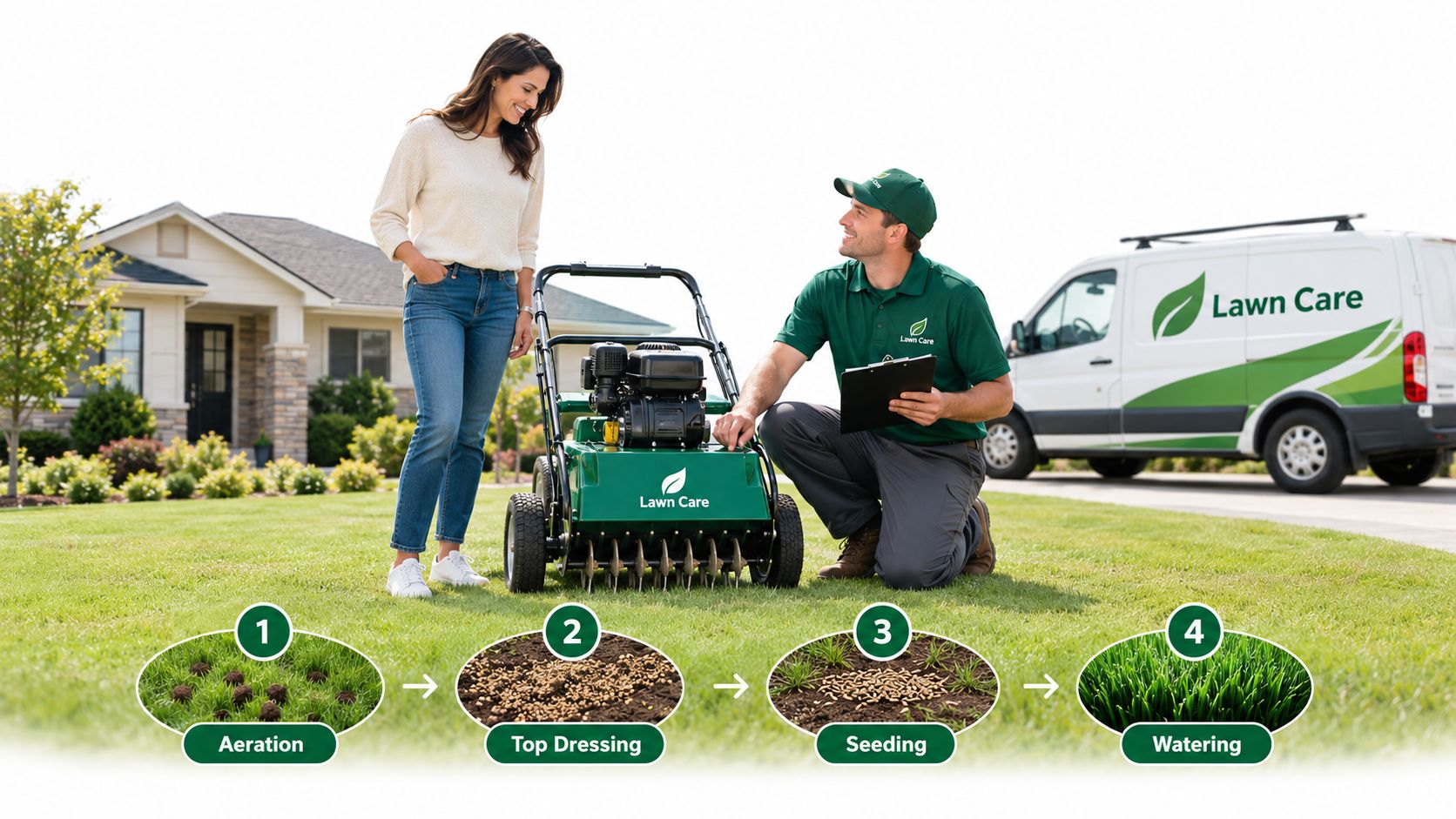
A competent crew doesn't arrive blind, unload a machine, and start driving. The visit should have a visible sequence, and each phase gives you something to verify.
Before the machine starts
The provider should ask about grass type, irrigation, drainage complaints, recent seeding, slopes, and areas that receive repeated traffic. On arrival, the crew should walk the property, identify compacted zones, and mark sprinkler heads or other vulnerable features.
The machine pass should leave actual cores when core aeration is the agreed method. Ask whether the crew plans one pass or intersecting passes in dense areas. You should see a reasonably consistent pattern of holes and soil plugs across the contracted treatment area, not just a few scattered marks near the front door.
The five-minute verification
Use the service specification from University of Massachusetts as a practical check. Cores should be roughly 3 inches deep, about 0.75 inches wide, and distributed at approximately 20 to 40 holes per square foot when those parameters suit the lawn. Plugs typically remain on the surface to dry and break down naturally.
The provider should also explain watering, recovery, and any overseeding plan. If the soil is too wet or too dry, rescheduling is a sign of judgment, not poor service. Clemson guidance emphasizes active turf growth, recovery time, and moderate soil moisture in its lawn aeration factsheet.
End the visit with a written or digital report containing:
A structured job verification process gives homeowners a useful standard: the work should leave an evidence trail, not just a verbal assurance. If the crew can't explain what it did in writing, the visit wasn't documented well enough.
How to Pick a Provider You Can Actually Trust
The local market is fragmented, so a polished truck and a low price aren't reliable proof of quality. The better question is whether the person coming to your property can establish identity, credentials, relevant insurance, and a record of completed work.
Demand evidence before booking
Start with the actual operator. Ask who will arrive, whether subcontractors are involved, and whether the company can provide current proof of insurance. If local licensing applies to the work or business, ask how the provider satisfies it.
Then inspect the work history. Star averages don't tell you whether the reviews belong to completed aeration jobs, whether the reviewer hired the company directly, or whether the photographs show the provider's own work. Look for structured reviews tied to identifiable projects and images that show the treatment, not just a green lawn months later.
A credible provider should answer these questions without becoming defensive:
The provider who can prove the work is safer to hire than the provider who only promises a result.
Platforms that verify identity, background, licensing, and insurance can make this screening easier, especially when they connect reviews to real projects and preserve photographs with the job record. That is more useful than a pay-per-lead listing where the visible incentive is acquiring the next customer rather than documenting the last job.
Use a local contractor directory only after checking what its profiles verify. A guide to how to find local contractors can help you build a shortlist, but you still need to inspect the aeration scope, equipment, and proof-of-work record yourself.
The right provider won't promise that every lawn will respond identically. They will explain the soil problem, choose a method, record the treatment, and tell you what evidence to review after recovery.
Your Action Plan for This Season
Start with the lawn, not the calendar. Check the traffic routes, push a screwdriver into representative soil, and watch where irrigation water pools or runs off. Photograph those areas before requesting quotes so each provider sees the same problem.
Use this hiring sequence
A service-management platform can also help solo operators keep these records organized. For providers building repeatable reports and customer communication, admin tools for solo lawn care owners may simplify scheduling and documentation, but the homeowner should still receive the underlying evidence.
Aeration is a verifiable transaction. You should know why the lawn needs it, what the crew did, and what recovery should look like. If the quote, treatment, and report line up, the service is easier to trust and the next decision becomes easier to make.
HomeProBadge helps homeowners find professionals with verified identity, background, licensing, and insurance information, then connects reviews and tamper-proof proof-of-work to completed jobs. For a lawn aeration service, that means you can vet the provider and review documented work before the crew arrives, so visit HomeProBadge when you're ready to hire with evidence instead of guesswork.