

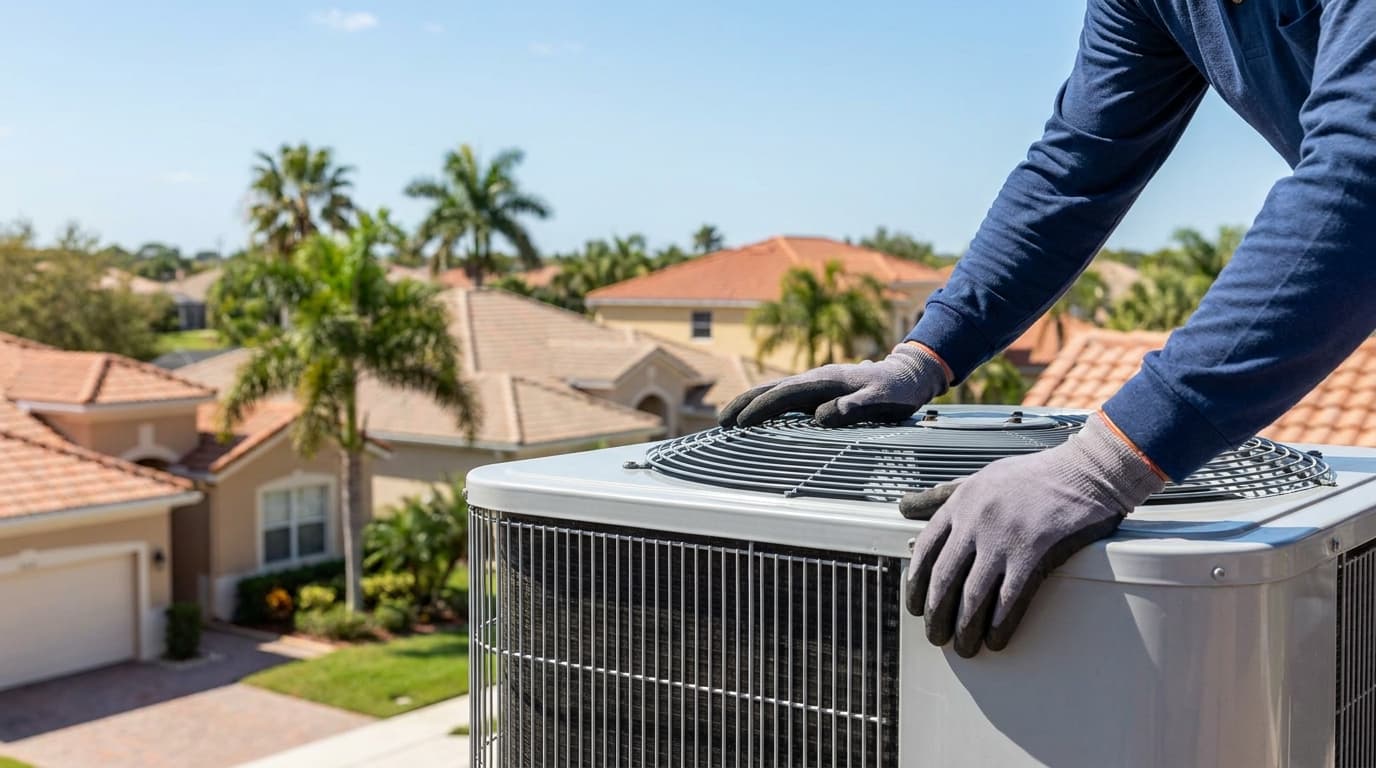

Marketing for HVAC companies works when it connects three systems: being found, being trusted, and responding before the customer moves to the next contractor. Local search and paid advertising create visibility. Reviews, credentials, and proof-of-work reduce hesitation. Fast routing and persistent follow-up turn attention into booked appointments.
AI-assisted search adds a new layer. Homeowners increasingly ask conversational tools to recommend contractors, so a company's marketing assets must do more than include service keywords. They need to explain what the company does, where it works, how it performs, and whether real customers can verify those claims.
zing for AI-Assisted Search and Conversational Queries](#optimizing-for-ai-assisted-search-and-conversational-queries)
- Write pages an assistant can understand
- Make reputation machine-readable and human-verifiable
- Match the message to the season
- Use one dashboard, not disconnected reports
Why Search Dominates HVAC Customer Acquisition
HVAC demand is driven by immediate intent. A homeowner with a failed furnace or an air conditioner blowing warm air usually searches for help, compares available contractors, and contacts the company that appears credible and ready to respond.
Industry benchmarks report that 78% to 84% of consumers search online before contacting an HVAC company (WebFX HVAC marketing statistics). Search is where urgent demand becomes visible, including searches shaped by conversational tools and AI-assisted recommendations.

What this changes for an HVAC owner
Referrals can produce strong leads, but they give you little control over when demand appears. Search lets your company meet homeowners during the decision window. The system includes your Google Business Profile, map visibility, service pages, reviews, proof-of-work, call handling, and paid coverage for high-value searches.
Your online information must answer practical questions quickly. Show the services you perform, the areas you cover, your hours, emergency availability, and the easiest way to contact you. Use service-specific website pages rather than sending every visitor to a generic homepage. Add completed-job photos, technician details, and reviews that support the claims your business makes.
AI-assisted search raises the standard further. A contractor may be recommended because its content clearly explains who it serves, which equipment it handles, and what customers can verify. Review velocity and consistent evidence of completed work help reinforce that trust. Accurate information still matters because an incorrect service area or unanswered call can waste the lead.
Practical rule: Treat local visibility as operating infrastructure. If customers cannot find, verify, or reach your company during an urgent search, a capable technician team may never get the opportunity to win the job.
The financial side matters just as much. HVAC leads can carry meaningful value, while competition makes visibility expensive. Track your customer acquisition costs alongside booked jobs, close rate, average job value, and profitability. Clicks and impressions are useful only when they contribute to revenue.
Search compresses the decision window to minutes. The companies that win combine discoverability with credible proof and fast response, then measure each stage from search to booked appointment.
Building a High-Converting Local Presence
Your Google Business Profile and website perform different jobs. The profile captures local discovery and map actions. The website handles deeper evaluation, service explanation, and conversion. Weakness in either asset creates friction.
Start with the profile customers see first
Complete the profile before spending more on promotion. Use the correct primary category, then list specific services such as air conditioning repair, furnace replacement, heat pump service, ductwork, indoor air quality, and maintenance. Make service descriptions clear enough that a homeowner understands whether you handle the problem.
Keep these fields accurate:
For a more detailed walkthrough, this guide to Google Business Profile for HVAC offers a useful local optimization reference.

Build pages around decisions, not just keywords
Create dedicated pages for each major service and important service area. An AC repair page should explain symptoms, likely causes, what the visit includes, emergency availability, and how to request service. A replacement page should help visitors understand equipment options, the evaluation process, warranties, and the next step.
Put the phone number in the header on mobile, use a prominent click-to-call button, and keep forms short. Add real project photos, technician credentials, financing information where applicable, review excerpts, and clear service boundaries. Online booking can work well for predictable maintenance requests, while complex replacements should offer a fast consultation path.
The first screen should answer three questions: Can you solve my problem? Do you serve my location? How can I reach you now? Anything that delays those answers costs attention.
Turning Reviews and Proof-of-Work Into Revenue
Reviews aren't decorative trust signals. They influence whether a homeowner believes your company can safely enter the home, diagnose the issue correctly, and complete the work without surprises.
One 2026 industry summary reported that companies maintaining 5 to 12 new reviews per month and average ratings above 4.5 stars saw 12% to 25% higher close rates and better ad visibility (HVAC review and advertising benchmarks). That doesn't mean every company will receive the same result. It does show why reputation should be managed as a recurring operating process rather than an occasional request.
Create review velocity through the job workflow
Ask for feedback after the customer has experienced the completed service. The office can send a short message with a direct review link, while the technician can mention that feedback helps local homeowners choose responsibly. Keep the request neutral and never pressure a customer to remove or alter an honest review.
Review quality matters as much as volume. A useful review mentions the actual service, the technician's communication, the condition of the equipment, or how the company handled the appointment. Those details help future customers match your experience to their own concern.
A review says you were chosen. Proof-of-work shows what happened after the customer chose you.
Make completed work verifiable
Before-and-after photos are stronger when they're attached to a real project rather than posted as disconnected social content. Show the equipment, installation context, workmanship, cleanup, and final result. For replacement work, explain what changed and why. For repairs, show the failed component when appropriate and protect customer privacy.
A platform such as verified reviews tied to real projects can help structure that evidence. The important principle is not the platform itself. It's the connection between identity, completed work, customer feedback, and service claims.
Proof also improves content efficiency. One completed installation can supply a project page, a review request, a case-style explanation, a Google Business Profile update, and social posts. That's more valuable than publishing generic HVAC tips that don't demonstrate your team's actual work.
When customers compare contractors on a phone, visible evidence reduces uncertainty quickly. Strong reviews may earn the click, but specific project proof helps earn the call.
Paid Search Economics for HVAC Campaigns
Paid search creates immediate visibility, but HVAC owners lose money when they manage it as a traffic source instead of a booked-job system. The useful question is not how cheap the click was. It is what that click cost to produce a profitable appointment.
Air conditioning installation and repair averages $9.68 per click and $127.74 per lead, while maintenance and tune-up traffic averages approximately $17 to $50 per lead (HVAC Google Ads benchmarks). These figures reflect different buying intent. Combining them in one campaign hides which services produce efficient opportunities.
| Campaign Type | Avg CPC | Avg CPL | Conversion Rate |
|---|---|---|---|
| Emergency repair | $12 to $20 | Use your campaign dashboard | 12% to 15% |
| Installation and replacement | Use your campaign dashboard | Use your campaign dashboard | 8% to 10% |
| Maintenance and tune-up | Use your campaign dashboard | $17 to $50 | Use your campaign dashboard |
Use the table as a starting point, then replace dashboard fields with your own results. Track spend, qualified leads, booked appointments, quoted work, won jobs, and revenue by campaign. A benchmark can frame the decision, but it cannot account for your service area, close rate, margins, capacity, or call-handling performance.
Separate intent before you write the ad
Emergency repair searches need immediate language, phone access, service-area confirmation, and a landing page focused on getting help now. Replacement searches need a different promise, such as an evaluation, equipment comparison, clear options, or a quote process. Maintenance searches can emphasize preparation, system care, and scheduling convenience.
Put each intent group in its own campaign or tightly controlled ad group. Send each group to a matching landing page. Blending “furnace won't start” with “new furnace installation” forces one ad and one page to address two different buyers. Relevance usually drops, and wasted spend rises.
Use negative keywords to block searches you do not serve, including employment queries, training searches, parts-only requests, and do-it-yourself research. Review search terms regularly. A campaign can look productive at the keyword level while paying for irrelevant variations.
Budget against cost per booked job, not CPC. A cheap click that never becomes a conversation is still wasted spend.
Judge campaign economics after revenue is connected to the original search and lead. Maintenance may provide efficient lead economics, while replacement campaigns may support larger tickets. Neither is automatically better. Choose the mix based on capacity, margins, season, and whether the business needs immediate repair volume or a stronger installation pipeline.
Speed-to-Lead and Multi-Touch Follow-Up Systems
The most expensive lead is often the one your team already paid to generate but never contacted. HVAC customers don't always wait patiently for a callback. They may call another contractor, submit another form, or ask an AI assistant for a different recommendation.
Contacting a lead within 5 minutes makes it about 21 times more likely to convert than waiting 30 minutes, and it can take 8 to 12 touches to close 80% of HVAC deals (HVAC speed-to-lead benchmarks). The operational response should be simple enough for a dispatcher to follow under pressure.
Build the first 60 seconds
A useful follow-up system combines a live call with text and email. The messages should add information, not repeat the same sales pitch. Send appointment options, preparation guidance, answers to common questions, estimate reminders, and a clear way to reply.

Automation helps, but it shouldn't replace human judgment. An AI chat system can qualify basic requests and capture more leads with AI, while a person handles safety concerns, complex diagnostics, pricing, and appointment decisions.
Measure the leak
Track first-response time, contact rate, appointment rate, missed-call recovery, quote follow-up completion, and booked-job rate. Review recordings and message logs when leads fail to schedule. The issue may be price, availability, unclear communication, or a dispatcher who never completed the handoff.
Your CRM and field-service stack should support this workflow. A practical best HVAC software comparison can help owners evaluate scheduling, dispatch, customer records, invoicing, and follow-up capabilities together.
Optimizing for AI-Assisted Search and Conversational Queries
Ranking for “HVAC near me” remains useful, but it's no longer a complete search strategy. Homeowners now ask AI assistants to recommend contractors, and AI search is becoming a new front door for lead generation. That makes answer-ready content and verifiable trust signals more important than keyword volume alone (HVAC industry search trends).
AI-assisted search changes the shape of the question. Instead of typing a short phrase, a homeowner may ask which contractor serves a specific neighborhood, handles a particular heat pump issue, has strong reviews, offers emergency appointments, or can explain replacement options. Your content needs to answer those questions directly.
Write pages an assistant can understand
Start each service page with a plain answer. State the service, locations served, common symptoms, and the appropriate next action. Use descriptive headings, short paragraphs, question-and-answer blocks, and clear service boundaries. Avoid hiding essential information inside vague marketing language.
A proof-rich service page might include:
Don't create a page for every slight keyword variation. Create the clearest resource for each real customer decision, then connect it to supporting project pages and local service information.
Make reputation machine-readable and human-verifiable
AI systems need consistent information across your profile, website, directories, and review sources. Your business name, service area, contact information, qualifications, and service descriptions should agree. Project evidence should identify the work without exposing private customer information.
A useful guide to optimizing for AI Overviews locally can provide additional direction, but the practical foundation is straightforward: publish accurate answers, support claims with evidence, and keep the business data current.
The objective isn't to produce the most content. It's to become the clearest trustworthy answer for a specific HVAC problem in a specific service area.
Reviews and proof-of-work also give AI systems stronger context than generic claims such as “quality service” or “trusted experts.” They help a recommendation reflect actual services, locations, customer experiences, and completed work.
Seasonal Campaign Calendar and KPI Tracking
HVAC marketing should follow customer demand and operational capacity, not a fixed publishing schedule. The campaign that fills maintenance slots during a quieter period won't necessarily be the campaign you want when emergency calls consume the board.
Use the calendar as a planning framework, then adjust based on weather, inventory, technician availability, and current lead quality.
Match the message to the season
Winter heating push: Emphasize furnace repair, no-heat response, safety checks, and replacement evaluations. Make emergency contact paths obvious, and ensure the office can handle increased call volume. Spring tune-up push: Promote cooling-system inspections, maintenance, airflow concerns, and preparation before peak demand. This is also a strong period for publishing educational content and refreshing project galleries. Summer AC peak: Shift paid coverage toward urgent cooling issues if capacity allows. Separate repair, replacement, and maintenance messaging so each visitor sees a relevant page and next step. Fall maintenance: Focus on furnace preparation, system reliability, indoor comfort, and appointment scheduling before demand spikes. Use past-customer email and SMS lists to reach people who already know the company.The quieter periods are valuable for improving assets that urgent-season work exposes. Update service pages, organize project photos, train staff on call handling, and build review requests into the completion workflow.
Use one dashboard, not disconnected reports
Track the path from visibility to cash:
This week's priority is operational, not cosmetic: verify every contact path, repair the profile gaps, request reviews from recent satisfied customers, publish one real project, and test an immediate callback from a form and missed call.
Marketing for HVAC companies becomes measurable when every channel feeds the same system. Search creates demand capture, proof reduces hesitation, and speed protects the opportunity. Review the dashboard regularly, stop funding sources that produce attention without booked work, and reinvest in the pages, campaigns, and processes that produce profitable appointments.
HomeProBadge gives HVAC contractors a public profile for credentials, completed jobs, structured verified reviews, and proof-of-work that can support local search and AI-assisted recommendations. Visit HomeProBadge to create a verifiable reputation asset and turn completed HVAC work into reusable marketing evidence.