

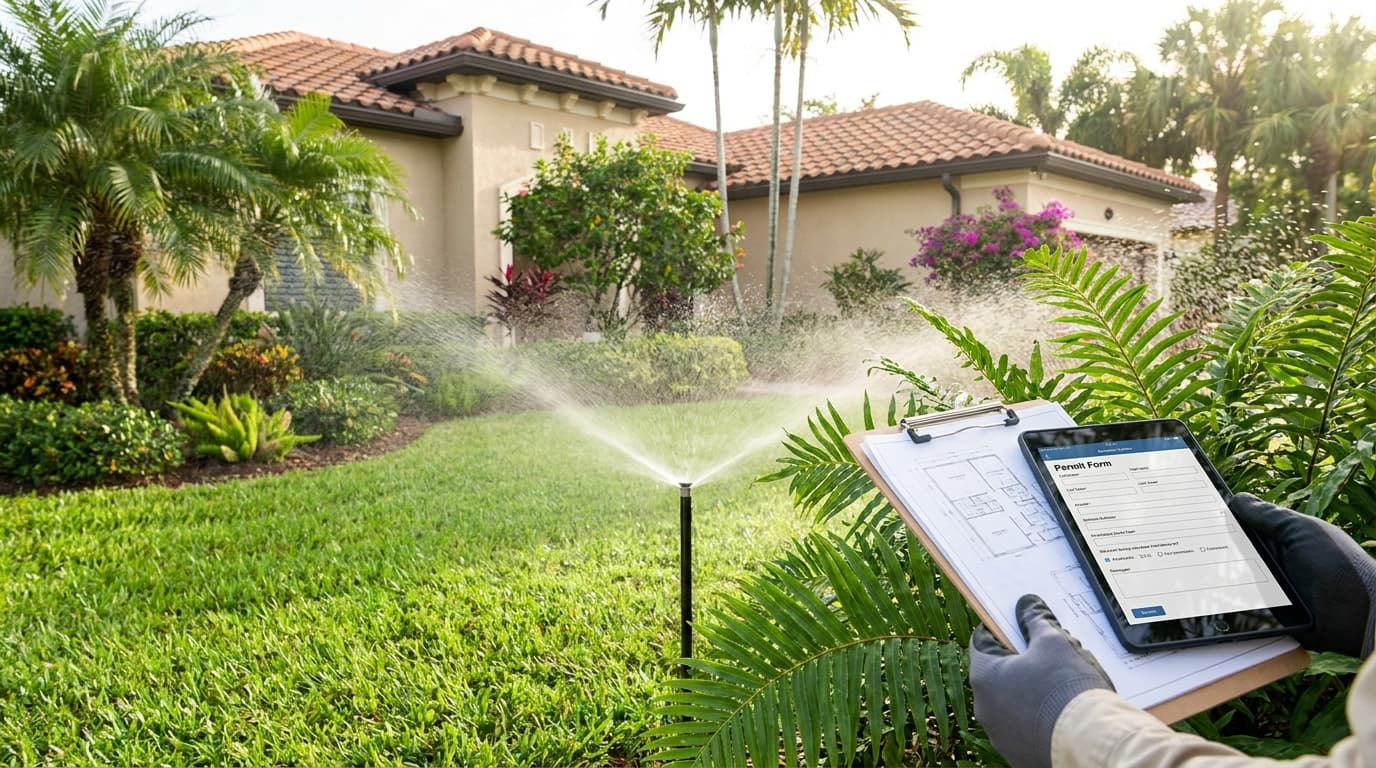

Permit compliance work is the most profitable—and often least competitive—niche in residential landscaping. While most landscaping contractors fight over price on basic maintenance jobs, permit compliance specialists command premium rates, work with motivated clients, and build long-term relationships with homeowners desperate to fix violations.
In Leon County, Florida, landscaping permit violations are rising. The county's rapid residential growth, combined with complex local regulations under Florida Statute 553 and Leon County's Design Guidelines, has created a steady stream of homeowners facing fines, stop-work orders, and work-in-progress projects they don't know how to fix.
This is your opportunity. Landscaping contractors who position themselves as permit compliance experts in Leon County don't compete on price. They compete on knowledge, authority, and results.
This guide walks you through the exact steps to win landscaping permit compliance jobs in Leon County—from understanding local code requirements to marketing yourself as the trusted expert homeowners call when they're in trouble.
Step 1: Master Leon County Landscaping Permit Requirements
Before you can market yourself as a permit compliance expert, you must become one. Leon County landscaping work is governed by:
Why This Matters
Most landscaping contractors never read the actual code. They rely on loose knowledge or trial-and-error. Homeowners with violations have already learned this lesson the hard way. When you can cite specific code sections, explain why their work violated county rules, and outline a clear fix, you instantly position yourself as an authority.
What You Need to Know
Landscape Installation Standards — Florida Statute 553 requires:Action Items
Watch Related Videos on YouTube
landscaping permit compliance jobs Leon County how to fix guide
Step 2: Build Your Permit Compliance Expertise Narrative
Knowing the code is one thing. Being able to explain it to stressed homeowners is another. You need a clear, trustworthy narrative that positions you as the specialist who fixes permit problems.
The Three-Part Story
Part 1: Diagnostic Authority"I review your original permits and the violation notice from the county. I identify exactly which code section was violated and why the original contractor missed it."
Part 2: Solution Clarity"I create a detailed remediation plan—with cost breakdown, timeline, and county approval path. Before I touch anything, you know exactly what we're fixing and what it costs."
Part 3: Compliance Certainty"Once the work is complete, I coordinate final inspection with Leon County. You get a signed-off permit. No surprises. No more violations."
This narrative works because it:
How to Use This Narrative
Key Warning: Don't position yourself as a "permit expert" if you're not actually reading the code and studying local requirements. Homeowners with violations are scared. False confidence will destroy your reputation faster than you can rebuild it.
Step 3: Get Verified (HomeProBadge)
In permit compliance work, trust is everything. Homeowners are making high-dollar decisions (often $10K+) with contractors they may not know. A single bad review can tank a specialized niche business faster than a general landscaper.
HomeProBadge is a $5 identity-verified, background-checked badge that signals you've passed basic trust vetting. For Leon County homeowners researching contractors for permit compliance work, a HomeProBadge shows you're serious, legitimate, and willing to be held accountable.
Create your free profile at homeprobadge.com/florida/leon-county. Then, include your badge link in:
Verification takes 10 minutes and costs $5 one-time (renewed annually). It's one of the fastest trust-builders in the industry.
Step 4: Document and Showcase Your Compliance Work
Permit compliance jobs are perfect for building a portfolio. Each project has:
This is different from standard landscaping. You're not just showing a pretty yard—you're showing proof of regulatory success.
Portfolio Documentation Strategy
For Each Compliance Project, Capture:Where to Showcase This
Homeowners searching for "landscaping permit violation fixes near me" will see your portfolio and immediately know you've done this before.
Step 5: Identify and Target High-Opportunity Homeowners in Leon County
Not all landscaping work is permit-related. But some homeowners are actively looking for compliance specialists right now. Here's where to find them:
Source 1: Leon County Public Records
Leon County Development Services publishes violation notices online. You can search for recent landscaping violations at:
Look for:
These homeowners are in the active problem-solving phase. This is your best-qualified lead list.
Source 2: Google Local Services Ads (LSA)
If you have a legitimate business license (which you should), set up Google Local Services Ads. Run campaigns for:
Leon County homeowners actively searching these terms are ready to hire.
Source 3: Neighborhood Facebook Groups
Join Leon County neighborhood groups (Tallahassee, Killearn, Southwood, etc.). Monitor posts about:
Respond helpfully (not salesy) and offer to review their situation. Build authority, then ask for their contact info.
Source 4: Referral Partnerships
Build relationships with:
Offer a 15% finder's fee or reciprocal referral for each qualified lead. Over 12 months, this adds up.
Step 6: Price Landscaping Permit Compliance Work Correctly
This is where most contractors leave money on the table. Standard landscaping pricing (hourly labor + materials + 25–35% markup) doesn't apply to compliance work.
Why Compliance Work Is Worth More
Pricing Framework
| Project Complexity | Typical Scope | Recommended Price | Notes |
|---|---|---|---|
| Low | Small setback correction, minor grading | $2,500–$4,500 | 1–2 week timeline |
| Medium | Tree removal + replanting, drainage fix, moderate grading | $5,000–$12,000 | 3–4 week timeline |
| High | Full landscape remediation, stormwater redesign, multiple violations | $12,000–$25,000+ | 6–12 week timeline |
Pricing Strategy
1. Diagnostic Fee (Optional but Recommended)Key Tip: Never undercut your price to compete. Compliance buyers don't shop on price—they shop on trust and certainty. A higher price signals expertise and confidence.
Step 7: Create a Lead-Capture System
You'll get inquiries from homeowners with violations. How you respond in the first 24 hours determines whether they hire you or call your competitor.
Your Initial Contact Template
Via Phone:"Hi [Name], thanks for reaching out. I specialize in landscaping permit violations here in Leon County. I'd like to help. Can you tell me what violation you received?" [Listen, take notes.] "That's something we fix regularly. Here's what the next step looks like: I'll come out and review your violation notice and take photos. Then I'll create a remediation plan that shows Leon County exactly how we'll fix it. From there, we'll get your county approval and execute the work. Does that sound helpful?"
Via Email:"Thanks for contacting [Your Business]. I specialize in landscaping permit violations in Leon County. To give you the most accurate estimate and timeline, I need:
Once I review this, I'll send you a free remediation plan outline within 24 hours. Let me know if you have questions."
Lead Tracking
Use a simple spreadsheet or CRM (HubSpot free version, Pipedrive, or even Google Sheets) to track:
Review this monthly. You'll start seeing patterns in which violation types convert to jobs and which sources generate your best leads.
Step 8: Build Local Authority with Content
Content marketing is the highest-ROI strategy for niche specialists. Write blog posts, create videos, and share insights that position you as the Leon County landscaping permit expert.
Content Topics to Create
Where to Publish
Don't overthink this. One detailed blog post per month is enough to start building authority.
Step 9: Coordinate with Leon County Planning & Development Services
Building a relationship with the county doesn't just help homeowners—it helps you. County planners can become unofficial referral sources.
How to Build This Relationship
Step 10: Scale with Referral Partnerships and Reputation
Once you've completed 5–10 compliance projects, you'll have proof, testimonials, and a portfolio. Use this to scale.
Referral Partnership Outreach
Contact these professionals in Leon County:
Email template:
"Hi [Name], I'm [Your Name] with [Your Business]. I specialize in landscaping permit compliance in Leon County. If you ever have clients with landscaping violations that need remediation, I'd like to be your go-to contractor. I offer a 15% finder's fee for qualified referrals and always guarantee professional, code-compliant work. [Your website/portfolio link]. Would you be open to staying in touch?"
Google Reviews and HomeProBadge Reputation
After each completed project, ask the homeowner for a Google review. Reference your HomeProBadge profile to make leaving a review easy. Testimonials about compliance success are worth far more than standard landscaping reviews because they're scarce—most contractors don't have them.
Build Your Brand
Consider a business name that reflects your niche:
This makes your specialty instantly clear to homeowners searching for help.
FAQ: Landscaping Permit Compliance Jobs in Leon County
Q: Do I need a special license to do permit compliance work?
A: You need the same license you use for standard landscaping. However, if you're creating remediation plans (engineering-level design), you may need a landscape architect stamp in Florida. Most compliance work is execution-based (fixing what a plan specifies), not plan creation. If homeowners ask you to design the fix, partner with a landscape architect or refer out.Q: How long does a typical Leon County compliance project take?
A: 4–12 weeks, depending on complexity. Plan review takes 2–4 weeks. Work takes 1–4 weeks. Final inspection and approval takes 1–2 weeks. Simple setback corrections may be 4 weeks total. Complex stormwater redesigns may be 12+ weeks.Q: What if a homeowner's violation is outside my expertise (e.g., stormwater engineering)?
A: Partner with other specialists. Build relationships with landscape architects and drainage engineers. Take the job as a "compliance coordinator," manage the team, and keep a 10–20% coordination fee. This lets you offer full-service solutions without needing every expertise yourself.Q: Should I charge for the initial site review?
A: Yes. Charge $300–$500 for a diagnostic visit. This signals that your time has value, filters non-serious buyers, and covers your cost if they don't hire you. Apply the fee toward the project cost if they do.Q: Can I bid on multiple violation fixes for the same homeowner?
A: Absolutely. Many violations have 2–3 separate issues (setback AND tree removal AND grading, for example). You can bid each as a separate project or bundle them. Bundling often makes sense because the homeowner is already motivated.Q: How do I handle homeowners who've already been denied by the county?
A: This is actually a good lead. Ask why the county rejected the previous plan. Sometimes it's because the previous contractor didn't understand the code. This is your chance to show you do. Create a new plan that addresses the county's specific feedback.Q: Do I need to carry special insurance for permit compliance work?
A: Check with your insurance agent, but standard landscaping liability coverage typically includes permit-based work. Some carriers may charge a slight premium for remediation work because the stakes are higher. Get clarification in writing.Q: How do I win against established competitors in Leon County?
A: Specialization. An established general landscaper does many things. A permit compliance specialist does one thing extraordinarily well. Position yourself as the expert, build a portfolio, get verified (HomeProBadge), and target homeowners actively looking for compliance help. You'll outcompete generalists every time.Q: What's the best way to follow up with leads that don't hire me immediately?
A: Send a low-pressure email 2 weeks later: "Hi [Name], I wanted to check in. If you'd like to move forward with the remediation plan we discussed, I'm ready. If you're still deciding, I'm here to answer any questions. Either way, thanks for considering us." Then stop. Aggressive follow-up damages trust in a compliance niche where trust is everything.Q: Can I do landscaping permit compliance work part-time while keeping standard landscaping jobs?
A: Yes. Many contractors start this way. Begin taking compliance jobs on the side. As they become a larger percentage of revenue (and higher-margin), gradually shift your time allocation. Eventually, you may decide to focus on compliance exclusively.Ready to Win Landscaping Permit Compliance Jobs in Leon County?
You now have the roadmap. The next step is to act.
Start with Step 1: Download Leon County's Design Guidelines and Chapter 22, then call Planning & Development Services at (850) 606-1600 to learn what violations are most common.
Then, create your free HomeProBadge contractor profile at https://www.homeprobadge.com/florida/leon-county. A verified badge signals to Leon County homeowners with violations that you're legitimate, trustworthy, and serious about compliance work.
From there, build your portfolio, create content, and target homeowners actively looking for permit remediation specialists. In 6–12 months, you'll have a sustainable, high-margin niche business that competitors can't easily replicate.
The homeowners are out there. The violations are real. The demand is growing. The only question is: will you position yourself as their solution?