


You've priced the job, checked material availability, and told the homeowner when your crew can start. Then the customer asks for your contractor license number. They open a permit portal, search your business, and find nothing. The estimate may be solid, but the sale can still disappear before you get a chance to explain your experience.
That moment is why learning how to get a contractor license is a business decision, not a paperwork exercise. The license determines which work you can legally perform, which permits you can pull, and whether homeowners, commercial general contractors, associations, and referral partners can treat your company as a credible vendor. The process varies by state and trade, but the practical approach is consistent: identify the correct authority, document your qualifications, pass the required exams, align your business records, and publish proof customers can verify.
Why the License Is a Business Decision Not Just Paperwork
A roofer can lose a substantial replacement job because a homeowner can't confirm the contractor's authority to perform the work. The problem isn't always price or workmanship. Sometimes the customer searches the county or state permit system, sees no matching license number, and chooses the contractor whose credentials are easier to verify.
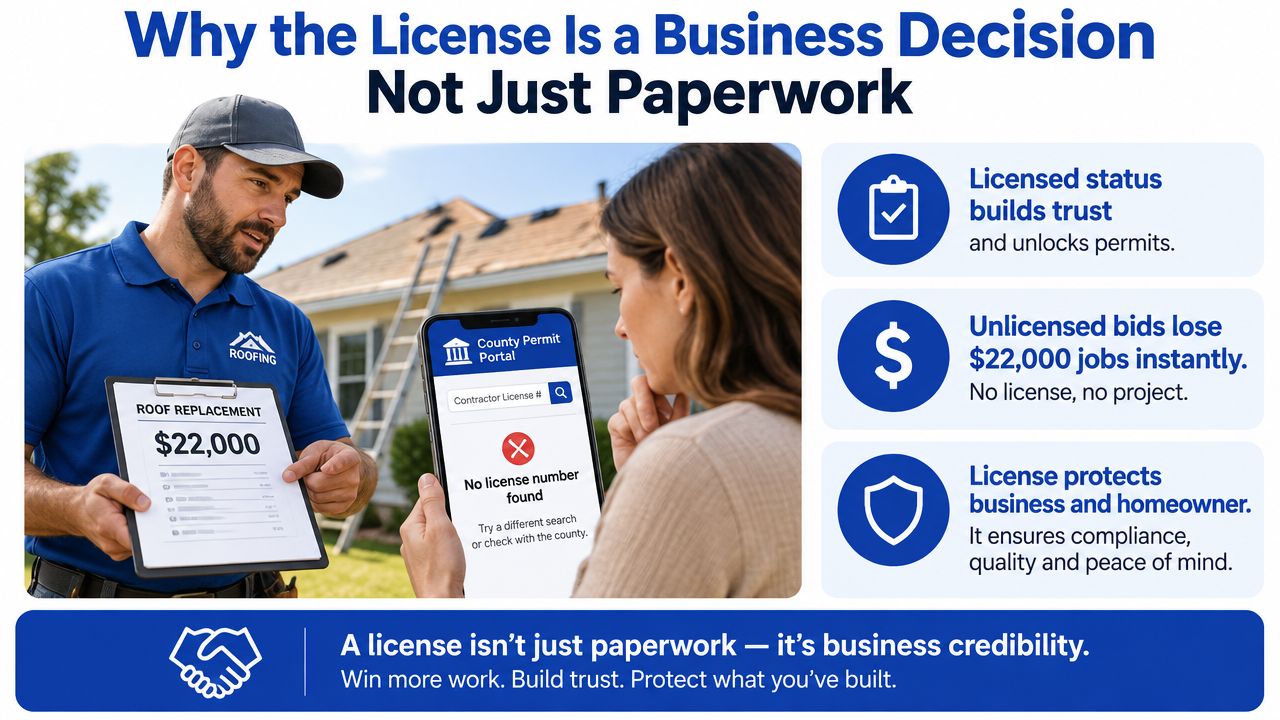
A license creates several practical revenue advantages:
The consequences of operating outside the rules can be more expensive than the application process. You can lose bids, face code or permit problems, create disputes over responsibility, and damage warranties or customer confidence. A license doesn't guarantee good workmanship, but the absence of one can stop a qualified contractor from getting considered.
Practical rule: Treat the license as an operating asset. Before you apply, decide which work, customers, and jurisdictions the credential must support.
The legal structure matters too. Founders sometimes confuse a contractor license with the broader question of how a business is organized. A resource on franchise vs license for founders can help separate those concepts before you invest in branding, contracts, and expansion.
The predictable expense of becoming credentialed is easier to manage than the uncertain cost of lost work and enforcement trouble. Start by confirming eligibility, because paying for the wrong classification can put you back at the beginning.
Meeting the Eligibility Requirements for Your Trade
Boards usually screen applicants through four questions: Are you old enough to apply? Can you prove the experience? Can the authority match your legal identity? Did you select the classification for the work? The exact answers differ, so never rely on a checklist written for another state.
California provides a useful example. The Contractors State License Board says most construction work requires a license when the project needs a building permit or when the total value of labor and materials reaches $1,000 or more, while its applicant guidance also states that work valued at $500 or more in labor and materials must be performed by a licensed contractor. The same guidance requires applicants to show four years of journey-level experience in the trade within the previous ten years, then pass a law-and-business examination and a trade examination before issuance. Review the California CSLB applicant requirements directly because the classification and project rules matter.
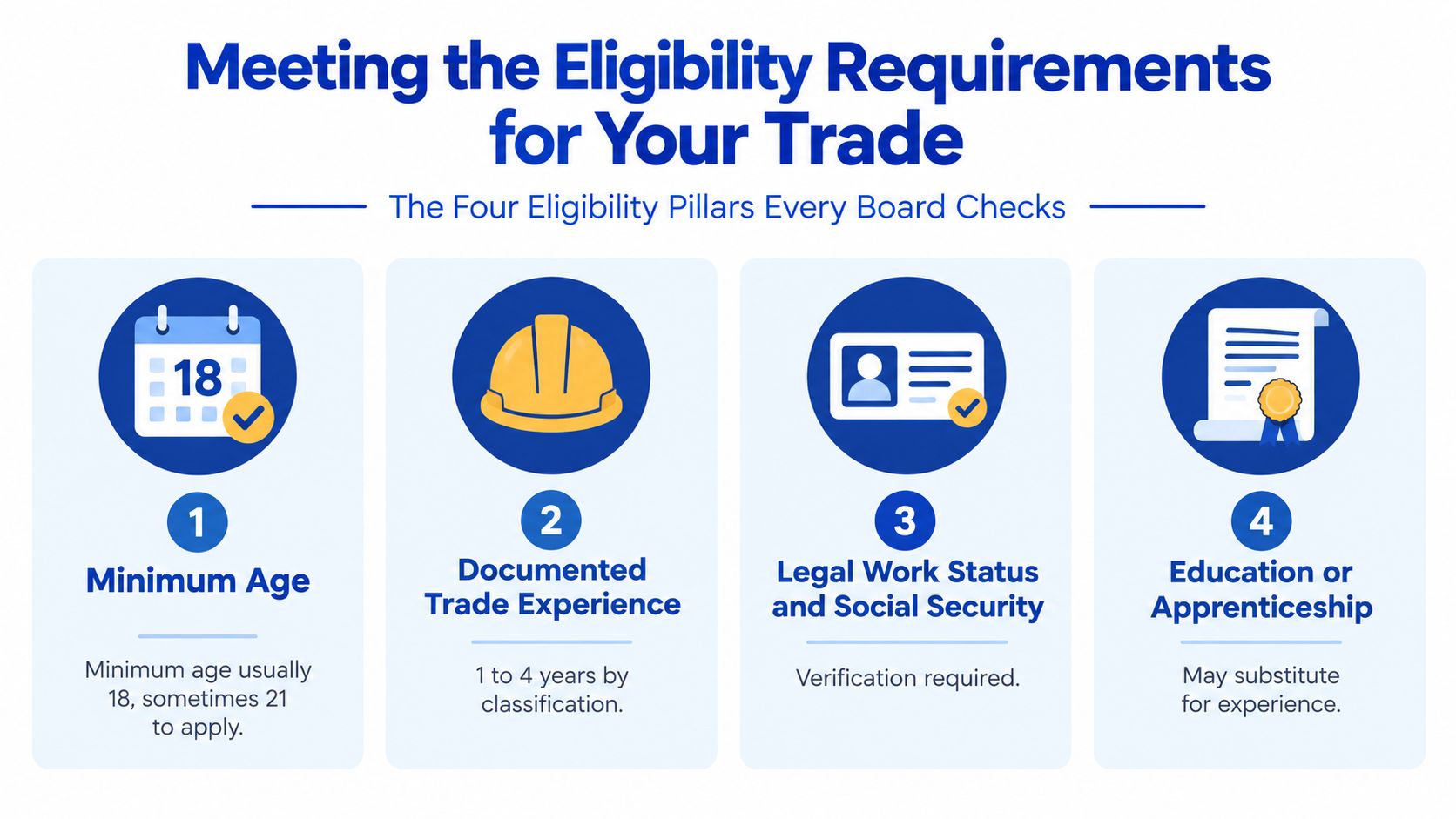
Four checks before you submit
States without the same experience threshold may still impose examinations, financial screening, local registration, or specialty credentials. Florida, for example, distinguishes statewide certified authority from registered authority limited to approved local jurisdictions, while specialty work can require separate licensing. Medical gas, fire suppression, and similar regulated work may require additional testing or documentation.
Before paying a fee, write down the work you perform, the project locations, the authority that regulates it, the classification that appears to fit, and the person who can verify your experience. If any answer is uncertain, contact the board before filing.
Gathering the Documents That Actually Pass Review
Applications usually fail because the packet is inconsistent, not because the applicant lacks practical skill. Assemble the records in an order that lets you compare names, entities, classifications, and signatures before the board does.
Start with your government photo identification and the required Social Security or taxpayer identification confirmation. Then establish the applicant or company identity with the EIN, sole-proprietor information, business registration, or DBA filing that applies to your structure. If you formed an entity, decide whether the license will belong to you personally or to that entity before requesting a bond or insurance certificate.
Build the packet in a controlled sequence
A common mistake is submitting an experience letter under “John Smith Roofing” when the applicant's identification says “Jonathan Smith” and the application names an LLC. Another is attaching an EIN belonging to a prior company or using a classification code that doesn't match the duties described in the experience form. Missing notarization, incomplete pages, and unsigned certifications create the kind of delay that has nothing to do with exam performance.
| Required Document | Most Common Rejection Reason |
|---|---|
| Government photo ID | Legal name differs from the application or experience record |
| Social Security or taxpayer identification confirmation | Number or identity details are incomplete or inconsistent |
| Business registration or DBA filing | Entity name doesn't match the bond, insurance, or application |
| Experience certification | Qualifying individual didn't sign, dates are missing, or duties don't support the classification |
| Bond documentation | Bond is issued to the wrong legal entity or carries incorrect license information |
| Insurance certificate | Coverage details or certificate holder information doesn't satisfy the board |
| Financial statement | Required statement is absent, outdated, or prepared in the wrong format |
Keep a digital folder and a paper backup. Use project documentation templates for contractors to standardize job records, experience evidence, and supporting files before you request signatures. A clean packet gives reviewers fewer reasons to stop the application.
Preparing for and Passing the Trades and Business Exams
Most applicants should expect two kinds of testing. The business-and-law exam covers the rules behind running the company, including contracts, lien issues, payroll, and safety obligations. The trade exam tests the technical knowledge tied to the classification, such as codes, materials, installation methods, estimating, and jobsite decisions.
California uses a Law and Business examination and a trade examination, as described in the CSLB applicant guidance. Other states may divide the material differently. Tennessee, for example, requires a contractor license before bidding or negotiating on projects valued at $25,000 or more and requires Business and Law plus trade examinations for certain classifications, along with additional licensing documentation. Virginia's published contractor exam schedule lists $40 for one portion, $72 for two portions, and $85 for three portions. Those requirements are summarized in the Virginia contractor examination fee schedule.
Use a study plan that exposes weak spots
Industry summaries place first-attempt licensing pass rates broadly around 50% to 70%, while another summary reports trade-level first-time rates near 55% for general contractors, 48% for electrical, 50% for plumbing, 52% for HVAC, and 58% for roofing. These figures come from the contractor licensing exam pass-rate summary, and they should be treated as preparation benchmarks, not a promise about your board or classification.
A failed section usually points to a study problem, not a career verdict. Find out whether the board lets you retain a passed portion, then budget for the waiting period and another application or exam fee before you schedule again.
Bring the identification the testing center requires, arrive early, and check whether calculators, reference books, or personal notes are allowed. Use the testing provider named in your candidate bulletin, such as PSI or ICC, rather than relying on an unofficial location list.
Understanding Real Costs and Timelines Across States
The cost of licensure isn't one number. It may include the application, examinations, background processing, issuance, bond, insurance, business registration, and local requirements. Because those amounts change by jurisdiction and classification, build your budget from the current board fee schedule instead of copying a figure from a contractor forum.
Virginia illustrates how exam charges can depend on the number of portions taken. Tennessee illustrates the other side of the decision, a clear project-value trigger that determines when licensing is required for bidding or negotiation. California's process adds documented experience and two examinations, so the financial plan must include preparation time as well as filing charges.
| State | Application + Exam Fees | Bond Premium | Insurance Down Payment | Total End-to-End Timeline |
|---|---|---|---|---|
| California | Confirm current CSLB application and examination charges | Request a quote based on the required bond | Obtain board-compliant coverage quote | Depends on application review, testing, bonding, and issuance |
| Virginia | Exam portions are listed in the state schedule | Varies by license and underwriting | Varies by trade and carrier | Depends on board processing and exam availability |
| Tennessee | Confirm current application and examination charges | Varies by classification and bond requirement | Varies by trade and customer requirements | Depends on documentation, exams, and issuance |
Fund the recurring obligations too
Renewal, continuing education, insurance, and bond costs can continue after the first license arrives. A contractor who budgets only for the initial application may have enough money to get approved but not enough to keep the credential active.
Before filing, ask the licensing authority:
For a practical state comparison, use this contractor licensing requirements by state guide as a starting point, then verify the details with the governing board. The right budget is the one that includes both compliance costs and the cash buffer needed while applications and exams are pending.
Bonding Insurance and the Business Structure Behind It
A contractor license often sits on top of three separate business foundations: a surety bond, liability insurance, and a properly registered business identity. They don't protect against the same risks, and one cannot substitute for another.
A surety bond protects the customer or the public under the conditions set by state law if the contractor fails to meet certain obligations. General liability insurance addresses covered claims involving property damage or injury. Business registration tells the board, insurer, supplier, and customer which legal entity is responsible for the work.
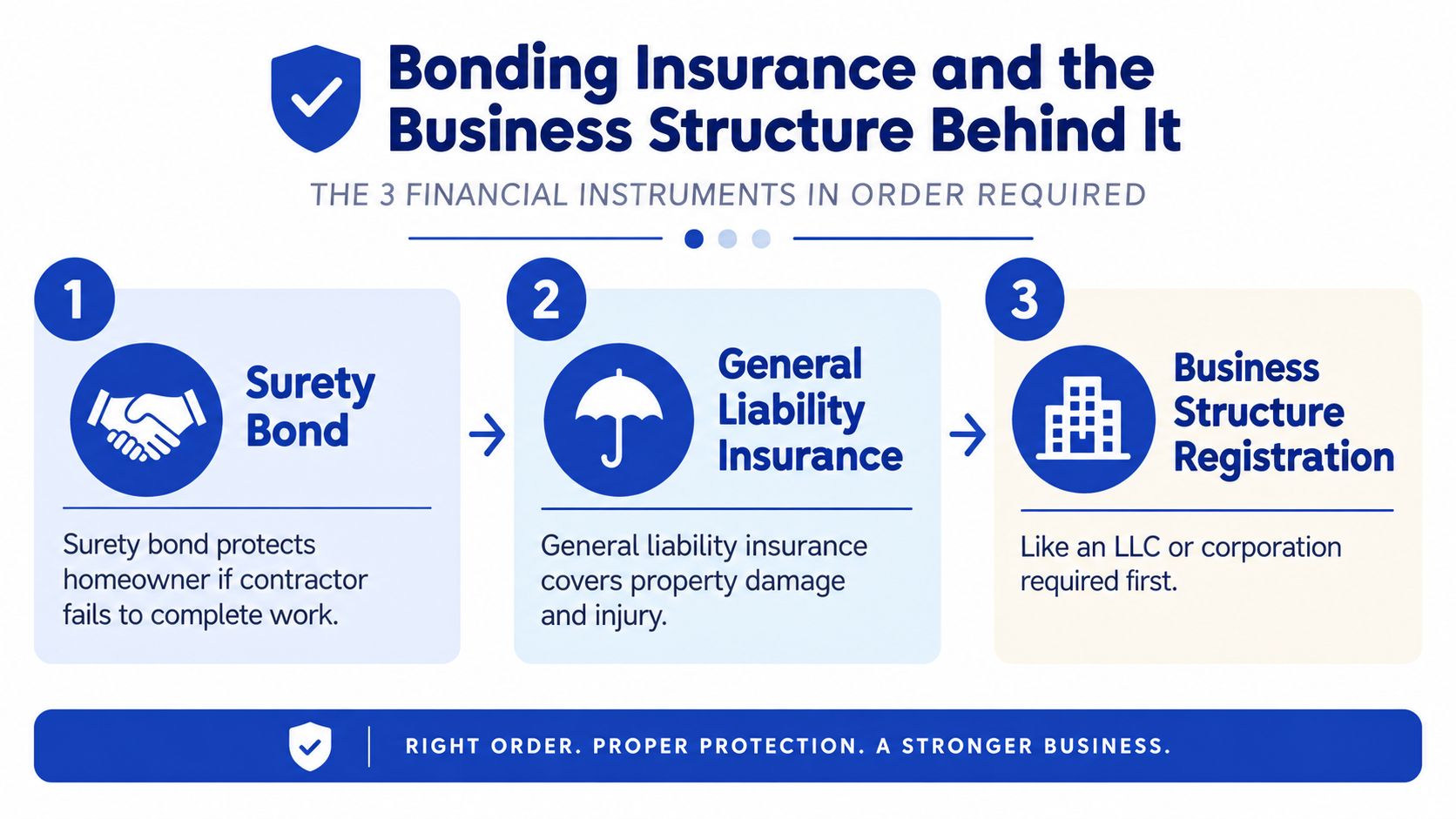
Put the documents in the right order
Register the business name or entity first. Then ask a surety producer for the bond using the exact legal name and intended license information. After that, request insurance certificates that identify the same entity and satisfy the licensing authority's wording.
The bond amount is not the same as the premium you pay. The board may set the required bond amount, while the surety company prices the premium according to its underwriting review. Credit, experience, business history, and the specific license can affect the quote.
Workers' compensation is a separate question. It may be legally required when you employ workers, while a sole proprietor without employees may qualify for an exemption in some jurisdictions. Homeowners and commercial customers can still request evidence of coverage, so don't treat an exemption as a universal substitute for insurance.
Entity check: The name on your bond, insurance certificate, EIN, application, and public license record should describe the same business. Fixing that alignment before submission is cheaper than reissuing documents later.
For a plain-language explanation of the role business bonds can play, review why Florida requires business bonds with an insurance professional, then confirm your own state's rules with its licensing authority.
Give your broker and surety company one complete packet:
Turning Your License Into Trust Leads and Steady Work
A license number only creates business value when customers can find and verify it. Put the number, classification, and expiration information on your business profile, estimates, invoices, email signature, vehicle graphics, and yard signs. The goal is simple, a homeowner should see the credential before asking whether you have one.
Check the public lookup maintained by the state board and link customers to that official record from your website or business profile. Don't make people search through a long marketing page to confirm the status. If the county requires a separate registration or permit record, publish that proof as well and label which authority issued it.
Keep every public record consistent
Directory data creates a quiet trust problem. If your company appears under one legal name on the license record, a shortened name on Google Business Profile, and an old address on a review directory, a customer may hesitate even when the license is active.
Run a regular audit of:
A verified license works better alongside visible workmanship. A homeowner wants to know both that you're authorized to perform the work and that you've completed similar projects carefully. Before-and-after photos, clear estimates, structured reviews, and a direct path to official verification answer those questions without forcing the customer to call several offices.
The same proof helps referral partners. A property manager or general contractor can review your classification and business identity quickly, then evaluate your scope, documentation, and previous work. Contractors building this system can also review home service lead generation guidance for ways to connect credential proof with local marketing and follow-up.
HomeProBadge is one option for presenting verified identity, licensing, insurance, public business information, and project proof in a customer-facing profile. Its TrustBadge and job documentation tools are designed to make those records easier for homeowners and referral partners to review.
If your license is active, make the proof easy to find before your next estimate, and if you're still applying, organize the entity, experience records, exams, bond, and insurance in one consistent packet. Visit HomeProBadge to create a public contractor profile that connects verified credentials with real project documentation, so customers can check your business with less friction.