



The contractor is scheduled to start, the deposit is ready, and an insurance certificate has just landed in your inbox. It looks official, but the business name isn't quite the one on the estimate, and the expiration date falls before the expected finish. Approving it now would be quick. Sorting out whose policy applies after damage occurs won't be.
A useful insurance verification form makes those discrepancies visible before anyone arrives on site. Treat it as a review record, not a receipt for an uploaded PDF. Separate what the document says, what the policy provides, and what the issuer has confirmed.
Required Fields Every Insurance Verification Form Needs
The form is an index to the policy, not a replacement for it. A certificate condenses essential details from a policy that may run hundreds of pages; the Docutrax certificate guide describes the standardized certificate's role in communicating insured names, carriers, coverage categories, dates, and limits.Start with the named insured, before checking the dollar amounts. Match that legal entity to the contract, applicable license record, and invoices. A familiar trading name isn't enough to resolve a different LLC on the certificate.
Copy the following fields onto your blank review form before opening the contractor's PDF. That gives you a fixed checklist rather than letting the contractor's document determine what you notice.
Required fields and what to record in each
| Field | What to record | Why it matters |
|---|---|---|
| Named insured | Legal name matching the license, contract, and invoices | A trade name or sister LLC requires clarification of which entity is insured |
| Issuing insurer | Carrier name and NAIC number, where shown | Identifies the carrier for a separate state authorization check |
| Policy number | Policy identifier for each coverage line | Lets the issuer trace the coverage; some lines may share a policy |
| Effective and expiration dates | Dates covering the full job window | Identifies a potential gap before completion |
| General liability limits | Each occurrence and general aggregate | Prevents an aggregate figure from obscuring a lower occurrence limit |
| Auto liability | Combined single limit, if that is the policy's limit basis | Allows comparison with the contract's vehicle-related requirements |
| Workers' compensation | Statutory coverage and employer's liability limits | Separates employee injury coverage from employer's liability |
| Additional insured | Intended insured party and endorsement reference | Identifies the policy wording that needs review |
| Certificate holder | Your exact legal name and relevant property address | Identifies the recipient, not a grant of coverage |
| Producer signature | Authorized representative and issue date, where provided | Identifies who purportedly issued the certificate for confirmation |
An NAIC number helps identify an insurer, but it doesn't establish authorization by itself. Likewise, a policy number and signature are information to verify, not independent proof of authenticity.
Practical rule: Leave a field unresolved when the evidence is missing. Don't turn a blank into a pass because the rest of the certificate looks complete.
Keep a separate column for required, shown, and confirmed. Those entries expose the difference between a contract requirement, a certificate statement, and a completed verification.
Verify Each Coverage Line and Avoid Certificate Mistakes
A current certificate can still be unsuitable for the job. Certificate received, policy active, and coverage applicable are separate findings. The Georgia insurance commissioner's certificate guidance makes the underlying boundary clear: certificate language cannot add protection absent from the policy, including assurances about residential-construction exclusions.
Use this process to test the certificate against the actual work.
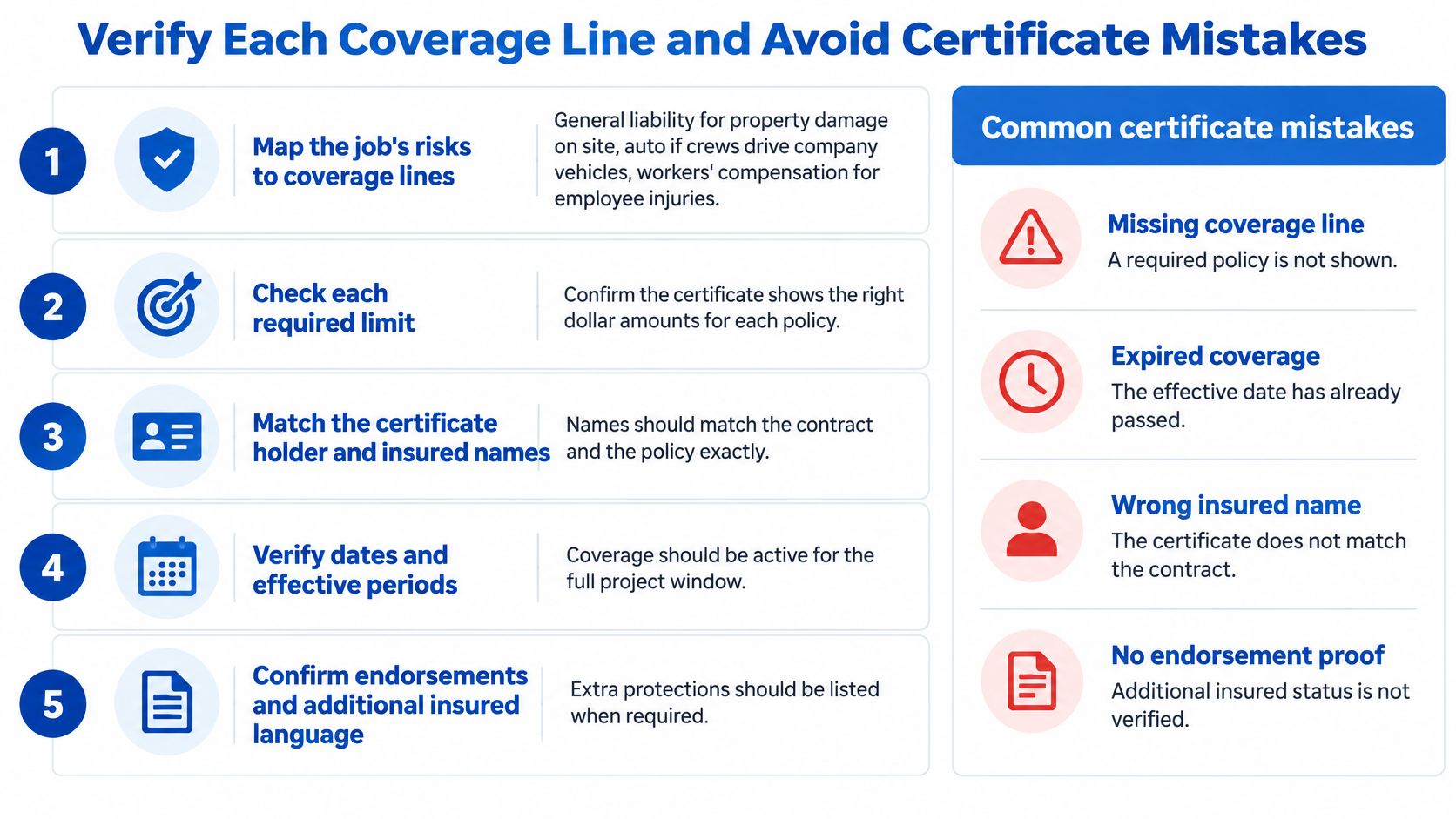
Run the coverage review
Common certificate mistakes and what to check instead
| Mistake | Why it fails | Check instead |
|---|---|---|
| Outdated certificate | Coverage may have ended before work finished | Compare expiration with completion and recheck before material work |
| Claims-made policy with a late retroactive date | Earlier work may fall outside coverage | Review the retroactive date and required reporting or tail provisions |
| Limits combined into one total | The occurrence limit may miss the contract minimum | Compare occurrence and aggregate figures separately |
| Blanket additional-insured wording accepted without review | The intended party may not satisfy its conditions | Obtain the actual endorsement and test its requirements |
| Operations-box text read as coverage | Descriptive wording creates no coverage | Match the claimed protection to policy wording and endorsements |
Say a roofer provides an authentic certificate, but the policy excludes the roofing activity your project requires. The document passes an authenticity check while the project fails the coverage review. Request relevant policy provisions, not a revised description in the operations box.
Record the outcome for every required line, the reviewer, verification timestamp, and unresolved exceptions. Schedule another check before expiration and before material work begins.
Red Flags in the Document and the Upload
The source matters more than the layout. A contractor-uploaded PDF is useful for intake, but direct issuer confirmation is stronger evidence. The New Hampshire Insurance Department's contractor insurance guidance recommends obtaining the certificate from the insurer or agent and confirming that coverage remains active and appropriate.Use document discrepancies to frame specific requests, rather than accusing the contractor of submitting a false certificate.
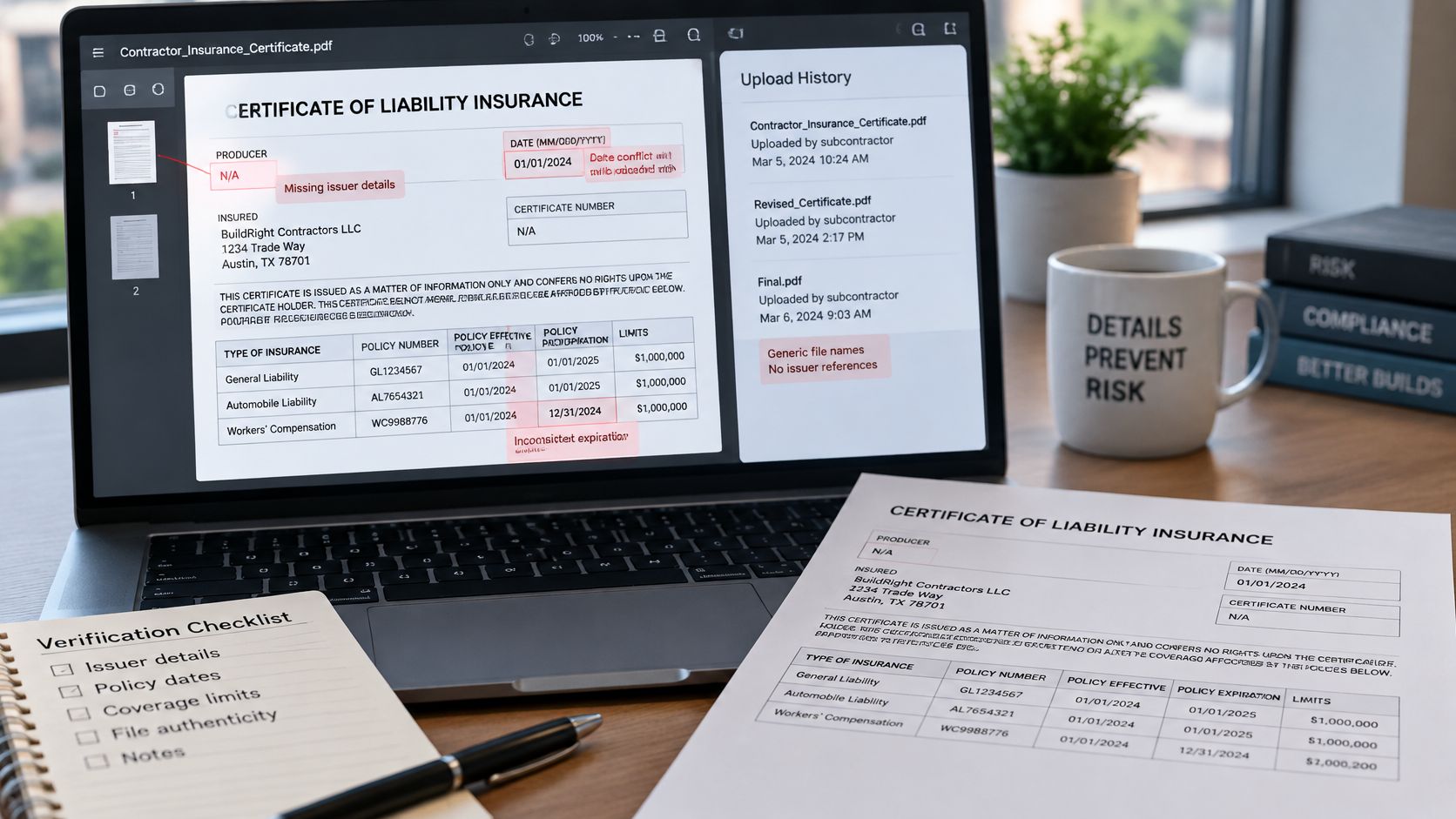
A QR code is a route to information, not a substitute for checking who issued that information.
Keep identity verification separate from insurance verification. A document can belong to a legitimate business yet no longer describe its current policy. Recheck when the scope, contractor, or coverage changes.
Sample Completed Form for a Roofing Contractor
Consider a hypothetical roof replacement on a single-family home, scheduled from April through June. Ridgeline Roofing and Exteriors LLC signs the contract, invoices the homeowner, and employs the crew. The entries below illustrate a completed review; the limits are example contract requirements, not universal recommendations.
Start with the entity match, then enter insurer details from the issuer's response. Don't invent a carrier or policy identifier to make a sample look complete. In a live file, the actual identifiers must replace the descriptive entries below.
Sample completed verification form for a roofing job
| Field | Example entry | Verification note |
|---|---|---|
| Named insured | Ridgeline Roofing and Exteriors LLC | Matches the state license, signed contract, and invoice |
| Insurer and policy number | Actual carrier name, NAIC identifier, and policy references transcribed from issuer-confirmed documents | Carrier authorization checked for the project's state |
| Policy period | Begins before April mobilization and expires after June completion | Covers the planned job with scheduling margin |
| General liability | Hypothetical requirement of $1,000,000 each occurrence and $2,000,000 aggregate | Each figure checked separately against the example contract |
| Auto liability | Hypothetical $1,000,000 combined single limit | Issuer confirms coverage treatment of the crew truck |
| Workers' compensation | Statutory coverage with hypothetical employer's liability of $500,000 | Employment arrangement and applicable coverage confirmed |
| Additional insured | Homeowner identified; applicable endorsement attached | Wording and conditions checked against the policy and contract |
| Certificate holder | Homeowner's exact legal name and property address entered in the live record | Recipient and job location checked |
| Producer signature and date | Authorized agency representative; issued before mobilization | Issuance confirmed through independently verified agency contact |
The general liability figures don't answer whether the roofing operation is covered. The reviewer also needs the provisions affecting the actual roof work, subcontractors if used, and the requested additional-insured protection.
Suppose the certificate instead names only Ridgeline Roof Pros, while the license and invoice name the LLC. Mark the named-insured entry unresolved, not approved. The trade name may be valid, but the file needs evidence connecting it to the insured legal entity.
Finish by attaching the policy documents reviewed, the applicable endorsement, and the issuer's confirmation. Record the reviewer and verification date, then schedule a pre-expiration check. If completion moves beyond the confirmed period, obtain renewal evidence before continuing under the revised schedule.
Recordkeeping for Insurance Verification Files
A usable file lets another person reconstruct the decision without calling the original reviewer. Keep the evidence exactly as received, alongside the notes explaining what was accepted and what remained unresolved.
The Texas Department of Insurance certificate FAQ explains why the certificate cannot substitute for policy rights. Your records should therefore preserve the supporting policy evidence, not just the certificate's summary.
Keep the evidence and the decision together
Store the folder under the contracting entity's legal name. Include the contractor name, job address, and verification date in filenames, and log each recheck's date and result rather than overwriting the previous approval.
File standard: Preserve what you knew when you authorized the work, not merely the newest document.
Connect the insurance file to the project's construction photo documentation so scope changes and site conditions remain traceable. Confirm retention requirements with counsel using your contract and applicable state rules; don't assume a convenient deletion schedule is legally sufficient.
Confirm Coverage Before the First Day on Site
Authorize the start only after the coverage review is complete. An approaching delivery date isn't a reason to approve an unresolved insured name, missing endorsement, or unconfirmed policy status.Request issuer-originated evidence, reconcile the contracting and payment entities, and confirm the required policy provisions. Then sign and date the review record. When selecting a specialist, whether a residential roofer or a commercial roofing contractor such as America Roofing, use the proposed scope to define the insurance questions rather than treating a service description as coverage evidence.
Make approval conditional on current evidence
Homeowners' insurance companies often require proof of coverage, and our HomeProBadge profiles make that proof instantly accessible. Our verified badges are re-verified annually to keep them active and current, but a project-specific review still needs to address the work being authorized.
Use licensed and insured contractor checks to keep credential questions distinct. Verification documents the evidence reviewed; it doesn't guarantee claim payment. If a field fails, tell the contractor exactly what needs correction and keep the start date on hold.
HomeProBadge helps homeowners review contractor verification status and accessible proof of coverage alongside real project evidence. Visit HomeProBadge to review a professional's profile, then use your completed insurance verification form to resolve project-specific coverage questions before work begins.