

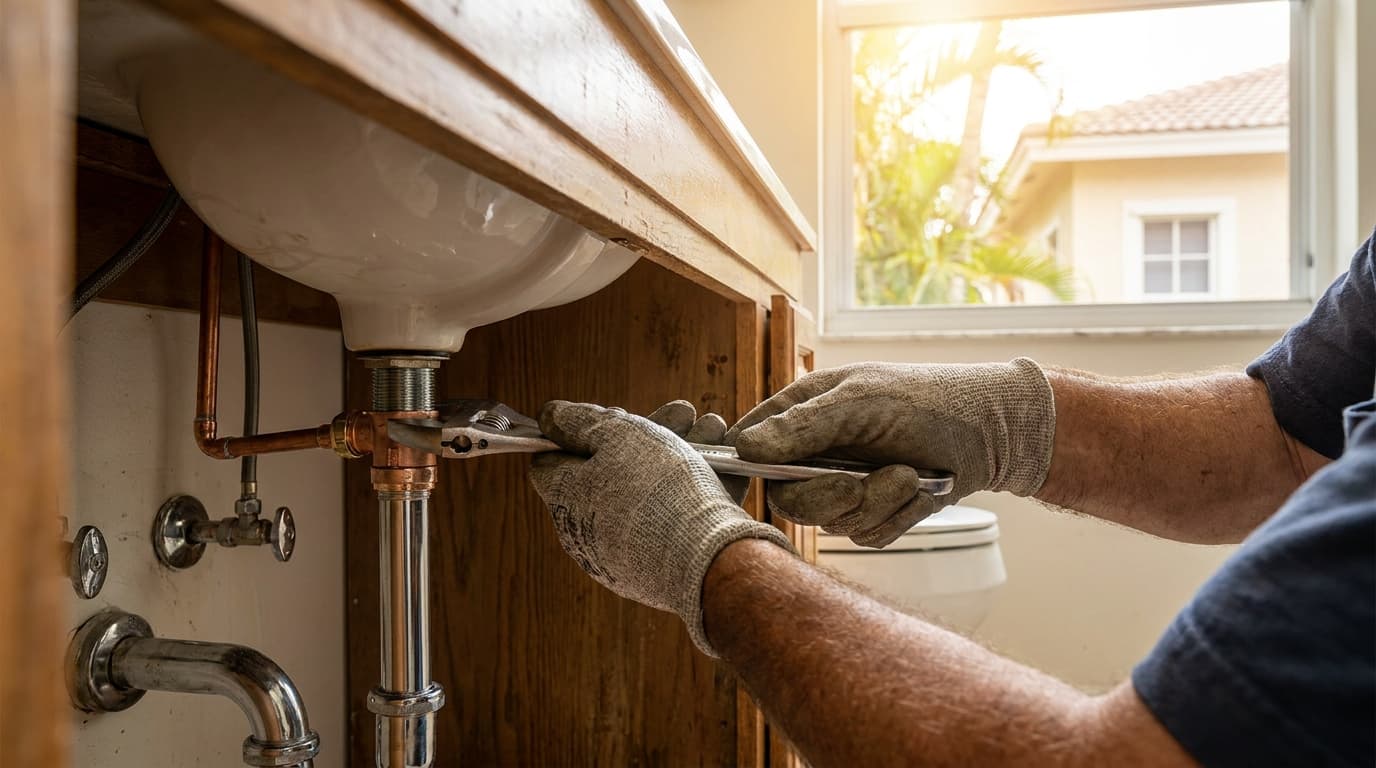

You usually know it's bad before you see the break. You hear water running where there shouldn't be any. A wall darkens. A ceiling starts to sag. The floor near a bathroom vanity turns slick, and now you're trying to decide whether to grab a towel, a wrench, or your phone.
In a burst pipe emergency, the wrong first move can make the damage worse. The right one buys time, protects your home, and keeps you safe. After that, the main question is what kind of burst pipe repair makes sense. A fast patch can be useful. It can also fail the moment pressure comes back on if it's the wrong fix for the pipe, the damage, or the location.
Most homeowners get plenty of advice on stopping the water. They get far less help on the trade-off that matters next: when a temporary patch is good triage, and when it's just delaying a bigger repair. That's where practical judgment matters.
First Steps During a Burst Pipe Emergency
When you hear active water flow, move fast but stay methodical. A sound emergency sequence is to shut off the main water supply, cut power if water is near outlets or wiring, drain the system by opening faucets, then call for professional help, as outlined in this burst pipe repair guidance.
Shut the water off first
Go straight to the main shutoff valve. In most homes, it's near where the water service enters the house, in a basement, utility area, garage, crawl space access point, or near the meter. Turn it fully off.
Then open faucets to drain the remaining water out of the lines. Start with the lowest fixtures you can reach safely. This relieves pressure and helps stop water from continuing to feed the failed section.
If water is coming through a ceiling, don't stand under the bulge and don't start cutting into drywall until you know the area is electrically safe. Put buckets down, move rugs and small furniture out of the way, and create a path that won't turn into a slip hazard.

Practical rule: If you haven't shut the water off yet, nothing else matters. Cleanup can wait. Photos can wait. The valve can't.
If you need a quick reference while things are chaotic, this short guide on steps for handling a burst pipe is a useful homeowner checklist.
Treat electricity as a separate emergency
Water around outlets, extension cords, appliances, or wiring changes the situation immediately. If you can reach the panel without stepping into wet areas, shut off power to the affected area or the whole home. If the panel is in a wet zone, leave it alone and call for electrical help.
A lot of burst pipe advice stops at “call a plumber.” That's incomplete. When water has soaked walls, ceilings, insulation, or flooring, the problem isn't only plumbing anymore. It becomes a safety and drying problem too.
Call a plumber, and if there's meaningful water spread, call a water-restoration company as well. If the leak affected wiring, fixtures, outlets, or a ceiling cavity, arrange for the electrical system to be assessed before normal use or re-entry in that area.
Make the right calls before you start moving things
Once the water is off and the area is safe enough to approach, make your calls in this order:
Take photos before you tear anything out. Don't rush into reopening the valve just to “see if it's still leaking.” That extra pressure test, done too early, can turn a controlled problem back into an active flood.
How to Apply a Temporary Pipe Repair
A temporary repair is a holding action. It's there to stabilize the situation until you can cut out the damaged section or hand the job to a plumber. The mistake homeowners make is treating a temporary patch like a finished burst pipe repair.
The right choice depends on pipe material and on whether the damage is a pinhole, split, or freeze-burst, and the fastest-looking fix isn't always the most reliable, as highlighted in this repair discussion on clamps, epoxy, and tape.
Which temporary fix matches the leak
A pipe clamp works best when you have a localized damaged area on a rigid pipe and enough access to wrap and tighten the assembly properly. It's strong for spot control, but it needs a clean seating area and enough room around the pipe.
Silicone repair tape is useful when you need speed and the leak is small enough that wrapping tension can help contain it. It's handy to keep in a home emergency kit, but it's sensitive to surface conditions and shape. It's not the patch I trust on a long split or on badly deformed pipe.
Epoxy putty can buy time on small defects if the surface is cleaned and dried as well as possible first. It's often the most misunderstood option because people try to use it on wet, actively splitting pipe and expect it to behave like a structural repair. It won't.
Comparing Temporary Burst Pipe Fixes
| Method | Best For | Effectiveness | Lifespan |
|---|---|---|---|
| Pipe clamp | Localized damage on accessible rigid pipe | Strong when it fits the pipe and damage correctly | Short-term only until permanent repair |
| Silicone repair tape | Small leaks and quick containment | Useful for fast wrap repairs, but limited by pipe condition and leak type | Short-term only |
| Epoxy putty | Small isolated defects on prepared surfaces | Can help stabilize minor damage if prep is good | Short-term only |
A temporary patch should lower risk, not create false confidence. If you're afraid to leave the area after applying it, it isn't a finished repair.
What temporary repairs do badly
Temporary methods fail in predictable ways.
Use a temporary patch only when the water is already shut down or isolated and you need control, not certainty. If the line serves a critical fixture, sits behind finished surfaces, or shows a long split, skip the patch and plan a permanent repair.
Permanent DIY Repair for Common Pipe Types
A proper burst pipe repair means removing the failed section and installing sound material with the right connection method for that pipe. The basics stay the same across copper, PEX, and PVC: isolate the line, measure carefully, make straight cuts, and don't rush the joint.
This visual gives a good material-by-material overview before you start.

Copper repair that doesn't leak later
Copper gives you a clean, durable repair when the cut is square and the fitting is fully seated. For many homeowners, a push-to-connect coupling is the most practical option for an accessible repair. The details matter.
Clean the pipe. Remove burrs with a reamer or file. Mark the insertion depth before you push the fitting on. One repair demonstration uses a 7/8-inch reference line on copper to verify full seating, and it emphasizes that incomplete insertion is a common cause of leaks in DIY push-fit work, shown in this push-fit copper repair demo.
Steps that work on copper:
If you're working near a fixture branch, this guide to a bathroom sink drain pipe repair approach can help you think through access and layout before you cut.
Here's a video walkthrough for the broader repair process and tool handling.
If a push-fit joint goes on too easily, that's not reassuring. Most bad ones fail because the pipe wasn't cleaned, wasn't deburred, or wasn't pushed in far enough.
PEX repair with the right connector and clean cuts
PEX is forgiving in some ways and unforgiving in others. It bends well, handles replacement sections cleanly, and doesn't require solder. But it still needs straight cuts, the correct fitting style, and proper ring or clamp placement if you're using crimp or clamp connections.
For a clean DIY repair:
A short replacement section with couplings at both ends is usually cleaner than trying to save every inch of damaged tubing. If the burst happened because the line rubbed against framing or was left unsupported, fix that condition too or the next leak won't be far away.
PVC repair that holds under normal service
PVC is straightforward when the line is dry, stable, and accessible. It's a poor candidate for rushed work in a damp cavity if you can't get the surfaces ready.
A reliable PVC repair usually means cutting out the cracked section and solvent-welding in a new piece with the correct fittings. Dry-fit everything before you apply primer or cement. Once those parts are joined, your alignment window is short.
Keep these points in mind:
The emergency sequence itself matters here too. A sound process is to shut off water, cut power if needed, drain the system, isolate the damaged section, replace it with a measured new segment using clean straight cuts, and then reopen the valve slowly to avoid pressure shock, as described in this step-by-step burst pipe repair guide.
Essential Tools and Materials for Pipe Repair
Most bad repairs start before the first cut. The homeowner has the wrong cutter, no deburring tool, the wrong coupling, and not enough towels or buckets to keep the area controlled. A good burst pipe repair kit separates emergency containment from real repair work.

Emergency kit
Keep these items together, not scattered around the garage.
Permanent repair toolkit
This is the set that lets you do repair work correctly.
Nice to have, but not mandatory for every homeowner, includes a wet/dry vac, inspection mirror, and a compact moisture meter for checking nearby materials after the leak is under control.
Hiring a Plumber and Understanding Repair Costs
Some burst pipe repairs are clean DIY jobs. Many aren't. If the pipe is buried in a wall, under a slab, above a finished ceiling, or tied to broad water damage, the smart move is to bring in a licensed pro early.

When DIY stops making sense
Call a plumber if any of these apply:
That last point gets missed all the time. Once water has spread through building materials, the question isn't just who can reconnect pipe. It's also who can verify the area is safe to use again.
What actually drives the bill
Homeowners often focus on the pipe itself. The pipe is rarely the expensive part. According to this burst pipe repair cost breakdown, labor accounts for 80% of the total repair price, pipe material may cost only $0.50 to $30 per linear foot, and typical repair pricing in the U.S. runs $150 to $250 per linear foot for labor and materials combined. The same source reports repairs behind walls often run $150 to $500 before drywall restoration, bathroom and kitchen repairs commonly run $150 to $800 depending on access and damage severity, a common pro-service estimate is around $500, and larger jobs can reach $5,000+ when underground replacement or water-damage work is involved.
The bill follows access. If a plumber has to open walls, work in tight spaces, and coordinate around damage, the labor climbs fast even when the failed pipe section is short.
That's why two leaks that look similar on the surface can price very differently. One is under a sink with open access. The other is inside a wet exterior wall with damaged drywall, insulation, and trim.
How to choose the right plumber
Don't hire on speed alone. In a burst pipe emergency, people get impatient and skip the basics.
Check for:
If you want a starting point, browse a verified plumber directory so you can compare professionals with documented credentials and job history instead of relying on guesswork.
For buried utility work, there's also a bigger industry context. The U.S. EPA describes trenchless pipe bursting as a rehabilitation method for pipes roughly 100 mm to 600 mm in diameter with a typical replacement pace of about 30 m (100 ft) per hour, and a broader infrastructure study cited in the same source noted about 260,000 water main breaks annually in the U.S. and Canada, $2.6 billion per year in maintenance and repair costs, and about 11% of supplied water lost to leakage, summarized in this water infrastructure repair study. Homeowners won't use that method for a sink supply line, but it explains why modern pipe repair is often as much about access, replacement strategy, and restoration as it is about the pipe itself.
How to Prevent Future Burst Pipes
The best burst pipe repair is the one you never need. Most prevention comes down to protecting exposed piping, reducing freeze risk, and catching small warning signs before they turn into an active break.
Cold weather habits that prevent failures
Walk the house before winter and identify any pipe in an unheated or drafty area. Pay close attention to crawl spaces, garages, exterior walls, utility rooms, and attic-adjacent runs.
Use this checklist:
Simple checks that catch trouble early
Prevention isn't only about freezing. It's also about noticing trouble before the pipe bursts.
For broader home-risk planning, including ways to think ahead about emergencies and contractor response, this guide to homeowner protection services is worth reviewing.
A calm household handles a burst better than a surprised one. Label the main shutoff. Keep basic repair items in one bin. Know who you'll call before the next freeze or leak hits.
When you need a contractor after a plumbing emergency, trust matters as much as speed. HomeProBadge helps homeowners find verified home service pros with documented identity, licensing, insurance, and proof of past work, so you can hire with more confidence when the pressure is on.