


A winning bid is the one you can audit later, not the lowest sticker or a familiar brand. Compare 2026 quotes with the $3,800 to $9,500 typical full-installation range reported in the 2025 contractor-price survey, then judge each bid by its scope and documentation.
A polished proposal proves little on its own. Require a heating-load calculation, the exact equipment model, recorded startup measurements, and a permit that reaches final approval. Keep those records: they help you assess the installation if the furnace struggles or a buyer asks about the work at resale.
What Furnace Installation Actually Costs
The 2025 contractor-price survey from Homefixx puts a typical full furnace installation between $3,800 and $9,500. Use that as a starting budget, not a promise that every house fits inside it.
The important question isn't whether a quote falls somewhere inside the band. It's whether the contractor priced the work your house needs. An accessible replacement with compatible utilities is a different project from a fuel conversion with new venting and return-air corrections.
Match the budget to the work
The table separates project types without inventing separate price bands the survey doesn't establish. Where there's no supported dollar range, require an itemized quote rather than accepting a made-up allowance.
2025 furnace installation budget bands| Job type | Planning range | Usually included | Often extra |
|---|---|---|---|
| Full replacement, survey band | Survey benchmark stated above | Equipment, labor, basic startup | Venting, ducts, fuel, or electrical changes |
| Like-for-like gas furnace | Base replacement quote after compatibility check | Matching equipment and labor | New liner or gas-line upsize |
| High-efficiency with new venting | Equipment quote plus priced venting and drainage | Specified AFUE, approved vent materials, condensate routing | Condensate pump or new circuit |
| Furnace plus duct or return work | Replacement quote plus a defined duct scope | Equipment and targeted duct fixes | Whole-house duct replacement |
| Oil or propane conversion | Fuel-specific conversion quote | New furnace and specified fuel connections | Tank removal or chimney liner |
| Permit fees | Local department's published fee schedule | Listed permit charges | Separate gas or electrical permits |
| Old furnace disposal | Included only when the contract says so | Removal and haul-away when specified | Haul-away billed separately if excluded |
A like-for-like replacement should mean the installer has checked compatibility, not merely spotted another gas furnace in the basement. Ask whether the existing flue, fuel supply, electrical connection, and equipment access can support the proposed unit.
High-efficiency work needs its own scope. The bid should describe approved exhaust materials, termination locations, and condensate disposal, rather than treating them as installation-day decisions.
Keep unrelated work out of the comparison
If you're replacing cooling equipment too, use our guide to the cost of a new furnace and air conditioner to separate the combined project from a furnace-only quote. Don't compare a bundled system proposal with a heating-only price.
Don't confuse domestic hot water with space heating, either. For readers sorting out that distinction, Total Plumbing & Hot Water Systems provides a Melbourne homeowner's guide to reliable showers, a separate resource for the hot-water side of household comfort, not a benchmark for U.S. furnace pricing.
Budget rule: Set your spending ceiling after the house assessment, then require every bidder to price the same work.
For a business with rooftop equipment, request a commercial assessment. Access equipment, operating-hour restrictions, and the cutover plan belong in that proposal. A residential replacement band isn't a substitute.
How to Find and Vet Local Installers
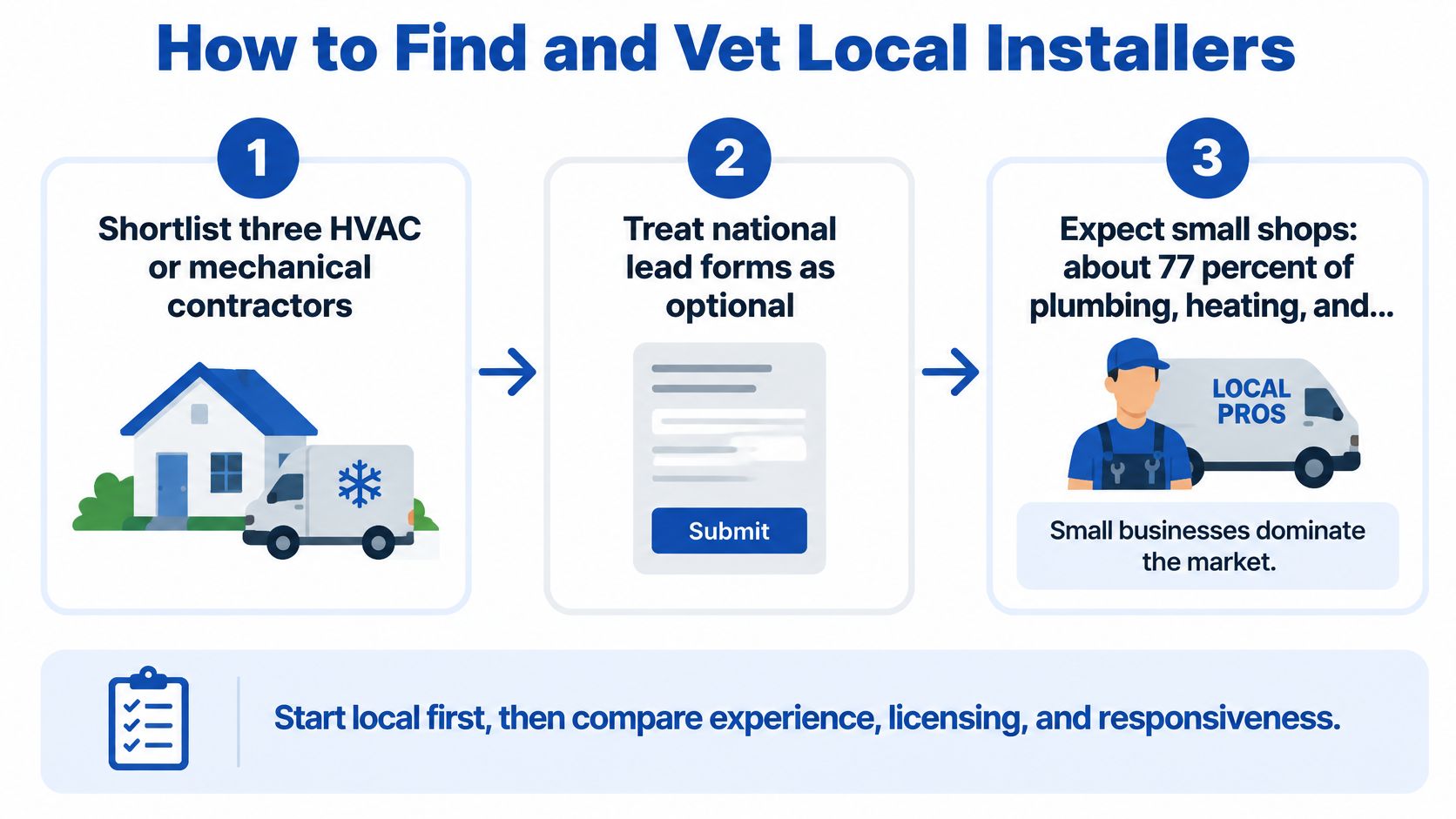
Start with contractors who already service your area and can return when something needs correction. National lead forms are optional. They aren't evidence that the person arriving at your door knows your local inspection process.
Expect small businesses. Census-based industry figures published by Hyre HVAC show that 76.8% of employer establishments in the broader plumbing, heating, and air-conditioning contracting industry had fewer than ten employees in 2023. Small doesn't mean unqualified, but you shouldn't mistake a friendly owner for a complete quality-control system.
Use this screening path before discussing equipment prices.
Screen for replacement experience
For a complicated remodel or a project involving multiple building systems, HireArchitects explains how to assess MEP firms for project fit. That distinction helps when you need coordinated engineering rather than a routine equipment replacement.
Ask questions before asking for a price
Put the same questions to every firm. You're testing whether they have a repeatable installation process, not whether the salesperson can recite product features.
For a visual introduction to the equipment discussion, use the video alongside your written interview notes.
Listen for specific ownership. An answer such as “the office handles that” needs a named contact and a clear next step.
Finish screening with licensed, insured candidates willing to inspect the house. Don't reward the fastest phone estimate by skipping the visit.
Line Items Every Written Bid Should Show
The cheapest bid may be the one whose author skipped the house. If a contractor hasn't examined the return duct, vent route, and utility connections, the total may describe only the furnace and the hope that everything else works.
Brand and AFUE aren't an installation scope. AFUE describes rated fuel efficiency, not whether your existing ducts can carry the required airflow or whether the exhaust arrangement is suitable.For context, ENERGY STAR's equipment-planning materials identify gas-furnace performance targets of at least 95% AFUE in the U.S. North/Canada region and at least 90% in the South. Those are program-planning targets, not a blanket statement of your local replacement code.
Make the proposals comparable
Give every bidder the same checklist. Require a price, an included-work description, or not required with a written reason for each applicable item.
Furnace bid comparison checklist| Bid line | Why it matters | Red flag if missing |
|---|---|---|
| Heating-load calculation | Sizes the furnace to this house | Price based only on the old nameplate |
| Model and AFUE | Identifies the equipment and efficiency sold | Brand name or good-better-best tier only |
| Output versus design load | Compares delivered heating capacity with calculated heat loss | No output BTU stated |
| Venting and combustion air | Establishes a compatible exhaust and air-supply arrangement | Existing flue reused without explanation |
| Gas line and electrical | Identifies required utility work before installation | Neither is mentioned |
| Ducts, returns, filter access | Addresses airflow restrictions and maintenance access | No duct inspection |
| Permit and disposal | Assigns filing and removal responsibilities | Homeowner told to arrange everything afterward |
| Labor versus parts warranty | Separates equipment coverage from service costs | Parts language only |
| Commissioning included | Puts startup testing inside the agreed price | Power-on demonstration only |
Require the full model number, not a sales tier. Put rated output capacity beside the calculated design heat loss so the sizing decision is visible.
Include condensate routing in the written scope when the proposed equipment needs it. The contractor should identify the discharge location, pump if necessary, and responsibility for any required drainage changes.
Control changes before demolition
Say one contractor includes a return-air correction and another leaves the ducts untouched. Those aren't competing prices for the same job. Ask the second contractor whether they inspected the return and what supports leaving it alone.
The same applies to venting. Don't accept a generic promise to reuse existing connections without a compatibility assessment and the manufacturer's installation requirements.
An empty bid line isn't a saving. It's work nobody has agreed to own.
Require written approval for substitutions and additional work. If the proposed model becomes unavailable, the replacement model and any resulting venting, electrical, or capacity changes should be documented before installation.
Also specify the handover evidence: equipment labels, before-and-after photos, test results, and the completed scope. A contractor who agrees to documentation in the proposal is easier to hold accountable than one who promises to send it later.
Permits and Licenses Before You Sign
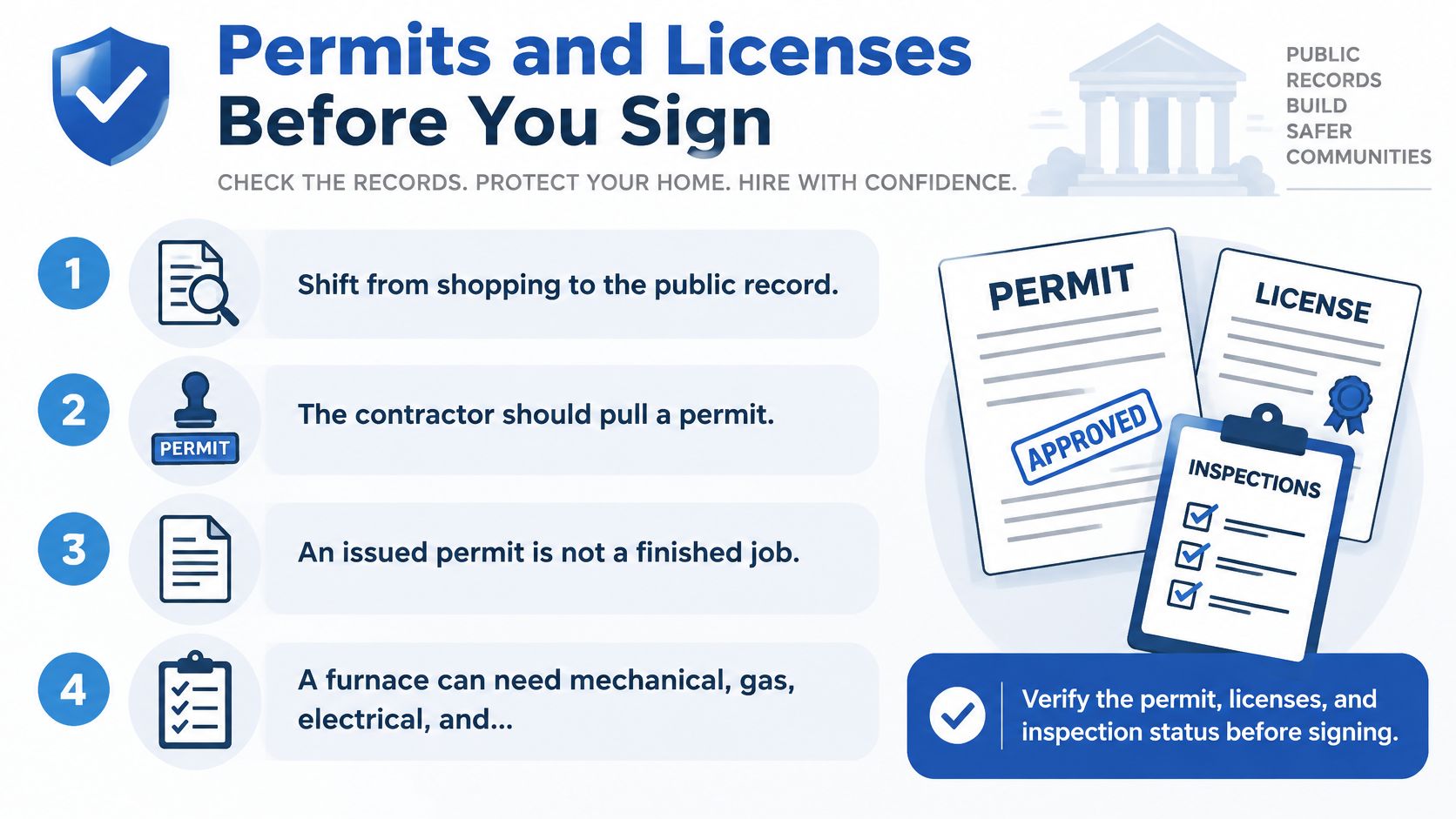
An issued permit is not a finished job. It means the department authorized the project to proceed, not that an inspector accepted the completed installation.A complaint published on the Better Business Bureau's contractor complaint page alleges that a furnace/mechanical permit was issued but never scheduled for final inspection. That's an allegation, not a finding, but it illustrates the exact status gap a homeowner should check.
Use the public record, not a salesperson's reassurance.
Verify the authority and the responsibility
Start with the department that serves your address. It may be a city department or a county office. Don't assume a neighboring municipality's rules apply.
Ask which approvals the project needs, including mechanical, gas, electrical, or venting work. Our guide to HVAC permit requirements can help frame those questions, but the local department determines the requirements for your property.
Permit and license closeout checkpoints| Checkpoint | Who owns it | Accepted proof |
|---|---|---|
| Mechanical or HVAC license | Contractor | License number matching the applicable state or city lookup |
| Liability and workers' comp | Contractor | Current insurer-issued certificate, with job-specific documentation where applicable |
| Permit application | Contractor under the agreed scope | Application listing your address and responsible contractor |
| Permit issued | Building department | Issued status and a permit number |
| Inspections scheduled | Contractor | Dated inspection appointment you can confirm |
| Final approval | Inspector or building department | Final, Approved, or equivalent closed-and-accepted status |
| Records you keep | Homeowner | Permit card, correction notices, approval record, model and serial details |
A license lookup should match the legal business on your contract. Check the license classification and status, not just whether a number exists.
For insurance, request documentation from the insurer or agent. A logo on a proposal doesn't establish current coverage, and a liability certificate doesn't automatically answer workers' compensation questions.
Agree on closeout before paying the deposit
Put inspection scheduling and correction work in the contract. The installer should remain responsible for returning to correct deficiencies within their scope and arranging the required reinspection.
Don't become the permit holder merely because the contractor says it's easier. Ask the department what obligations that would transfer to you before agreeing to anything.
Closeout condition: Negotiate a final-payment milestone tied to required inspection approval and delivery of the project records.
That condition belongs in the signed payment schedule. Don't invent a new withholding arrangement after the contractor has completed work under different terms.
If the contractor disappears, contact the department with your address, permit number, and contract. Request the inspection history and ask how to resolve outstanding corrections, transfer responsibility to another qualified contractor, or report unpermitted work.
Keep copies last, after confirming the status. Save the approval record itself, not just a screenshot of the original application, so a future buyer doesn't have to reconstruct the project.
Timeline Commissioning and Warranty Proof
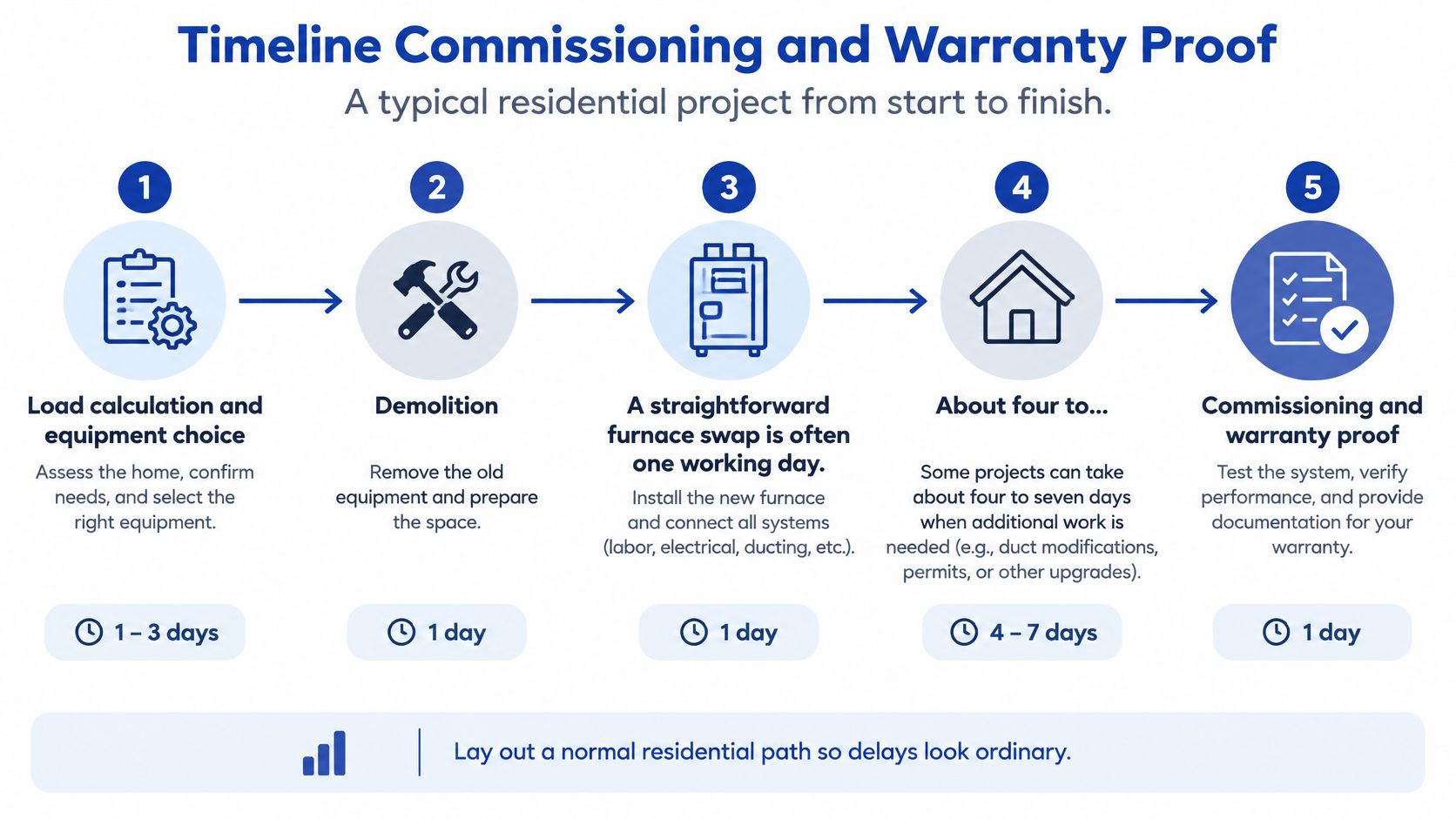
The installation schedule should separate equipment delivery, physical work, startup testing, and inspection. A running furnace doesn't mean all those milestones are complete.
Before demolition, get confirmation that the specified equipment is available and that the contractor has planned any utility shutdowns. If the work leaves the house without heat, agree on the contingency before anyone disconnects the old furnace.
Use the timeline as a sequence of responsibilities, not a guaranteed duration.
Require measurements instead of a demonstration
A defensible sequence begins with Manual J or an equivalent heat-loss calculation, followed by equipment selection using manufacturer performance information and Manual S principles. Copying the old unit's capacity isn't a substitute.
The ENERGY STAR quality-installation guide generally specifies furnace output at 100–140% of calculated design heat loss, or the next available nominal size, and an airflow verification target within 15% of design. These are documented quality-installation criteria, not permission to ignore the selected manufacturer's requirements.
Ask for the calculated load, listed output, and actual airflow together. The figures mean more as a connected record than as isolated entries on different forms.
Startup readings and warranty clocks| Item | Target or term | Proof to request |
|---|---|---|
| Output capacity | Quality-installation sizing criterion stated above | Listed output and calculated load on the installation record |
| Airflow | Quality-installation verification criterion stated above, checked against OEM data | Measured airflow sheet and design reference |
| Supply and return temperatures | Temperature rise within the model's specified range | Recorded readings and manufacturer limits |
| Static pressure | Within the equipment's permitted operating limits | Recorded reading, test locations, and blower reference |
| Manufacturer parts warranty | Exact term in the supplied warranty | Warranty document and registration confirmation |
| Heat exchanger | Separate component coverage stated by the manufacturer | Model-specific coverage and exclusions |
| Contractor labor | Exact duration and conditions in the contract | Written labor terms and responsible service company |
Have the installer record the model, serial number, AFUE, and output capacity. Request combustion and carbon-monoxide checks appropriate to the equipment, with results recorded rather than described as “all good.”
Static pressure needs context. Ask where the technician measured it and which equipment limit they used. A number without a location or reference doesn't tell you whether the duct system is acceptable.
Separate the warranty obligations
Parts coverage isn't labor coverage. A covered component can still leave you paying for diagnosis, removal, installation, travel, or other charges excluded from the agreement.Read the manufacturer parts warranty, heat-exchanger coverage, and contractor labor warranty separately. Ask who handles a claim if the original installer closes or stops servicing your area.
Require registration confirmation showing the correct model, serial number, installation address, and installation date. If the contractor hasn't completed registration, follow the manufacturer's process yourself and retain the confirmation.
Before accepting handover, have the installer demonstrate filter replacement, thermostat operation, and the equipment shutoffs. You should leave that conversation knowing both how to operate the system and whom to call when it doesn't work.
Choose the Bid You Can Prove Later
Sign the bid that makes the installation auditable: documented sizing, identified equipment, assigned permit responsibility, and an agreed testing record. Choose it over a lower total that leaves essential work unresolved.
That isn't an argument for automatically buying the expensive proposal. A higher price can be just as poorly documented as a cheap one. You're buying a defined result, not a premium logo.
Judge the response to missing information
The contractor's reaction to your questions is useful evidence. A competent bidder should be able to explain an exclusion, correct a missing model number, or identify who owns inspection scheduling without turning the discussion into an argument.
Use a simple decision test:
For a small business, identify the person who receives the handover. The office manager shouldn't have to search a technician's text messages for the model number or shutdown instructions during a no-heat call.
Use verification as the first filter
Our Find Verified Pros directory lets homeowners search for free without creating an account and filter by trade, location, or verification status. Use credential verification to narrow your candidates, then judge their proposals and project records.
A verified identity, license, and insurance record doesn't replace an in-home assessment. It also doesn't establish that a particular installation passed inspection. Treat contractor credentials and job acceptance as separate checks.
Keep the final documents together in a property folder, with a backup outside your email inbox. Include the contract, approved changes, equipment information, startup sheet, warranty confirmation, and final inspection record.
Schedule your shortlisted contractors' in-home assessments this week. Send each the same scope checklist before the visit, and require the completed proposal before choosing equipment or paying a deposit. The winning bid is the one you can explain and defend after the installer has left.
Visit HomeProBadge to find verified HVAC professionals and review their credentials and documented work before inviting them into your home. Build your shortlist, then require each furnace installation contractor to commit to a complete bid, recorded startup testing, and permit closeout before you sign.