

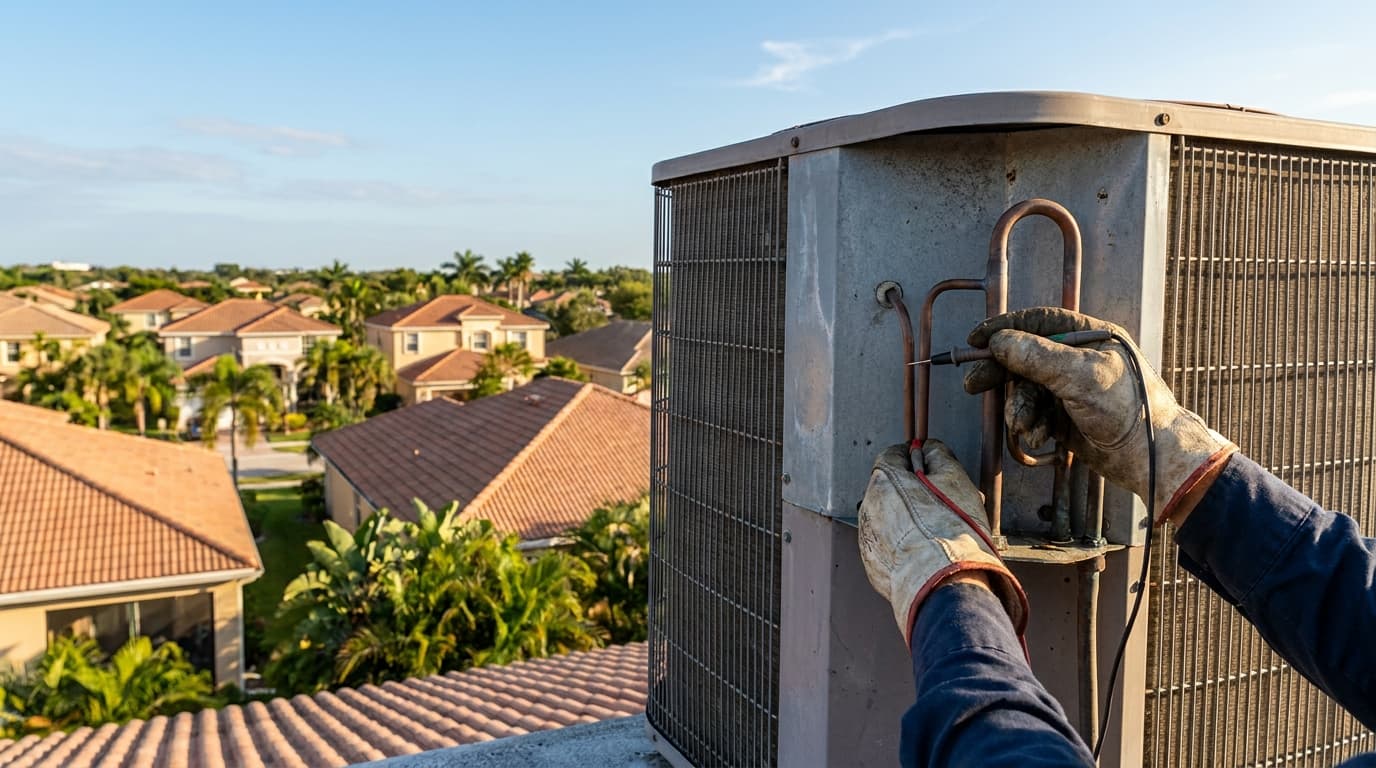

You've finished school or you're close to it. You can braze, diagnose, recover charge, and talk to customers without sounding green. Then the licensing questions start.
Do you need a license, a certification, both, or neither? Can you work as a tech before you become a contractor? Does a side job count if it's small? What changes if you cross a state line for work?
Most new people in this trade get tripped up because HVAC licensing requirements aren't one rule. They're a stack of rules. Federal rules govern refrigerant handling. State rules govern contractor licensing. Local rules and project thresholds can decide whether a job that looked simple is suddenly regulated.
This is the part that matters in the field. If you misunderstand the stack, you can do good technical work and still end up noncompliant.
Your Guide to HVAC Licensing in 2026
If you're new to the trade, the confusion usually starts with one bad assumption. You think there must be one HVAC license that covers everything. There isn't.
The cleanest way to understand HVAC licensing requirements is to separate them into three buckets. First, there's the federal credential tied to refrigerant handling. Second, there are state contractor licenses that control who can legally run jobs, contract with customers, and take responsibility for the work. Third, there are local and project-specific rules that can change when permits, registration, or monetary thresholds kick in.
That distinction matters because your legal path depends on your role. A new tech working under a licensed business has one set of requirements. The person who opens the shop, bids the replacement, pulls the permit, and signs the contract has another.
Most licensing mistakes don't come from bad intentions. They come from treating federal certification, state contractor licensing, and local job limits as if they were the same thing.
In practice, I'd tell any promising helper or junior tech to stop asking one broad question like “Do I need a license?” Ask better questions instead.
The upside is that the maze gets simpler once you put the rules in the right order. Start with the one universal federal requirement. Then figure out whether you're staying on the technician track or moving toward contractor status. After that, match your state's rules to the kind of work you plan to do.
The One HVAC Credential Everyone Needs EPA 608
Before you worry about contractor boards, local permits, or whether a state has loose employee-level rules, lock down EPA Section 608 certification. This is the foundation.
The only federally mandated credential for all HVAC technicians operating in the United States is EPA Section 608 certification, and it's legally required in all 50 states and Washington, D.C. for anyone handling refrigerants, according to Career Karma's overview of HVAC license requirements by state. If your work involves installation, recovery, charging, or disposal tied to refrigerants, this is not optional.
Why EPA 608 comes first
Think of EPA 608 like your baseline legal clearance to touch refrigerant work. A state may or may not require an employee-level HVAC license. A city may or may not have local registration. None of that overrides the federal rule on refrigerants.
The reason is straightforward. Refrigerant handling has environmental and safety consequences, so the Clean Air Act puts that requirement above the patchwork of state rules. If you're brand new and only remember one thing from this article, remember this one.

A lot of confusion starts when people hear that some states don't license HVAC technicians at the employee level. They take that to mean they can work on anything. That's wrong if refrigerants are involved.
Practical rule: If your hands are going anywhere near refrigerant handling, get EPA 608 squared away first.
What the certification types mean
EPA 608 is not one flat category in everyday use. The certification is commonly understood through four tracks:
| Certification type | Typical scope |
|---|---|
| Type I | Small appliances |
| Type II | High-pressure systems |
| Type III | Low-pressure systems |
| Universal | Covers all types |
For a working tech who wants flexibility, Universal usually makes the most practical sense because it removes guesswork about what equipment you can legally service. If you're still early in your career, broad coverage gives you more room to move between service calls, install work, and future employers.
What doesn't work is putting this off because you're “just helping” or “only assisting a lead tech.” If the task involves refrigerant handling, the credential matters. Shops that run clean don't play games with that line.
Technician vs Contractor Understanding Your Role
Many careers falter early concerning this point. A certified technician and a licensed contractor are not the same thing, and the law doesn't treat them the same way.
A technician does the skilled hands-on work. A contractor takes legal and financial responsibility for the project. That difference affects who can sign contracts, who can pull permits, who carries the business liability, and who the state expects to answer when something goes wrong.
You are a technician if
You're usually a technician when you work as an employee under a licensed HVAC company or under a licensed contractor where your state requires that structure. You diagnose systems, replace components, commission equipment, and perform service or install tasks assigned through the business.
In that role, your focus is usually on credentials, training, and documented experience. EPA 608 sits at the center if refrigerants are part of your work. Beyond that, your company may want additional trade certifications, but the legal burden for the contract itself usually sits with the licensed business.
Here's the practical test. If you aren't the one selling the job under your own business name, pulling permits, or assuming legal responsibility for code compliance, you're probably operating as a technician.
You are a contractor if
You're acting as a contractor when the customer hires you or your company to perform the work. You bid the project, sign the agreement, collect payment, and stand behind the job in the eyes of the state and the customer.
That role usually means more than passing a trade exam. It often includes business registration, proof of insurance, and sometimes bonding or financial requirements. If you're building toward ownership, it's smart to understand how contractor business insurance fits into that risk picture before you open the doors.
A simple side-by-side view helps:
| Question | Technician | Contractor |
|---|---|---|
| Who performs the work? | Employee or supervised worker | Business owner or licensed responsible party |
| Who signs the customer contract? | Usually not the technician | Contractor or contracting business |
| Who pulls permits? | Usually the company | Licensed contractor or company representative |
| Who carries legal responsibility for the project? | Limited to job duties and conduct | Primary business and regulatory responsibility |
If you want to stay in the field and grow your technical value, the technician path can be a strong career. If you want to sell jobs and run a company, you'll eventually need to satisfy contractor licensing rules where your state requires them.
What doesn't work is blurring the line. The moment a tech starts taking independent jobs under the table, using a personal invoice, or acting like the business without the right license, the role changes even if the van still looks unofficial.
Navigating State Contractor Licensing Requirements
State contractor licensing is where the easy answers end. This is the part of HVAC licensing requirements that changes the most from one state to the next.
Some states expect a long runway of supervised experience before you can even apply. Others put heavier weight on exams, financial responsibility, or project size. According to Insureon's review of HVAC contractor licensing requirements, state requirements range from 18 months to 4 years of experience, and project thresholds range from $500 to $50,000 depending on jurisdiction.
What states usually look at
Most contractor boards care about the same categories, even if the details are different.

One area that catches new business owners is bonding. If your state requires it, don't treat it like a last-minute paperwork item. This overview of contractor bonding requirements is useful if you're trying to understand what the bond is protecting and why boards ask for it.
How the rules change from state to state
The variation is not small. It changes how you plan your career.
Texas requires four years of practical experience within the state framework described in the Insureon summary. Florida requires a much broader contractor track that includes training plus trade, business, and finance exams in that same source. Alabama requires 3,000 hours, or 18 months, of experience under a licensed contractor and a $15,000 performance bond before licensure, also noted in the Insureon breakdown.
Project thresholds vary just as much. In the same source, California is listed at over $500, Arizona at over $1,000, Louisiana and Mississippi at over $10,000, and Kentucky at over $50,000 for commercial work.
A short video can help if you want a visual walkthrough of how state rules differ in practice:
The takeaway is simple. Don't copy your cousin's path from another state and assume it works in yours. It might not even come close.
Common Licensing Traps and How to Avoid Them
Most expensive mistakes in this trade are not technical mistakes. They're paperwork and scope mistakes.
The trap I see most often is the belief that a small job is automatically outside licensing rules. Sometimes a state threshold does matter. Sometimes it doesn't. And if refrigerant work is involved, federal rules still apply regardless of the invoice amount.
The small job mistake
The most dangerous sentence in HVAC startup talk is, “It's just a little side job.”
That's how people drift from employee work into unlicensed contracting without realizing it. A tech starts with a condenser swap for a friend, adds materials, handles the invoice personally, and suddenly the work looks a lot more like contracting than helping.
Wolters Kluwer notes an often-missed distinction between project-based licensing thresholds and broader contractor licensing rules, and reports that 32% of HVAC startup violations in 2025 stemmed from misinterpreting these thresholds, especially in tiered states, in its piece on HVAC contractor license confusion.
The job doesn't have to feel “big” to become a licensing problem. It only has to cross the line your state cares about.
A practical way to stay out of trouble is to ask these questions before any side work:
The moving state problem
The second trap hits people who relocate or work near state borders. They assume their experience or license transfers cleanly. Often it doesn't.
The problem usually isn't skill. It's documentation. One state may want hours logged under a particular license classification. Another may define supervised experience differently. If your records are vague, you can lose months sorting it out.
What works is boring but effective. Keep copies of employment dates, supervisor names, work categories, and any state registrations tied to your role. If you ever plan to become a contractor, your paperwork matters almost as much as your wrench time.
How to Verify a License and Build Client Trust
Being properly licensed is one thing. Proving it to a homeowner fast is another.
Most states offer some kind of online lookup through a licensing board or agency portal. In theory, that's enough. In real life, those systems can be clunky. Search fields vary, statuses aren't always obvious to customers, and homeowners often don't know whether they should be checking a business name, a license number, or an individual qualifier.
How verification usually works
A homeowner or property manager should typically verify a contractor by checking the relevant state board database and matching the legal business name, status, and trade classification. If the company says it's insured or bonded, the customer should confirm that separately because a state lookup doesn't always package everything together in one clean view.
That gap matters in trust-sensitive work. HVAC customers aren't just buying equipment. They're letting someone into their home, often during an urgent failure, and they want proof that the company is legitimate.
For a plain-language walkthrough of what customers usually need to confirm, this guide to contractor license verification is useful.
Turning compliance into trust
One way to reduce friction is to give customers a single profile that shows verified business details instead of making them hunt across multiple systems. HomeProBadge is one example. It verifies identity, licensing, and insurance, then presents that information in a shareable profile a pro can send before the estimate or attach to follow-up communication.

This also helps customers compare companies more intelligently. For example, if a homeowner is evaluating options for reliable AC repair in Orlando, they're usually looking for more than a truck and a promise. They want proof that the company is licensed and insured before they authorize expensive work.
A license satisfies the board. Clear verification satisfies the customer.
What doesn't work is telling people “we're fully licensed” and expecting that sentence alone to close the trust gap. Customers have heard it too many times. Show the proof cleanly and early.
Your HVAC Licensing Action Checklist
The best way to handle HVAC licensing requirements is to treat them like a career build, not a one-time form. If you do the steps in the right order, you avoid rework.
The mistake is trying to jump straight to “How do I start my own company?” before your foundation is in place. A stronger path is to earn the federal credential, build supervised experience, document everything, and then match your contractor application to the exact state where you plan to operate.
A working plan for new technicians
Use this as your operating checklist.

What to document from day one
Documentation is where a lot of otherwise qualified people get stuck. Recent 2025 to 2026 data cited in Zero HVACR reports that 44% of HVAC license applicants in multi-state regions were rejected due to non-aligned hour documentation, which is why state-specific recordkeeping matters so much, as summarized in this guide on state-by-state HVAC licensing requirements.
Keep a file that includes:
If your work expands into adjacent indoor air or duct services, it also helps to understand how other trade credentials are framed. A useful example is Purified Air Duct Cleaning's guide to certification, which shows how specialized credentials can affect customer expectations even when the licensing framework is different.
The techs who move forward fastest usually aren't the most talented on day one. They're the ones who keep clean records, work under the right supervision, and don't take shortcuts that become licensing problems later.
If you want one place to present your verified credentials to homeowners, HomeProBadge gives contractors and home service pros a public profile that can show verified licensing, insurance, identity, and proof of past work in a format customers can review quickly.