


Your water heater quits on a Sunday morning. The basement floor is wet, the shutoff valve won't budge, and a technician is standing at the door promising a fast fix. A neighbor gave you the number, the truck looks professional, and the company profile says “licensed and insured.” You're tempted to get the water running and ask questions later.
That's how homeowners get burned. “Licensed and insured” isn't one verification. It's two separate evidence chains, and either one can fail. A license may belong to an individual rather than the company doing the work. Insurance may have expired, been cancelled, or exclude the loss you're worried about.
Slow the job down long enough to capture the plumber's identity, verify the license with the proper authority, confirm the policy with the insurer, and require records showing what work was completed. A badge, yard sign, certificate, or marketplace profile is only a claim until an authoritative record supports it.
Why Hiring a Licensed and Insured Plumber Matters Right Now
A plumbing license is supposed to connect a person or company to a government authority that can define the permitted trade scope, track status, and record discipline. Insurance serves a different purpose. It should provide a financial response when the plumber causes property damage, injures someone, or leaves a completed installation defective.
Those protections don't overlap. A licensed plumber can still present stale insurance evidence. An insured business can still send someone whose individual credential doesn't authorize the work. Treating the phrase as a single checkbox creates false confidence.
The pressure makes shortcuts dangerous
Emergency plumbing creates the perfect conditions for bad decisions. A burst pipe, sewer backup, or failed water heater makes the first available technician look more attractive than the properly documented one. Paid lead marketplaces and friendly referrals can also make an unknown contractor feel familiar before you've checked the legal business name.
Ask for these details before work begins:
Requirements vary sharply by location and project. Tennessee's attorney general advises consumers to check local building-code offices and confirm relevant insurance, while contractor licensing applies before bidding on projects valued at $25,000 or more under the state rule described in the Tennessee consumer guidance. Smaller jobs can still involve local licenses, permits, or inspections.
Practical rule: If the plumber won't give you the information needed for an independent lookup, don't authorize non-emergency work.
The right question isn't “Are you licensed and insured?” The right questions are “Which legal entity is contracting with me, what work does its license authorize, what policy covers that entity, and what records will prove this job was permitted and tested?”
How to Confirm the Plumber's License
Don't accept a license card as proof. Capture the information, then verify it in the government database that issued the credential. The card can be outdated, altered, or connected to a different person or company.
Record the fields that matter
Ask the plumber for the following before signing:
Then search the state contractor licensing board, plumbing board, or local building department. Match the spelling of the legal entity, not just the phone number or brand on the truck. If the plumber says the company is authorized to contract for the work but the database shows only a personal journeyman credential, stop and ask who is legally responsible for the project.
A personal license and a company contractor authorization are not interchangeable. This is the scope mismatch that catches homeowners who thought they had done their homework.
Check the jurisdiction and scope
Rules differ by location. Some states regulate plumbing statewide, while others leave important licensing decisions to cities or counties. Even where a state license exists, a municipality may control permits, inspections, or local registration.
Use the plumber license requirements guide as a starting point for identifying the likely authority, then confirm the current rule with the relevant government office. A directory or commercial guide can help you find the right agency, but it isn't the authority that validates the credential.
For every lookup, save:
The lookup date matters because status changes. A license that was active when the estimate was written may not be active when the work starts. Recheck for major projects, especially when the plumber asks for a deposit long before mobilization.
A valid result still doesn't prove quality, permit compliance, or that the person at your door works for the listed company. It proves that a particular credential exists in a particular jurisdiction. Keep the license check separate from the insurance check, then connect both records to the contract and job address.
How to Read a Certificate of Insurance
Most homeowners request a certificate of insurance and then glance at the logo. That isn't verification. A certificate of insurance, or COI, is evidence that coverage was represented at the time it was issued. It isn't the insurance contract, and it doesn't automatically prove that your loss will be covered.
Read every field
The certificate should identify:
Call the insurer or agent using the contact information on the certificate. Ask whether the policy is currently in force, whether the named insured matches the contracting business, and whether the proposed plumbing work falls within the policy's coverage. For material jobs, ask whether the contracting party or licensing authority should be listed as certificate holder or additional insured. Don't assume the certificate's formatting answers that question.
A concrete example helps. Maryland plumbing license compliance requires at least $400,000 per occurrence, consisting of $300,000 in general liability and $100,000 in property-damage coverage, according to the Maryland plumbing insurance requirements. That is a jurisdiction-specific floor, not a universal recommendation for every residence or project.
Watch for the silent failure
The most dangerous combination is a valid license paired with expired, cancelled, or mismatched insurance. The plumber can truthfully say “licensed,” and the company may once have been insured, while neither fact protects the job in front of you.
Save the COI, the insurer's confirmation, and the date you made the call. Recheck annually and before every major project. If the named insured is a person but the contract is with a corporation or limited liability company, demand an explanation and corrected evidence before paying.
For broader context on what liability policies can mean for service businesses, general liability insurance guidance can help you identify questions to raise with the agent. It still doesn't replace direct confirmation of the plumber's actual policy.
What License and Insurance Do and Don't Guarantee
A license and an insurance policy answer different questions. Neither document proves that the crew will protect your framing, pull the right permit, pressure-test the system, or return when a concealed leak appears.
| Check | What it proves | What it does NOT prove |
|---|---|---|
| License | A government authority recognizes a person or business under a stated classification and jurisdiction | Current workmanship, project-specific competence, permit compliance, or authorization for every type of plumbing |
| Insurance | A policy is associated with a named insured, insurer, dates, and stated coverage types and limits | That your particular loss is covered, that the limits are adequate, or that the plumber will successfully file a claim |
| Permit and inspection record | The authority received the project information and recorded required inspection results | That every concealed detail was installed perfectly or that future maintenance will be unnecessary |
| Proof of work | The plumber documented conditions, tests, materials, and completed work | That an undocumented area is safe or code-compliant |
A Nebraska legislative study describes municipal licensure as a mechanism intended to ensure plumbers are competent, trained, and insured. That purpose matters, but the license still isn't a workmanship warranty. The strongest protection pairs credential verification with production evidence.
Demand evidence from the job itself
Before closeout, require dated photos of concealed piping, shutoffs, supports, venting, pressure or leakage tests, permit identifiers, and final inspection results. Keep the invoice, approved scope, inspection approval, and your sign-off together.
This is also why insurance advice from other service trades can be useful without being directly transferable. For example, pest control business insurance offers context about liability risks in a different home-service business, but a homeowner still needs plumbing-specific policy confirmation.
Homeowners often say “the plumber was licensed and insured” after a dispute. That sentence doesn't tell you whether the company pulled a permit, tested the drain-waste-vent system, or left evidence of concealed work. Ask for the records that answer those questions.
The same discipline applies when comparing contractors. Bonded and insured contractors aren't automatically suitable for your job just because the phrase appears in an advertisement. Verify the bond, license, insurance, entity, scope, and project records separately.
Contracts, Scope, and Payment Practices That Protect You
A verbal promise is a poor record when a wall is open and water is moving. Put the deal in writing before the plumber starts, even for urgent repairs. The document should identify the legal contractor, job address, customer, exact work, materials, exclusions, price, payment schedule, warranty terms, and responsibility for permits.
Put responsibility on paper
Your agreement should state:
Don't let a low bid distract you from missing scope. The cheapest estimate often becomes expensive after change orders, code corrections, wall repairs, and disputes over unpaid suppliers. Pay through a traceable method such as a credit card or check, and keep receipts. Cash removes useful evidence and weakens your dispute trail.
Set a deposit that reflects materials the plumber must order, not the contractor's need for working capital. For a larger project, release the balance only after required testing, documentation, inspection approval, cleanup, and your written acceptance.
Make proof of work part of the closeout
The ICC/NAHB survey reported improper framing notches or bores as the leading plumbing violation at 51%, followed by missing or improper nail plates at 44%, improperly supported pipes at 36%, and failed DWV leakage tests or inadequate venting at 24% each in the cited survey (ICC/NAHB research survey). Those findings explain why a clean-looking finished wall isn't enough.
Require these records before final payment:
If you're installing a whole-house filter or similar equipment, practical Water Filter Advisor installation tips can help you prepare questions about placement, access, shutoffs, drainage, and maintenance. The plumber still owns the responsibility for the actual code requirements and the documentation for your jurisdiction.
Red Flags and Emergency-Job Scams to Watch For
Emergency fraud doesn't always look amateurish. A clean truck, polished invoice, and confident technician can still hide a missing permit, a mismatched identity, or a cancelled policy. The National Insurance Crime Bureau reportedly found contractor-fraud reports increased 38% from 2023 to 2025, with storm-affected communities especially exposed (contractor-fraud reporting).
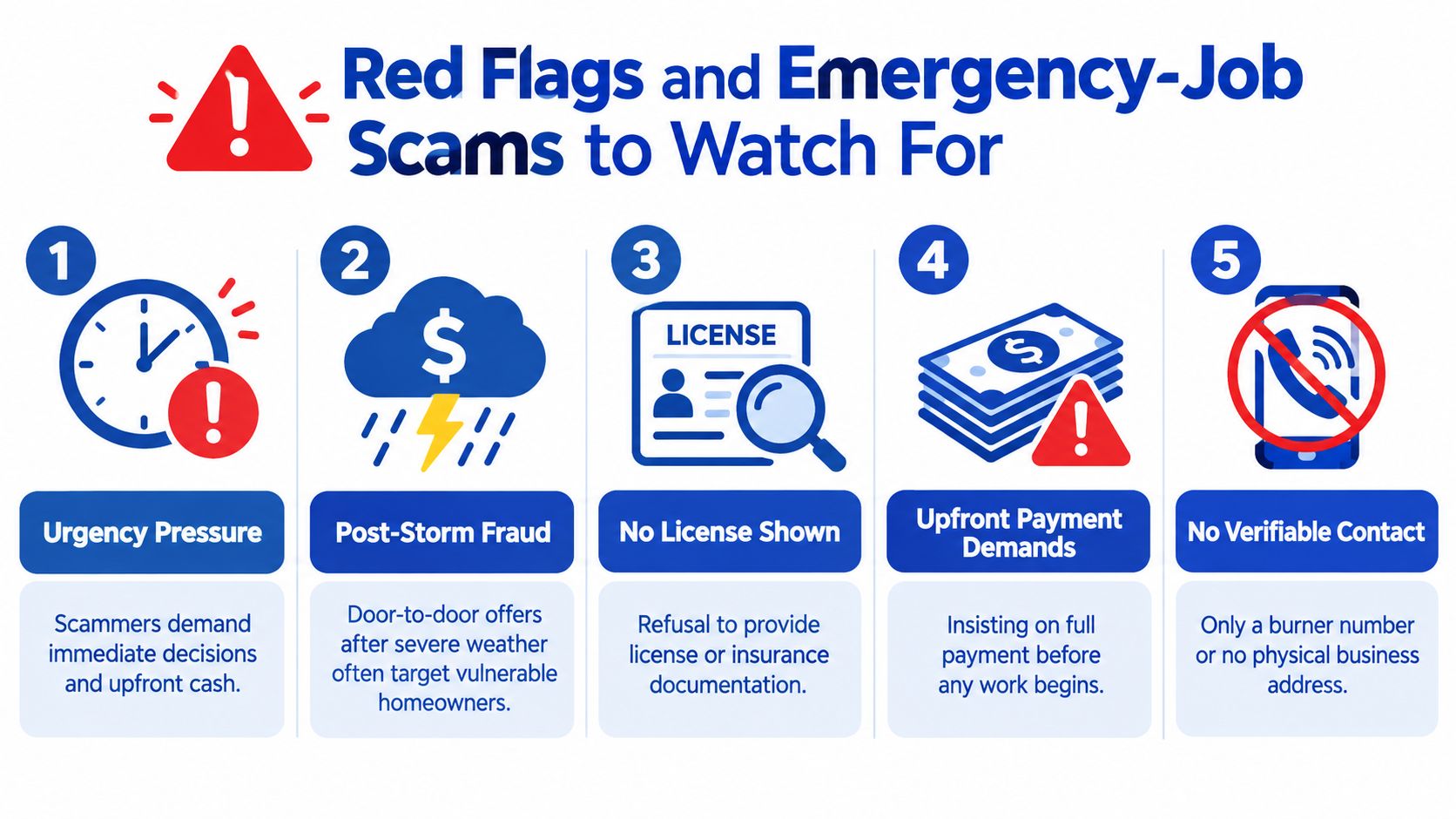
Walk away, or pause the non-emergency portion of the job, when the plumber:
A license lookup won't catch every problem. Fraudulent or noncompliant work can involve valid-looking advertising, missing permits, identity mismatches, or insurance that no longer applies. Capture the evidence while the technician is still on site.
Save the plumber's legal identity, license number, insurer and agent contact, written scope, payment terms, permit number, before-and-after photos, invoices, and inspection results. If the work is already complete, photograph defects before repairs alter the evidence and notify the licensing authority, insurer, and local building office as appropriate.
How HomeProBadge Simplifies the Whole Verification
The sensible workflow is simple, but homeowners rarely have time to repeat it for every contractor. HomeProBadge provides a verification layer that connects identity, licensing, insurance evidence, and proof-of-work records in a public professional profile. Its TrustBadge can surface the verified legal name, trade classification, and jurisdiction, while job records can connect dated photos, permits, and inspection evidence to completed work.
The platform's annual re-verification is listed at $9.95 per year. That recurring check matters because a certificate that was valid at hiring can become stale later. It doesn't replace checking the state database or calling the insurer for a serious project, but it makes the matching problem visible instead of leaving the homeowner with a static claim.

Homeowners can use the directory to find verified professionals, then cross-check the underlying license and insurance evidence. The platform also provides county-specific permit and inspection context across all 50 U.S. states and 3,143 counties, according to the publisher's product information. For safety questions beyond credentials, such as hot-water pressure control, a plumber may also need to address equipment-specific requirements such as a PLV safety guide for hot water.
Your action plan is straightforward. Search the directory, confirm the license in the issuing database, request a current COI, call the insurer for material jobs, and require dated proof of work, permits, tests, and inspections before final payment.
HomeProBadge helps homeowners find identity-verified plumbing professionals, review licensing and insurance evidence, and connect completed jobs to documented proof of work. Visit HomeProBadge before you authorize the next plumbing job, then use the profile as a starting point for your own license, insurance, permit, and inspection checks.