



You're standing in a hot room, looking at product pages or contractor quotes, and the same label keeps showing up: 1.5 ton AC unit. It sounds specific. It sounds like the answer should be simple. But the confusion starts fast.
One seller says a 1.5 ton unit is fine for a bedroom. Another says it works for a small apartment. A chart says one thing. A neighbor says another. Then you notice two units with the same 1.5 ton label can have very different power use, different monthly bills, and different comfort.
That's where many first-time buyers get stuck. They assume the main question is, “How many square feet does a 1.5 ton AC cover?” In practice, that's often the wrong starting point. The better question is, under what heat-load conditions is a 1.5 ton unit the right fit, and what will it cost to run over time?
A shaded, well-insulated room and a sun-beaten room of similar size can behave like two different homes. One may cool easily. The other may struggle, even with the same square footage. That's why so many AC decisions go sideways. People shop by tonnage first and load conditions second.
This guide is meant to clear that up in plain language. You'll learn what the “1.5 ton” label means, why it refers to cooling capacity rather than electrical use, how real room conditions change sizing, and why inverter efficiency can matter just as much as tonnage if you care about long-term cost and comfort.
By the end, you should be able to look at a 1.5 ton AC unit and judge it more like an HVAC pro would. Not by guessing from a room-size chart alone, but by connecting capacity, airflow, room conditions, and operating cost into one practical buying decision.
zing Your AC Correctly Matters](#introduction-why-sizing-your-ac-correctly-matters)
- Why first-time buyers often get tripped up
- What matters in the real decision
- Tonnage measures heat removal
- Why buyers often confuse capacity and electric use
- Why BTU and kW both appear on spec sheets
- Airflow still affects whether a 1.5 ton unit delivers its rated capacity
- What matters in the actual decision
- Two rooms can look similar and need different capacity
- Why two equal-size units can cost very different amounts to run
- What that difference feels like in day-to-day use
- Turning power use into a realistic monthly budget
- What a proper install usually includes
- Electrical planning starts with the nameplate
- What to verify before the crew leaves
- Permits and inspections protect the homeowner
- Compare the unit to the room's daily heat pattern
- Look at lifetime cost, not just sticker price
- Choose a contractor who sizes around the room, not the label
Introduction Why Sizing Your AC Correctly Matters
A common buying story goes like this. Someone has a main bedroom, studio flat, or compact living area that gets uncomfortably warm in the afternoon. They ask a simple question: “Should I get a 1.5 ton AC unit?” Then they search online and get buried in mixed answers.
One chart says the room is too small. Another says the unit could cool much more space. A contractor glances around and recommends replacing the old system with the same tonnage. Someone else says to go a little bigger “just to be safe.” That advice sounds practical, but cooling systems don't work like buying a larger fan.
An air conditioner has to do two jobs at once. It has to lower temperature, and it has to manage moisture. If it's too small, it can run too hard and still struggle. If it's mismatched for load conditions, it can leave the room uncomfortable in a different way.
A cooling system should match the room's heat load, not just its floor area.
That difference matters most when buyers focus only on square footage. Two rooms can measure almost the same and still need different cooling because one has strong sun through west-facing glass, weak insulation, a taller ceiling, and more internal heat from people or appliances.
Why first-time buyers often get tripped up
The label itself causes part of the confusion. “1.5 ton” sounds like weight or electricity use. It isn't either one. It's a cooling-capacity class. Once you understand that, the rest of the decision gets easier.
Buyers also tend to compare only sticker price. That can backfire. Two 1.5 ton systems may cool the same nominal amount of heat, but one can cost noticeably more to run over time if its efficiency and compressor design are different.
What matters in the real decision
When you're choosing a 1.5 ton AC unit, keep these questions in front of you:
If you hold onto those three ideas, the buying process becomes much less confusing.
What a 1.5 Ton AC Unit Really Means
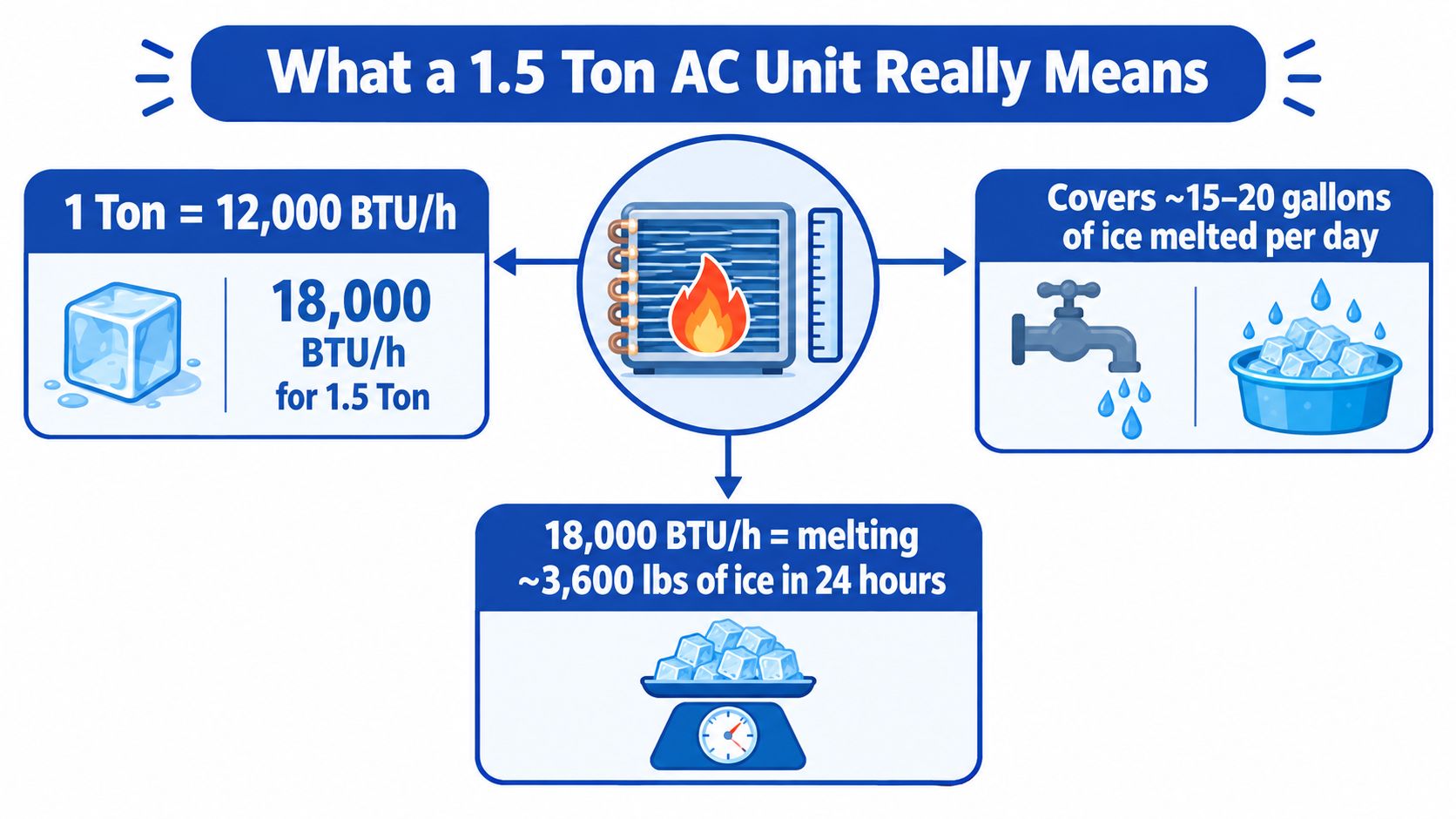
A 1.5 ton AC unit belongs to a cooling capacity class of about 18,000 BTU per hour. In metric terms, that is roughly 5.28 kW of cooling output according to this cooling-capacity explanation.
That number describes how much heat the system can remove from a space in an hour under rated conditions. It gives you a starting point for sizing. It does not tell you, by itself, whether the unit fits your room well or what your monthly bill will look like.
Tonnage measures heat removal
The word ton comes from older refrigeration language. In home AC buying, it helps to read tonnage as the unit's heat-removal size.
A simple way to picture it is a room filling with heat the way a sink fills with water. Sun through glass, warm attic surfaces, air leaks, people, lights, and appliances all keep adding heat. The AC has to remove heat fast enough to keep up. A 1.5 ton unit has a certain hourly heat-removal pace. Whether that pace is enough depends on how quickly heat is entering that specific room.
That is why two bedrooms with nearly the same square footage can land on different sizing recommendations. One may stay comfortable with 1.5 tons. The other may struggle or short cycle because the heat load is different.
Why buyers often confuse capacity and electric use
Cooling output and electric draw are related, but they are not the same thing.
Two systems can both be labeled 1.5 ton and remove a similar amount of heat, yet one can use less electricity over a season. The difference usually comes from efficiency rating, inverter versus fixed-speed operation, outdoor temperature, and installation quality. For a first-time buyer, this is one of the most useful distinctions to learn early, because the label on the box tells only part of the cost story.
Why BTU and kW both appear on spec sheets
Manufacturers and sellers often list cooling performance in BTU per hour and sometimes in kilowatts of cooling. Those are two languages for the same idea. Both describe output.
What buyers pay for, however, is electrical input over time. That is why capacity answers, “How much heat can this unit remove?” while efficiency answers, “How much electricity will it take to do it?”
Airflow still affects whether a 1.5 ton unit delivers its rated capacity
Capacity on paper and comfort in a real house are not always the same.
A 1.5 ton system is commonly matched with about 600 CFM of airflow using the usual 400 CFM per ton rule of thumb. If airflow is too low because of a restrictive filter, undersized ductwork, or poor setup, the system may not remove heat and humidity the way the rating suggests. If airflow is too high, the air may pass the coil too quickly and moisture removal can suffer.
What matters in the actual decision
Keep these points in mind when you see 1.5 ton on a quote or product page:
Once you read tonnage as heat-removal capacity instead of a shortcut for room size or energy cost, AC sizing starts to make a lot more sense.
How Much Space a 1.5 Ton Unit Can Cool and What Changes the Math
You measure two rooms and both come out close to 700 square feet. On paper, they look like the same job. In real life, one stays comfortable with a 1.5 ton unit and the other runs longer, feels sticky, and costs more to cool.
That gap is why square-foot charts only get you started.
Published guidance often gives broad coverage ranges for a 1.5 ton AC, and those ranges can look inconsistent at first glance. LG's sizing discussion shows why. Room size matters, but sunlight, insulation, layout, and local climate can shift the result enough that the same tonnage fits one space well and misses in another.
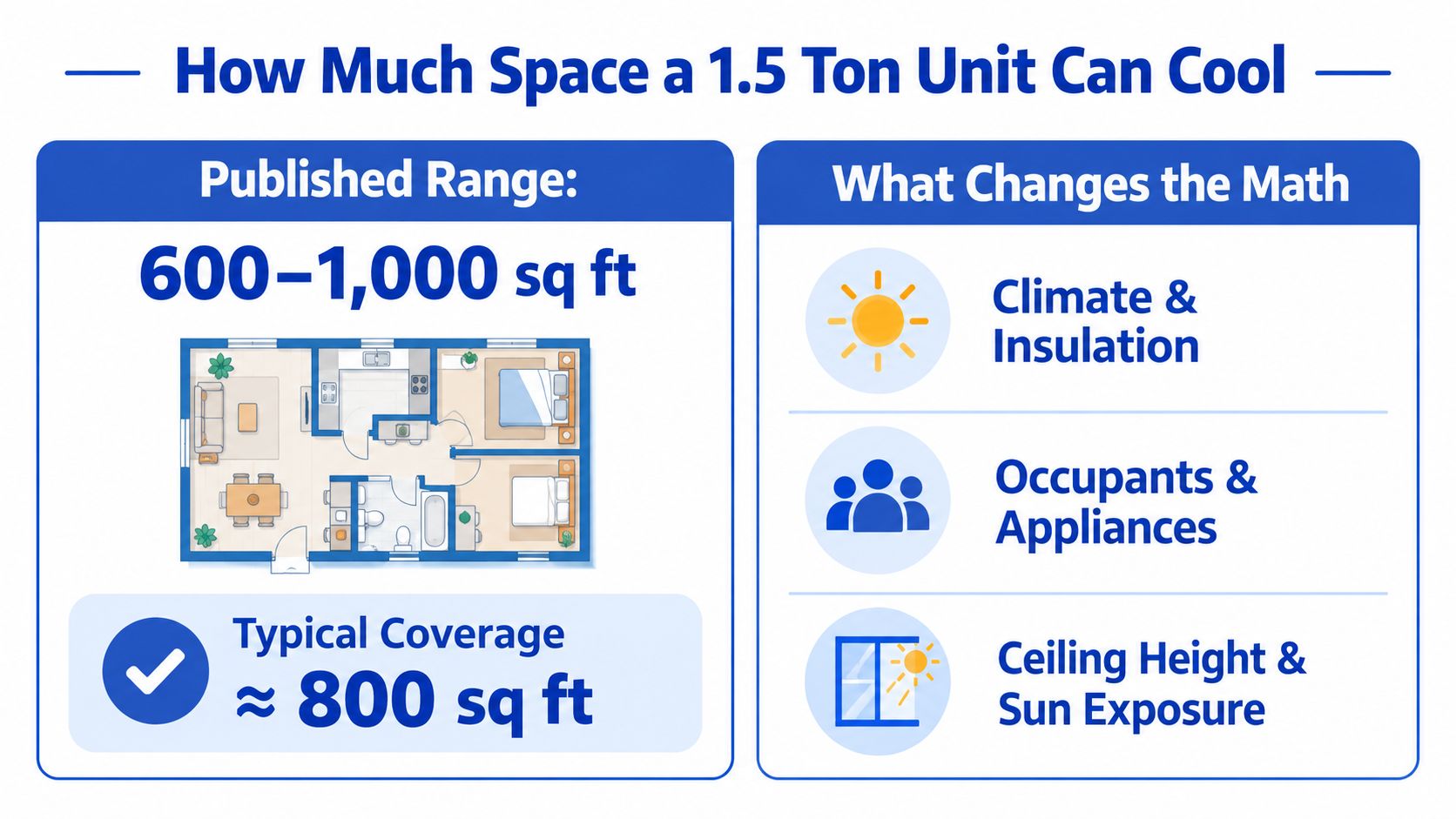
A better way to size is to ask a different question. How much heat enters the room each hour?
Floor area tells you the footprint. Heat load tells you the problem the AC has to solve. Helpful field guidance like this Covenant Aire Solutions advice points buyers toward that same idea.
Here are the conditions that usually change the math:
A useful comparison is a cooler with the lid shut versus one left slightly open. Both coolers may be the same size, but one holds temperature better because less heat gets in. Rooms work the same way.
Two rooms can look similar and need different capacity
A shaded room with good insulation and limited internal heat may be a comfortable match for a 1.5 ton unit. A slightly smaller room with direct afternoon sun, a high ceiling, leaky windows, and two computers can place a heavier load on the system.
That is why square footage alone can point you in the wrong direction. It describes size, not difficulty.
| Room Scenario | Load Factors | Is 1.5 Ton Likely Enough |
|---|---|---|
| Shaded medium room in a well-insulated home | Low solar gain, tighter envelope, moderate occupancy | Likely yes |
| Small top-floor room with strong afternoon sun | High solar gain, roof heat, possible air leakage | Maybe not |
| Compact apartment living room with kitchen heat nearby | Internal appliance heat, people, open layout | It depends |
| Medium room with tall ceiling and weak insulation | More air volume, faster heat gain | May be marginal |
| Bedroom with good shading and limited electronics | Lower internal loads, easier humidity control | Often a better fit |
A room responds to sun, insulation, air leakage, and internal heat. A sizing chart cannot see those details.
Air delivery also affects the result. As noted earlier, a 1.5 ton system is commonly paired with about 600 CFM of airflow. If the duct system is restrictive or the setup is off, the unit may deliver less comfort than its rated capacity suggests.
That matters for another reason many first-time buyers miss. Sizing affects the power bill over the life of the system, not just whether the room gets cool. Two homes with the same floor area can end up with different equipment choices because the harder-to-cool home places a higher load on the AC, and a high-efficiency inverter model can handle that load with a very different operating cost profile than a basic fixed-speed unit.
Efficiency Power Use and Real Operating Costs
A first-time buyer often sees two 1.5 ton units on a quote and assumes the monthly bill will be about the same. That is where many cost surprises begin.
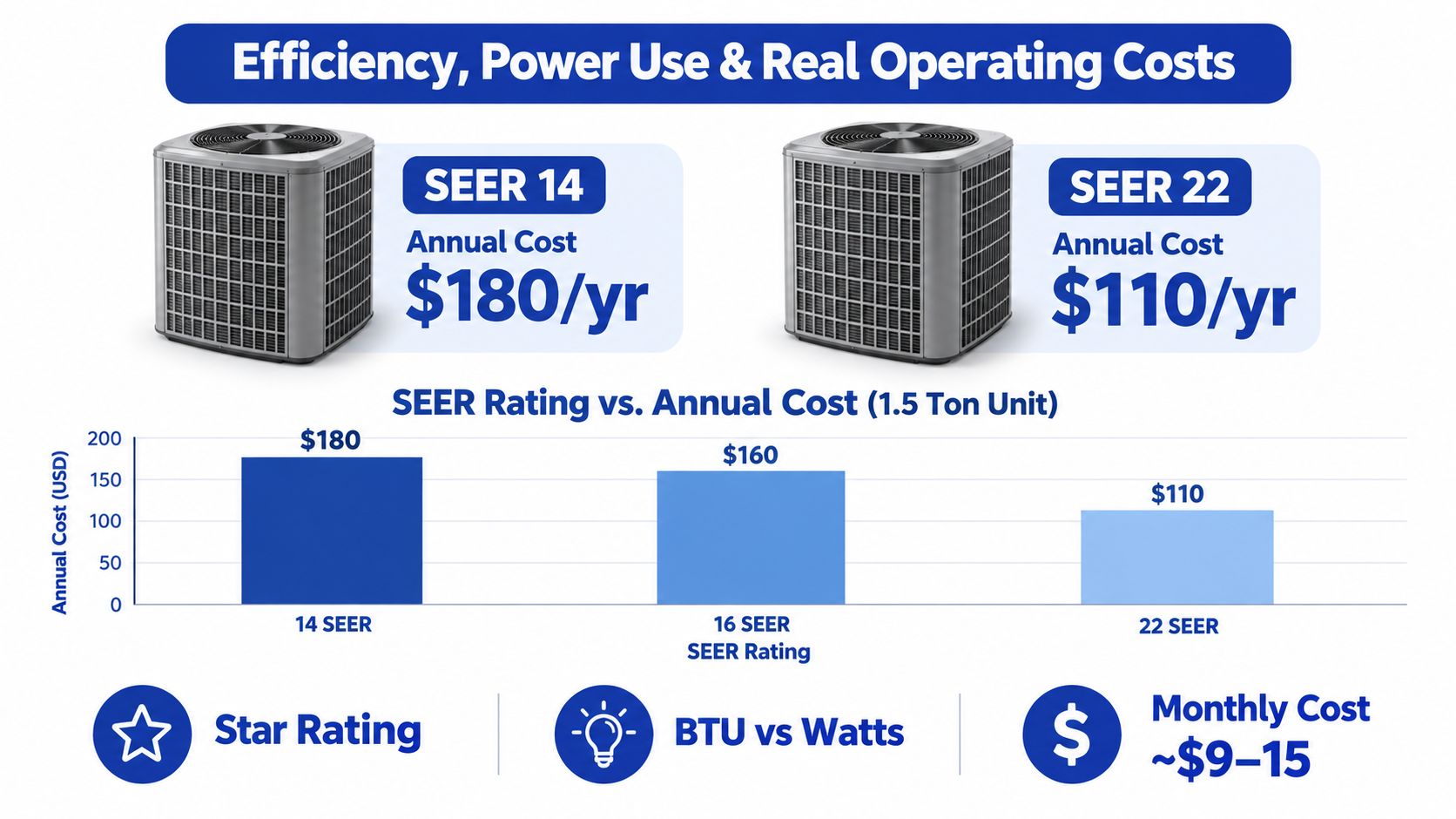
A 1.5 ton label tells you the cooling capacity class. It does not tell you how efficiently the unit turns electricity into cooling, or how well it handles the changing heat load in a real home. Published estimates for this size commonly show a wide spread in hourly electricity use, with inverter models often drawing less power than fixed-speed models under similar conditions, as shown in this AC power consumption calculator data.
Why two equal-size units can cost very different amounts to run
Room size is only part of the story. The harder question is how much heat keeps entering the room through sun, attic heat, leaky windows, appliances, and people.
That is why two homes with similar square footage can produce very different electric bills from the same nominal AC size. A shaded, well-sealed bedroom may let an inverter system settle into a lower-output rhythm for long stretches. A west-facing room with poor insulation can keep the same unit working much harder for much longer.
Efficiency ratings matter here, but operating style matters too. A fixed-speed unit usually cycles on at full output and shuts off when the thermostat is satisfied. An inverter unit can ramp up and down more gradually, which often reduces wasted energy during part-load operation and can keep the temperature steadier.
Independent consumer guidance on 1.5 ton systems makes the same point in plain language. Capacity may stay the same, while power draw shifts based on efficiency and compressor type, as explained in this running-cost overview.
What that difference feels like in day-to-day use
For many homeowners, inverter versus fixed-speed is not just a spec-sheet issue.
It often shows up as:
This video gives a useful visual explanation of how operating cost and efficiency thinking fit into AC ownership.
Turning power use into a realistic monthly budget
A simple estimate starts with three inputs. How many hours you run the AC, your local electricity rate, and whether the unit is likely to spend most of its time at full output or modulating at part load.
That last part is where square-foot charts stop helping. A properly sized inverter unit in a lower-load room may spend much of the day trimming temperature gently. The same size unit in a hotter, leakier room may run closer to its limits. Over a full cooling season, that difference can matter as much as the sticker price.
For a practical cost-planning example, the DLG Electrical aircon running cost guide gives a plain-language way to connect power draw with real bills. If you are also weighing long-term ownership, this central air conditioning repair overview helps explain the service side of the decision.
A lower purchase price can still lead to a higher lifetime cost if the unit uses more electricity year after year.
Installation Electrical Requirements Permits and Inspections
A 1.5 ton AC can be perfectly sized on paper and still underperform after installation. That usually happens because the room's heat load was only part of the job. The wiring, drainage, airflow, and permit work decide whether the system runs safely and delivers the comfort you expected.
What a proper install usually includes
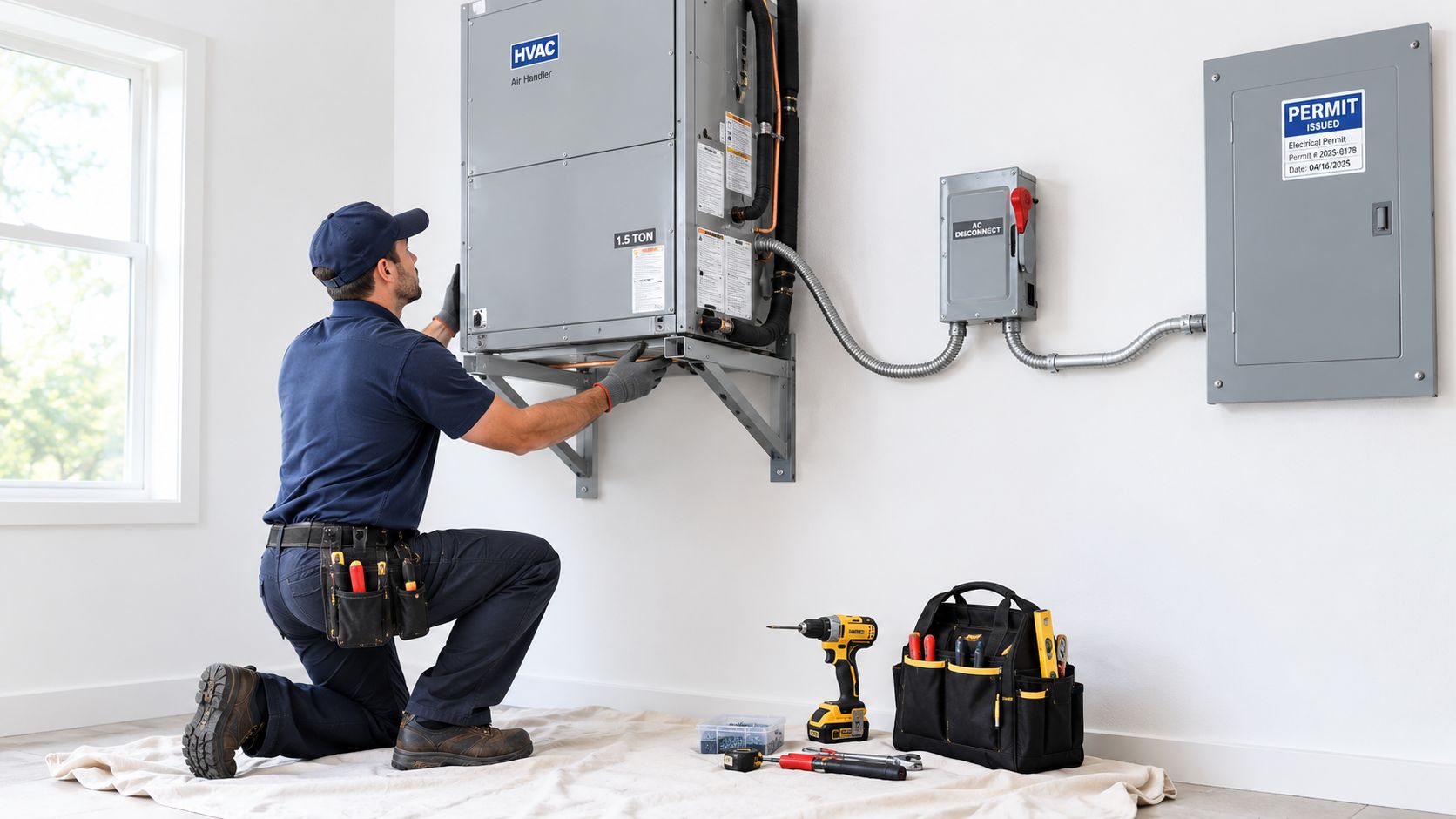
A split-system install is part mechanical setup and part quality control. The crew has to place the indoor and outdoor units correctly, connect refrigerant lines, route condensate so water drains where it should, verify airflow, and complete the electrical connection to code. Each step affects performance.
Two homes can buy the same 1.5 ton unit and get different results. A tighter, shaded room may let an inverter unit settle into lower-speed operation for long stretches. A sunnier or leakier room can keep that same system working harder, which raises energy use and puts more pressure on installation details like airflow and line set routing.
If you want a brand-specific example of what a professional install process can involve, this Trane AC installation page from Comfort Experts is a useful reference point.
Electrical planning starts with the nameplate
The electrical setup should follow the actual equipment, not the tonnage label alone. A 1.5 ton unit tells you cooling capacity. It does not tell you the exact breaker size, wire size, or maximum overcurrent protection the manufacturer allows.
The clearest place to verify that is the unit nameplate and installation manual. Manufacturers such as Carrier publish equipment documents that list values like minimum circuit ampacity and maximum fuse or breaker size for specific models. That is the information your installer and electrician should use.
Two 1.5 ton systems can draw power differently. Compressor design, efficiency rating, and inverter controls all affect electrical demand. That is one reason lifetime operating cost can differ even when the cooling capacity matches.
What to verify before the crew leaves
Use this short checklist during planning and installation:
A system that powers on has passed only the first test. Correct installation means it can run safely, control humidity, and operate at the efficiency you paid for.
Permits and inspections protect the homeowner
Permits create a paper trail for the work and trigger inspection where local rules require it. That can catch problems with electrical connections, disconnect placement, equipment location, or code compliance before those issues become your expense.
Local requirements vary, so review this guide to HVAC permit requirements by location before work starts. It helps you ask practical questions such as who is pulling the permit, what inspection is expected, and whether electrical work is included in the scope.
It also helps to ask for proof of licensing, insurance, and a written scope of work. Those documents do not guarantee a flawless job, but they make shortcuts harder to hide.
How to Choose the Right 1.5 Ton Unit and a Trusted Contractor
Two rooms can both measure about the same size and still need different cooling strategies. A shaded guest room used at night places a very different demand on an AC than a sunny home office with two computers running all afternoon. That is the frame to use when choosing a 1.5 ton system. Start with the heat the room collects, then look at what that choice will cost you to run over the years.
Compare the unit to the room's daily heat pattern
A 1.5 ton label tells you the cooling class. It does not tell you whether one model will fit your room better than another.
A fixed-speed unit works a bit like a car that is either pressing the gas pedal or stopping. It cools, shuts off, then starts again. An inverter unit adjusts its output more gradually, which often helps in spaces that stay warm for long stretches or need steadier temperature control.
That difference matters most in real rooms, not chart examples:
The better question is not “Which 1.5 ton unit is best?” The better question is “Which 1.5 ton unit matches how this room gains heat and how often it will run?”
Look at lifetime cost, not just sticker price
Many first-time buyers focus on purchase price because it is easy to compare. Operating cost is slower to notice, but it stays with you every month.
If your AC runs often, a higher-efficiency inverter model can lower the long-term bill and keep the room more even. If the room is used only occasionally, paying more upfront may be harder to justify. The right choice depends on run time, local weather, and how sensitive you are to temperature swings and humidity.
This is why two buyers can make different smart choices even if both are shopping for a 1.5 ton unit.
Choose a contractor who sizes around the room, not the label
Equipment choice and installer quality are tied together. A good contractor should ask how the room is used, when it gets the most sun, what is above it, how many people spend time there, and what appliances add indoor heat. Those questions help separate a quick guess from a load-aware recommendation.
If you want a practical checklist, this guide on how to choose a contractor gives you a clear starting point.
When comparing bids, check for a few signs that the contractor is treating the job seriously:
HomeProBadge is one option homeowners may use to review contractor trust signals such as identity, licensing, insurance, and proof of past work in one place.
A trustworthy contractor helps you choose a system that fits the room's actual heat load and your expected operating cost, not just the square footage printed on a chart.
Final Takeaways and Next Steps for Your Cooling Project
A 1.5 ton AC unit isn't a magic room-size answer. It's a cooling-capacity class. The question is whether your room's heat load matches that capacity and whether the unit's efficiency and installation quality will support comfortable, affordable operation.
If you remember only a few things, remember these:
A practical next step is to ask any contractor for a load-aware recommendation, not just a chart-based guess. Then compare efficiency options, verify the electrical plan against the unit nameplate, and confirm permit responsibility before signing anything.
That approach won't make every decision effortless, but it will make your decision far more informed.
If you're trying to choose a 1.5 ton AC unit and want more confidence in who installs it, HomeProBadge helps you review verified home service pros, including HVAC contractors, through visible proof such as licensing, insurance, and documented work history. It's a practical way to connect the equipment decision with the trust decision, which is often where cooling projects succeed or fail.