


Interior asbestos removal in the U.S. commonly runs about $5 to $20 per square foot, but your final project total can change substantially once testing, permits, containment, disposal, clearance, accessibility, and restoration are added. You're likely reading this because a remodel, home sale, or contractor visit just raised a question you didn't plan for, and now you're staring at numbers that don't line up. Don't treat that confusion as a failure on your part. Asbestos pricing is confusing because contractors aren't always quoting the same job, even when they use the same square footage.
Why Asbestos Removal Cost Quotes Differ
A homeowner asks two companies to price the same basement ceiling. Both measure the same area. One bid looks manageable, the other looks startling, and the cheaper one arrives first with a single per-square-foot rate and very little paperwork.
That gap usually isn't about square footage at all. One contractor may have priced removal labor only, while the other priced a complete project with containment, waste handling, and closeout. Until you compare what's inside each scope, the price difference tells you almost nothing.
What a Headline Rate Can Hide
Consumer cost guidance commonly places interior removal at about $5 to $20 per square foot, while roof and shingle work can reach roughly $50 to $120 per square foot, according to Angi's asbestos removal cost guidance. That spread alone shows why location matters. It also shows why a single rate can mislead you if you don't know which material and setting it describes.
A low quote may exclude items you'll still need to pay for later:
First question to ask: Don't ask why one bid is cheaper. Ask what work, documentation, and assumptions each bid actually includes.
Hidden conditions widen the gap further. Material behind a wall, under flooring, or inside a duct system can change quantity and access after work begins. A contractor who states those assumptions up front may look more expensive on day one and cost less by the final invoice.
What Determines Asbestos Removal Cost
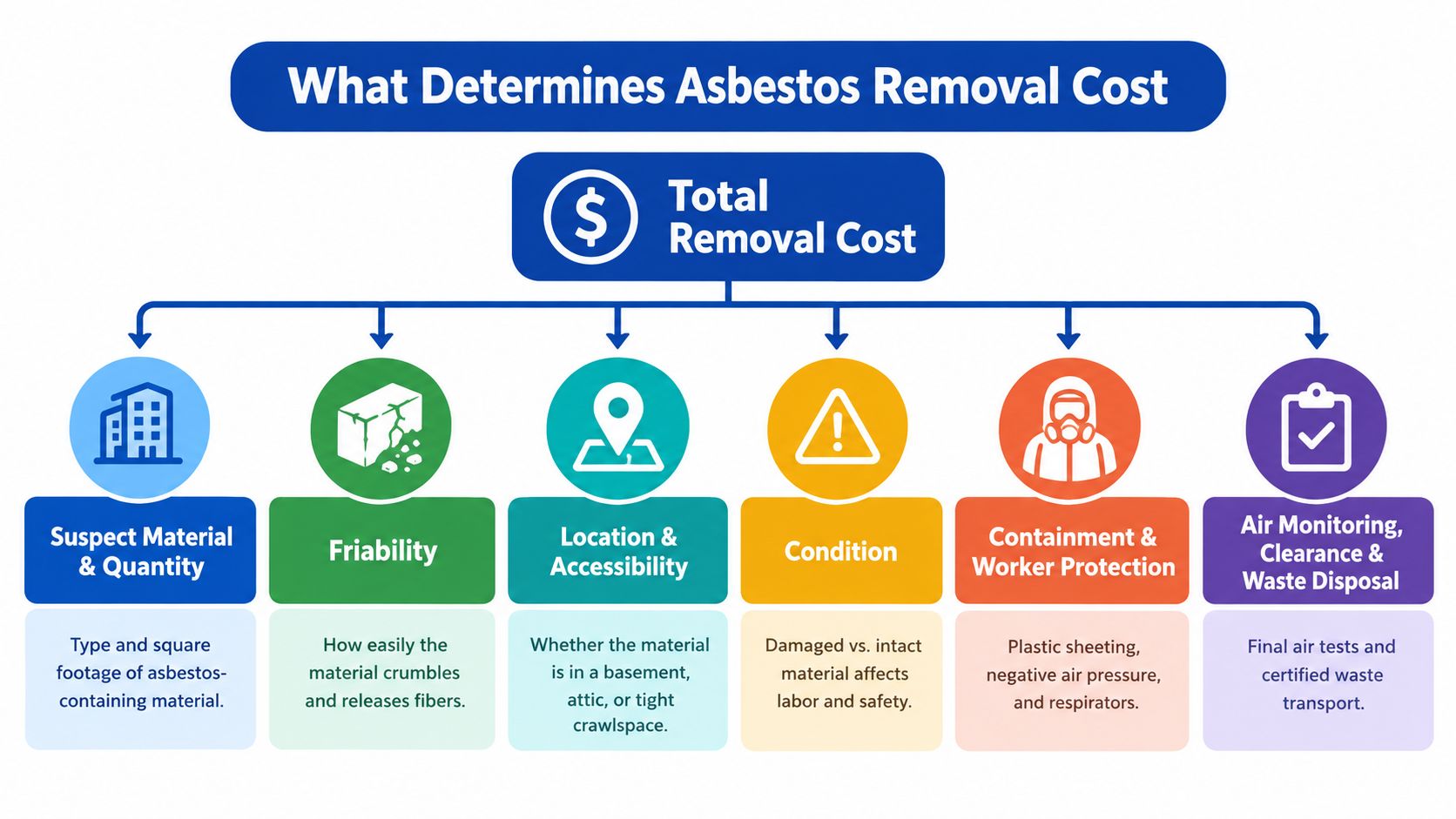
Think of asbestos removal cost as a stack, not a single rate. Each layer adds labor hours, equipment time, or fees. Change one layer and the total moves, sometimes more than a change in square footage would.
The diagram below builds that stack from the material itself through to disposal and clearance.
The Material Itself
Start with what the material is and how much of it exists. Floor tile, pipe insulation, sprayed coating, and drywall joint compound don't behave the same way when disturbed, so they don't price the same way either. Quantity matters, but it's only the first input.
Friability is the next driver, and it's where many homeowners get confused. Friable material can be crumbled or damaged easily, so it can release fibers more readily when disturbed. That usually means more intensive containment, wet methods, and decontamination than intact, nonfriable material requires.Condition works the same way. Damaged, deteriorating material demands more careful handling than material that's intact and stable. A contractor pricing crumbling insulation isn't padding the bid. They're pricing the controls that damage makes necessary.
Access, Containment, and Labor
Location and accessibility shape labor hours directly. Material in an open, empty room is simpler to isolate than material in a tight attic, crawlspace, or duct run. Harder access means slower work, more setup, and often more protective measures for the crew.
Containment is where much of the cost sits. Plastic enclosures, negative air pressure equipment, worker decontamination setups, and sealed boundaries keep fibers from migrating into occupied areas. These safeguards take time to build, run, and remove, and that time is billable.
EPA cost analysis identifies labor as a major component of friable asbestos removal and notes that training, medical surveillance, protective equipment, wet removal, handling, bagging, transportation, and approved landfill disposal all contribute to total project cost, as detailed in the EPA regulatory cost analysis for asbestos. You're not paying only for someone to pull material out. You're paying for trained people to do it without spreading contamination.
Monitoring, Waste, and Repair
Air monitoring during work and clearance testing afterward add another layer. So does waste packaging, transport, and disposal at an approved facility, because greater waste volume increases haulage and landfill charges. Finally, there's repair. Removal often leaves a surface that needs rebuilding, and that restoration frequently sits outside the removal price entirely.
When a quote seems high, trace it through this stack. You'll usually find the money in containment, labor, or disposal, not in the square footage.
Compare Costs by Material and Location
Material and location explain most of the variation you'll see between projects. The same square footage in a floor and on a roof are different jobs, with different access, weather exposure, and disposal logistics.
The table below uses the supplied consumer ranges introduced earlier. Read it as a comparison tool, not as a quote for your home.
| Material or project type | Supplied cost range | Main cost consideration |
|---|---|---|
| Flooring | $5 to $15 per square foot | Whether tile and mastic come up intact or break apart |
| Walls and drywall | $8 to $13.50 per square foot | Dust control and the extent of surface demolition |
| Attic insulation | $11 to $25 per square foot | Confined access and difficult isolation |
| HVAC ductwork | $35 to $55 per square foot | System complexity and hard to reach runs |
| Roof and shingles | $50 to $120 per square foot | Fall protection, weather, and heavy disposal |
| Encapsulation | $2 to $6 per square foot | Sealing in place instead of removing |
Why Location Changes the Price So Much
Roofs sit at the top of the range for practical reasons. Crews need safe access at height, protection from falls, and containment that works outdoors in changing weather. Heavy roofing waste also costs more to move and dispose of than lightweight interior material.
Attics and ductwork cost more for the opposite reason. The spaces are tight, hot, or awkward, and isolating them from the rest of the house takes extra work. Duct systems are especially sensitive because they connect directly to the air your household breathes, so sealing and cleaning standards matter a great deal.
Flooring and walls tend to sit lower because access is usually straightforward and the work area is easier to enclose. Even there, condition can push you toward the top of the range. Intact tile that lifts cleanly is a different job from brittle material that crumbles as it's handled.
Encapsulation Is Not Just Cheaper Removal
Encapsulation means sealing asbestos in place rather than removing it, and it's often quoted at about $2 to $6 per square foot. That lower figure tempts many homeowners, but encapsulation isn't automatically suitable. Condition, friability, your renovation plans, and regulatory requirements determine whether leaving material in place is appropriate.If you plan to disturb the material later, encapsulation may only delay removal and its cost. Ask a qualified professional whether management in place is defensible for your situation before you choose it on price alone.
Estimate a Sample Interior Removal Project
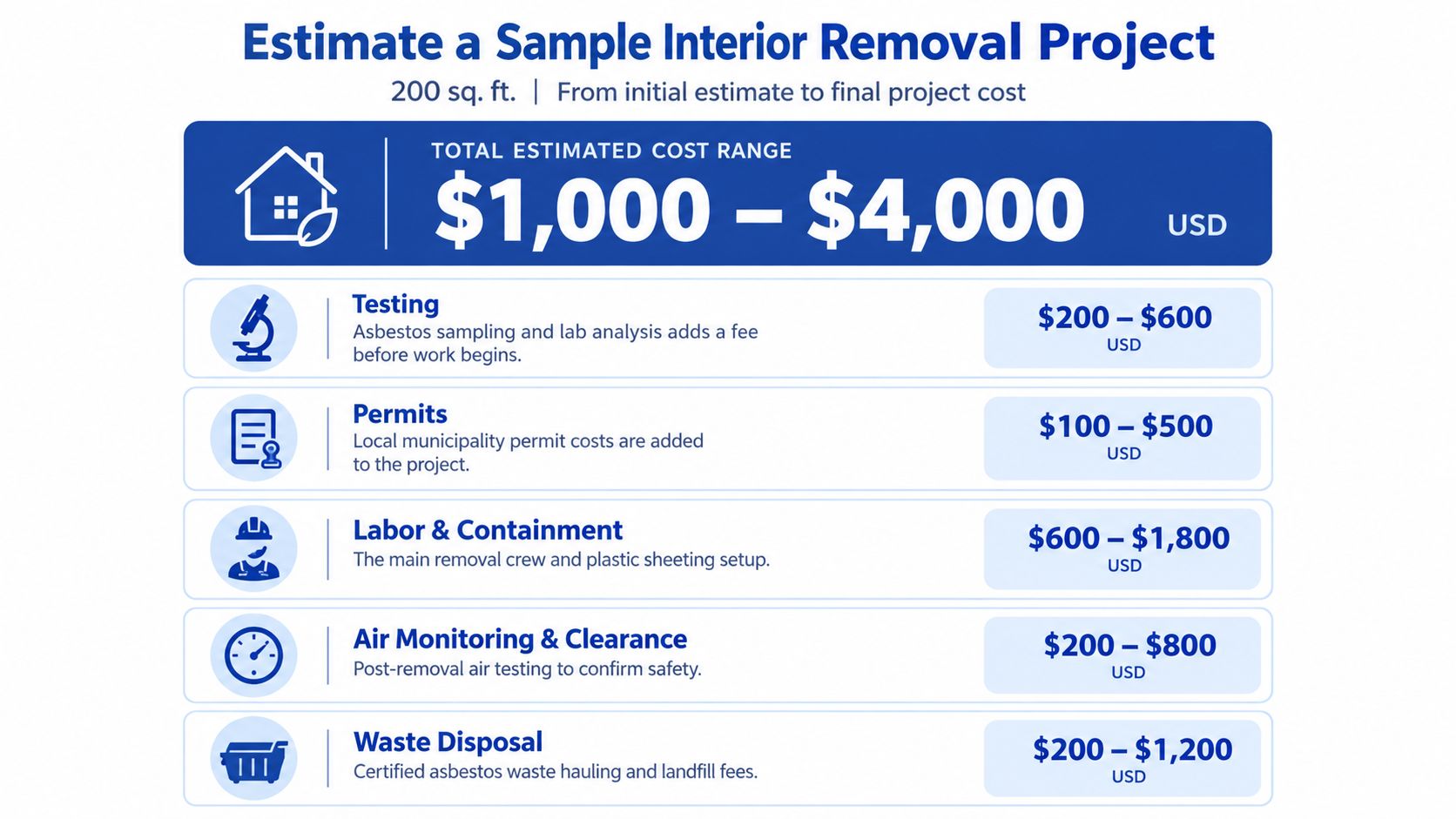
Numbers get clearer when you attach them to a specific area. Take a hypothetical 200-square-foot interior removal, roughly a medium bedroom ceiling or a section of basement flooring.
The estimate below starts with the removal range for that area, then shows the layers that may sit outside it.
Start With the Removal Range, Not a Final Price
At the interior rates covered earlier, 200 square feet implies a broad removal range of approximately $1,000 to $4,000 before possible testing, permits, repairs, and disposal charges. That's your starting point. It isn't a quote, and treating it as one is where budgets break.
Now run the same area as roof work. At the same 200 square feet, roof removal could theoretically range from $10,000 to $24,000, reflecting access challenges, fall protection, weather exposure, specialized containment, and heavier disposal logistics. Same area, completely different project. That's the clearest proof that location can matter more than size.
Build a Simple Budget Worksheet
Instead of guessing a single total, list each component and mark whether your quote includes it:
That last item catches people off guard during remodels. If your asbestos work is part of a larger renovation, it helps to understand how demolition and rebuilding are priced separately, which is why reviewing typical bathroom demolition costs and what's included can sharpen the questions you ask about restoration exclusions.
Fill in the worksheet with each contractor's answers before you compare totals. A bid that leaves three rows blank isn't cheaper. It's unfinished.
What Happens During a Removal Job
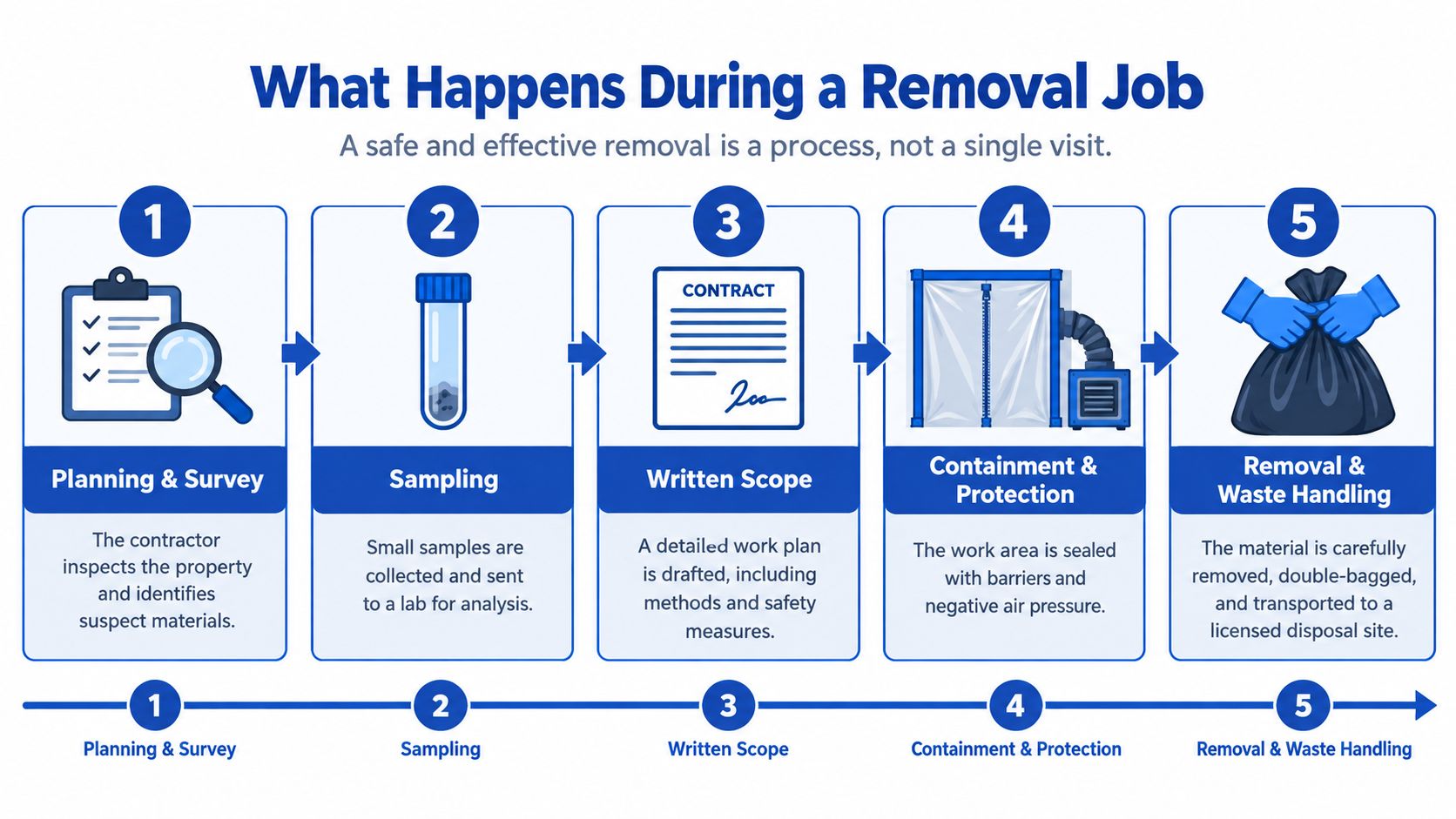
A professional project runs as a controlled sequence, not a single demolition visit. Knowing the order helps you spot missing steps in a quote before you sign anything.
The process overview below shows how a job typically moves from survey through disposal.
From Survey to Written Scope
Work begins with planning and a survey appropriate to what you intend to disturb. Sampling confirms whether suspect material contains asbestos, since you can't determine that by looking at it. The contractor then produces a written scope describing methods, boundaries, and safety measures.
A technically sound quote should identify the containment boundary, pressure-control method, worker decontamination setup, clearance standard, waste classification, disposal facility, and responsibility for regulatory notices, according to EPA guidance on asbestos project practices. If your quote doesn't name these items, ask for them in writing. Vague scopes create expensive disagreements later.
This stage is also where insurance belongs in the conversation. High risk demolition and abatement work carries specific coverage needs, and resources explaining demolition insurance for builders can help you understand what protection a contractor should carry before anyone disturbs material in your home.
Containment, Removal, and Closeout
Next, the crew seals the work area, establishes negative air pressure, and sets up decontamination for workers entering and leaving. Removal follows using wet methods where required, with material bagged, sealed in leak-tight containers, and transported for proper disposal.
The short video below walks through how professionals control a work area during removal, which makes the containment steps easier to visualize.
After removal, the crew cleans the area and clearance or other required testing confirms the space meets the applicable standard before reoccupation. Restoration comes last and is often a separate contract. At each stage, ask three questions. Who performs this step, what's included in the price, and what happens if concealed material changes the scope?
Get the answer to that last question in writing before work starts. Change order terms agreed in advance cost far less than terms negotiated mid-project.
Compare Bids and Check Contractor Credentials
Bid comparison works only when every contractor prices the same scope. Your job is to force that consistency, politely and in writing, before you look at totals.
Ask Every Contractor for the Same Breakdown
Request itemized pricing that separates each cost layer. When contractors use different structures, rebuild their bids into one shared format on a single page so you can compare line by line.
Then pin down the assumptions underneath those numbers. Ask what material type and quantity each bid assumes, what access conditions they've priced, and how concealed material triggers a change order. A contractor who won't state assumptions is asking you to accept open-ended risk.
Watch for warning signs while you compare. A verbal quote with no written scope, no mention of disposal documentation, and no clearance step aren't minor omissions. They're the places where cost and liability transfer to you.
Verify Credentials and Proof of Work
Price comparison is only half the decision. Verify the contractor's identity, relevant licensing or qualifications for asbestos work in your jurisdiction, and current insurance before you sign. Ask for documentation directly rather than accepting verbal assurance, and confirm who will perform the work on site.
Proof of completed work matters too. Look for a public professional profile, verification records, reviews tied to real projects, and before and after evidence you can inspect. If you're still building your shortlist, a structured approach to choosing a contractor and checking credentials gives you a repeatable method instead of relying on whoever calls back first.
Finally, ask what you'll receive at closeout. Waste manifests, disposal receipts, and clearance results are your permanent record that the job was handled properly. Contractors who compete on documented scope rather than headline price usually make comparison easier, not harder.
Manage Insurance Permits and Cost Savings
Insurance, permits, and savings get tangled together in most homeowners' minds, and that confusion leads to bad assumptions. Separate them, and each decision gets clearer.
Who Pays Is a Different Question From How Much
Routine testing or removal is generally treated as homeowner due diligence rather than an insured loss. Coverage may become possible when asbestos is disturbed by a covered event such as fire, storm, or a burst pipe. A planned renovation, pre-sale inspection, or demolition can therefore create a large cash requirement even if you're fully insured.
Don't guess where you stand. Get a written insurer determination before you budget around coverage, and confirm local permit and notification requirements before assuming approval timelines. Understanding how professionals document coverage through an insurance verification process for contractors also helps you ask for the right paperwork from anyone you hire.
Affordability pressure is real, and it isn't evenly shared. A 2025 Australian government-commissioned report found median maximum willingness to pay of $5,000 for low-income households, $8,000 for middle-income households, and $10,000 for high-income households, while reported project costs could reach tens or hundreds of thousands of dollars, as summarized in guidance on asbestos testing and insurance coverage. That gap is exactly why you should ask about local grants, remediation loans, and insurer review instead of assuming upfront payment is your only option.
Savings That Don't Create Risk
Safe savings come from scope discipline, not skipped safeguards:
Bypassing testing, containment, proper disposal, or clearance isn't a saving. It's a deferred cost with health and liability attached.
The honest cost control question isn't how to make the job cheap. It's how to make every dollar visible before you commit to spending it.
Build a Safer Removal Budget
History backs up everything you've read so far. A foundational EPA analysis estimated a national average of $4.94 per square foot for friable asbestos removal, while reported state-level observations ranged from approximately $1.00 per square foot in Pennsylvania to $13.75 in Missouri, according to the EPA economic analysis of asbestos in schools. Even in a federal study, local conditions produced a wide spread. Your home will be no different.
The checklist below turns that reality into a sequence you can follow.
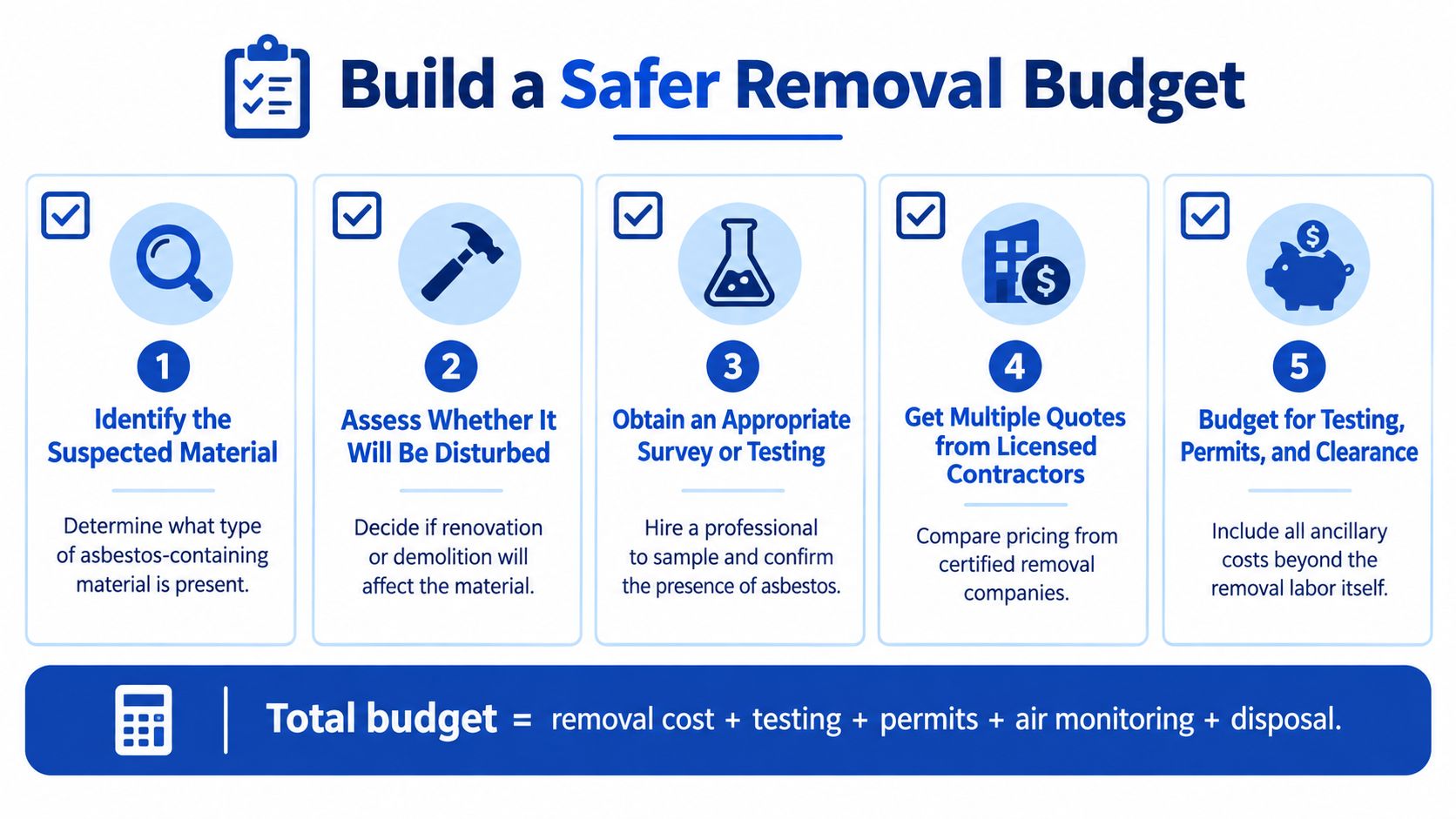
Your Decision Path in Order
Start by identifying the suspected material and whether your plans will disturb it. Undisturbed material and material in the path of demolition lead to very different decisions, so don't price removal before you've answered that question.
Next, obtain an appropriate survey or testing where needed, and define whether the right response is removal or management in place. Then collect written scopes that make testing, containment, disposal, clearance, and restoration visible as separate lines, with assumptions about concealed conditions stated plainly.
Before signing, compare more than totals:
The cheapest headline rate isn't necessarily the lowest total cost once exclusions surface. A complete, documented scope protects your budget and your household at the same time, and that's the standard every quote should have to meet.
When you're comparing asbestos contractors, verified credentials and documented proof of past work matter as much as the price on the page. HomeProBadge helps homeowners find identity, licensing, and insurance verified professionals with structured reviews and real project evidence, so you can check who you're hiring before work begins. Visit the directory, review contractor profiles and job documentation, and choose a pro whose scope and credentials you can verify with confidence.