



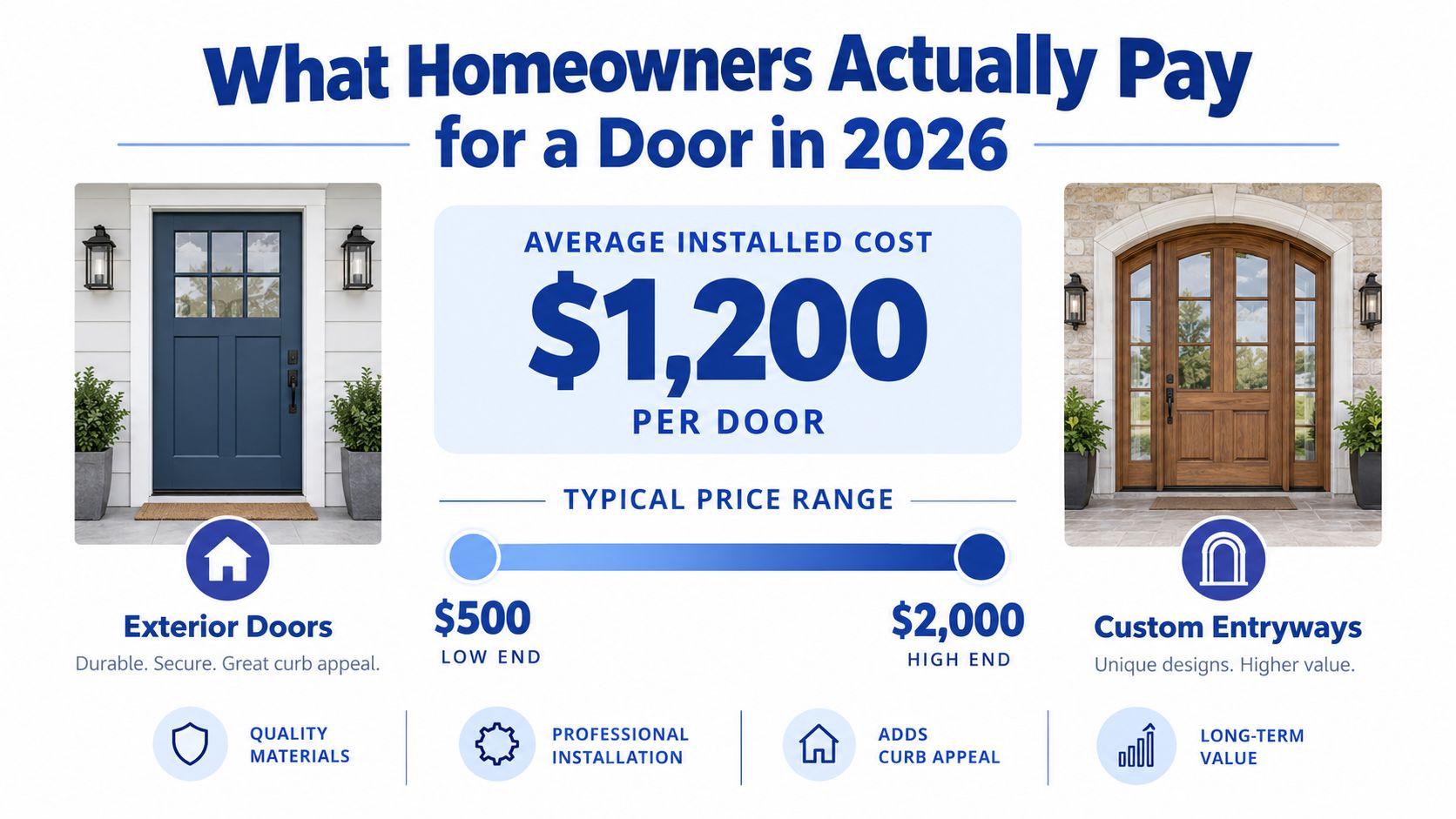
A typical 2026 U.S. door installation costs about $1,219, with most projects landing between $498 and $1,961. Exterior doors and custom projects routinely break above that band.
You're probably looking at three quotes that appear to describe the same replacement. One says $900, another says $1,400, and the third is higher still. The difference usually isn't contractor greed. It's buried scope: one price may cover a slab in an existing frame, while another includes a complete prehung system, weatherproofing, trim, disposal, and repairs to the rough opening.
The cost of a door is controlled by three decisions:
The categories matter, too. Interior doors, exterior entry doors, patio doors, storm doors, garage doors, French doors, and oversized custom openings don't belong in one average. Use the category that matches your project, then compare the installed scope rather than the door panel alone.
For garage projects, a separate guide to garage door installation cost, Cleveland can help because garage doors involve different equipment, tracks, springs, and opener considerations. For every other door, the pages ahead decode what each line on a typical quote really means.
ze, and Finish Adjustments Plus Money-Saving Tips](#regional-size-and-finish-adjustments-plus-money-saving-tips)
- Save money without weakening the installation
- Questions every bidder should answer
- Put the agreement in writing
What Homeowners Actually Pay for a Door in 2026
The national installed benchmark is $1,219, with most door projects between $498 and $1,961, according to HomeAdvisor's door installation cost guide. That figure is useful as an orientation point, but it isn't a universal price tag. Interior installations commonly fall toward the lower end, while exterior units cost more because they need stronger materials, thresholds, weather seals, and more careful installation.
Home Depot's door installation cost guide places exterior-door installation at $1,002 to $1,527 per door, based on its September 2026 calculator. Another HomeAdvisor estimate puts exterior-door installation at an average of $1,457, with a typical range of $547 to $2,375. Those figures explain why a front-door quote can look expensive even when the door itself seems reasonably priced.
Start with the opening, not the slab
A slab-only replacement makes sense when the existing frame is square, dry, stable, and compatible with the new hinges and latch. A prehung replacement includes the slab already mounted in its frame, which gives the installer a chance to correct alignment and renew the threshold and seals.
Rough-opening work is different. If the installer finds rot, an unusual opening, damaged framing, or a mismatch in size, the job becomes carpentry rather than a simple swap. That's where two apparently identical bids separate sharply.
Practical rule: Ask every contractor whether the quote replaces only the slab, the complete prehung unit, or the surrounding opening. If the answer isn't written down, the quote isn't comparable.
Match the category to the job
Interior doors are usually a finish and fit decision. Exterior doors are performance systems. Patio and sliding doors bring larger panels, tracks, glass, and weather seals. Specialty openings can require new framing, custom trim, or structural review.
A whole-house package can reduce the per-door price because the contractor makes fewer separate trips and repeats the same installation process across several openings. Home Depot's published tiers show interior installation at $159 to $798 each for 1 to 2 doors, $129 to $718 each for 3 to 5 doors, and $99 to $698 each for 6 or more doors. The lower per-door range reflects scale, not a lower standard of workmanship.
You'll get a more honest budget by deciding the scope first, then selecting the material and finish. Starting with a retailer's slab price reverses that order and almost guarantees surprise add-ons.
Average Price Ranges by Door Type
The table below uses the available national benchmarks for installed door work. Where the verified data doesn't provide a separate low, middle, and high figure for a category, the table uses a qualitative description rather than pretending there's a precise national range.
| Door Type | Low End | Mid Range | High End | Typical Inclusions |
|---|---|---|---|---|
| Interior door | $99 to $159 per door for larger packages | Low hundreds per door | Up to $698 to $798 per door for smaller or more involved projects | Slab or prehung unit, hinges, basic fitting |
| Exterior entry door | $547 | About $1,000 to $1,500 | $2,375 | Door system, frame or jamb work, threshold, weather seals, basic hardware |
| Patio or sliding door | Varies by size and configuration | Higher than a basic interior replacement | Can become a specialty project | Panel or panels, track, frame, seals |
| Storm door | Project-specific | Project-specific | Project-specific | Door, closer, frame fitting, basic hardware |
| Specialty or custom entryway | Above mainstream averages | High-variance | Custom projects can exceed $5,000, and some deluxe front doors reach $12,000 or more | Custom unit, specialty glass or wood, detailed fitting |
| Garage door | Separate category | Separate category | Can range from $400 to $3,000 | Door panels, tracks, springs, and related hardware |
The benchmark for interior work is especially useful. HomeAdvisor lists hollow-core doors at roughly $30 to $400, solid-core doors at $70 to $500, and solid-wood doors at $160 to $590, with installation labor often adding $100 to $300. The installed interior total commonly reaches $363 to $1,242, depending on the door and the opening.
The slab is only one component. A complete quote may include the frame, jambs, hinges, threshold, weatherstripping, lockset, trim, disposal, and finish work. It may exclude paint, stain, smart locks, electrical work for keypads, and structural reframing.
For design inspiration, Aureli Construction's door renovation ideas are useful when you're deciding between a standard replacement and a broader entryway update. The design choice should come after the opening and installation scope are clear.
Don't compare a $200 slab with a $1,200 installed system. Compare one written scope with another written scope. That's how you identify whether the spread comes from material, labor, or missing work.How Material and Hardware Drive Door Cost
A $300 door can become a $1,200 invoice because the contractor isn't installing a panel in isolation. The bill may include the frame, threshold, hinges, lock preparation, hardware, shimming, fastening, sealing, trim, and cleanup. Material selection sets the starting point, but hardware and finish determine how far the total travels.
HomeAdvisor's interior-door data illustrates the range. Hollow-core doors run roughly $30 to $400, solid-core models about $70 to $500, and solid-wood doors around $160 to $590, before installation labor. Hollow core is the sensible choice for many bedrooms and closets. Solid core earns its cost where sound control and a heavier feel matter. Solid wood belongs in visible, high-touch areas where grain and repairability justify the premium.
Choose material for the conditions
Exterior material needs a different test. Steel is often the value choice for security and strength, but it can dent. Fiberglass handles demanding exposure and accepts a range of finishes, making it a practical choice when appearance and durability both matter. Composite products can make sense where moisture and dimensional stability are concerns.
Wood creates the strongest visual impression, but it also demands the most disciplined finishing and maintenance. Custom, oversized, patio, French, and garage doors can move far beyond ordinary replacement budgets. CostHelper reports garage doors at $400 to $3,000 and deluxe front doors at $3,000 to $12,000 or more, while other high-end exterior projects can exceed $5,000 installed.
| Material or Hardware | Price Range | Strength | Weakness | Best Use Case |
|---|---|---|---|---|
| Hollow-core interior | $30 to $400 for the door | Light and economical | Limited sound control and impact resistance | Bedrooms, closets, utility rooms |
| Solid-core interior | $70 to $500 for the door | Heavier feel and better sound control | More weight and higher material cost | Bedrooms, offices, bathrooms |
| Solid wood | $160 to $590 for the door | Rich appearance and repairable surface | Requires careful finishing and maintenance | Visible interior rooms and selected entries |
| Steel exterior | Project-specific | Strong value and security | Can dent | Straightforward entry replacement |
| Fiberglass exterior | Project-specific | Stable and finish-friendly | Higher material tier | Exterior doors exposed to weather |
| Composite exterior | Project-specific | Moisture stability | May cost more than basic steel | Humid or demanding climates |
| Specialty glass or sidelights | High-variance | Light and visual impact | Raises material, sealing, and fitting demands | Custom entries and feature openings |
Hardware is not a small add-on
Basic hinges and a builder-grade lockset may be included, but upgraded handles, deadbolts, smart locks, and multi-point systems change both the product price and the fitting time. Premium hardware also needs accurate alignment. A good lock on a poorly squared frame still operates badly.
Budget the hardware and finishing as seriously as the door itself. Treating the slab as the whole budget is how homeowners get quote shock.
Upgrade where the conditions justify it. Fiberglass can be a better long-term choice than wood in a wet location. Decorative glass may be worth paying for when appearance is the priority, but don't assume every glass upgrade improves insulation or security. Ask what performance the upgrade adds and what installation changes it requires.
Labor and Installation Factors That Change the Total
Labor is where a door quote becomes a construction quote. Removal, fitting, weatherproofing, trim, disposal, and opening repairs can outweigh the price difference between two similar slabs.
The cleanest way to review labor is line by line. A contractor who lists each task gives you a way to compare bids. A contractor who writes “install door, materials included” leaves too much room for change orders.
| Line Item | Typical Cost Range | Notes |
|---|---|---|
| Interior installation labor | $100 to $300 | Varies by slab, prehung unit, and frame condition |
| Exterior installation | Part of the typical $547 to $2,375 exterior range | Includes more fitting and weather-sealing responsibility |
| Opening preparation | Project-specific | Adds work when framing is damaged or non-standard |
| Trim and casing | Project-specific | Confirm whether paint or stain is included |
| Weatherproofing | Project-specific | Ask about flashing, threshold sealing, and perimeter sealant |
| Removal and disposal | Project-specific | Confirm whether the old unit leaves with the contractor |
| Permit and inspection | Jurisdiction-specific | Exterior work may require local approval |
HomeAdvisor reports an installed interior-door total of $363 to $1,242, despite relatively modest door prices. That gap comes from the work around the door, including frame fit-up and labor. For exterior work, HomeAdvisor lists an average of $1,457, while its typical range reaches $2,375 because the installation must manage weather exposure and more demanding materials.
The rough opening decides the risk
A sound opening keeps the job predictable. A damaged or unusual opening can require carpentry before the new unit is installed. The contractor should inspect the jambs, sill, surrounding framing, and floor condition before ordering a custom system.
Exterior weatherproofing deserves special attention. The installer must create a continuous seal around the frame and threshold, not just run a bead of caulk over visible gaps. Skipping that work can leave drafts and moisture paths hidden behind trim.
For sliding glass projects, Home Pro's sliding glass door installation guide offers a useful comparison point because larger glazed units demand careful attention to tracks, alignment, seals, and surrounding finish work. Those same principles apply whenever the opening is heavier or wider than a standard hinged door.
Ask for the installation standard in writing. “Installed” should identify removal, fitting, sealing, trim, cleanup, and warranty responsibility.
Don't accept a low bid that omits opening preparation or weatherproofing. Those items are cheap to hide and expensive to correct.
DIY Installation vs Hiring a Professional
A simple interior door swap can be a sensible DIY project. A prehung exterior door, a damaged opening, or a custom unit is different. The installation method affects the final door cost, and mistakes can turn a material saving into a repair bill.
DIY fits a non-load-bearing opening with a sound frame. You need to check the opening, set shims, keep the jamb plumb, adjust hinges, and align the latch. A level, pry bar, shims, and drill cover the basic work. Buying tools you do not own raises the project cost, while your time and the risk of damaging trim or the new door add more.
Use three tests before choosing DIY
Skill: Can you measure the opening, confirm the frame is square, hang the door without binding, and align the latch? If not, hire the installer. A door is an expensive place to learn basic carpentry. Time: An interior replacement is manageable. An exterior system requires careful work around the sill, flashing, shims, fasteners, and sealant. Rushing any of those steps can create drafts or moisture problems that remain hidden until the framing is affected. Risk: Water intrusion, poor operation, and warranty disputes are common consequences of exterior installation errors. Structural openings and permit-related work require a qualified professional.Watch the installation sequence before deciding whether the work matches your ability.
Use this decision rule:
Before you decide, compare the roles in this handyman versus contractor guide. A professional quote pays for correct fitting and clear responsibility if the door does not operate properly. Choose the installation that works the first time.
Building a Cost Estimate and Reading a Quote
Three bids only help when they describe the same work. Put each quote into a worksheet and force every contractor to answer the same questions.
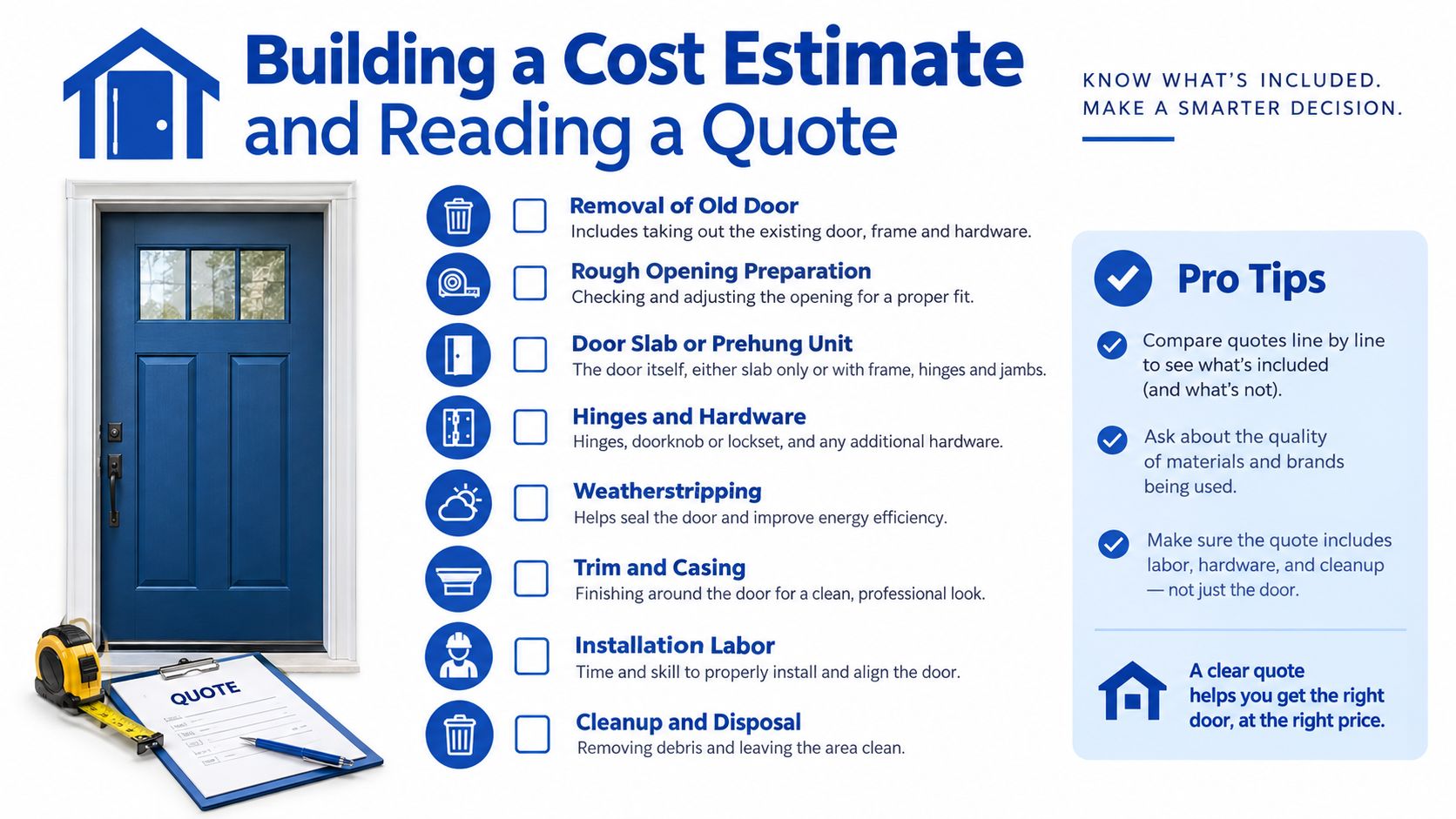
A professional quote should identify the door material and style, whether the unit is slab or prehung, the frame and jamb scope, hardware, trim, removal, disposal, weatherproofing, labor, permits, finish work, and warranty terms.
| Quote Item | Contractor A | Contractor B | Contractor C |
|---|---|---|---|
| Door slab or prehung unit | |||
| Frame and jambs | |||
| Hinges and hardware | |||
| Removal and disposal | |||
| Rough-opening preparation | |||
| Weatherproofing and sealant | |||
| Trim and casing | |||
| Paint or stain | |||
| Installation labor | |||
| Permit fees | |||
| Cleanup | |||
| Warranty | |||
| Total |
Compare scope before comparing totals
A $1,100 quote that includes removal, sealing, trim, and cleanup may be a stronger offer than a $900 quote that bills those items separately. Ask whether the contractor uses a flat installation price or an hourly rate for hidden conditions.
Flag vague language such as “materials included.” The quote should name the door type, hardware grade, finish, and weatherproofing method. An exterior quote that omits permit responsibility also deserves clarification.
The most common red flags are easy to spot:
Keep photos of the opening, measurements, product selections, and signed revisions with the quote. Project documentation templates from HomeProBadge can help organize those records, especially when several trades or openings are involved.
Never approve a change order verbally. If the contractor discovers damage, require a written description, added cost, and your approval before the work continues.
Regional, Size, and Finish Adjustments Plus Money-Saving Tips
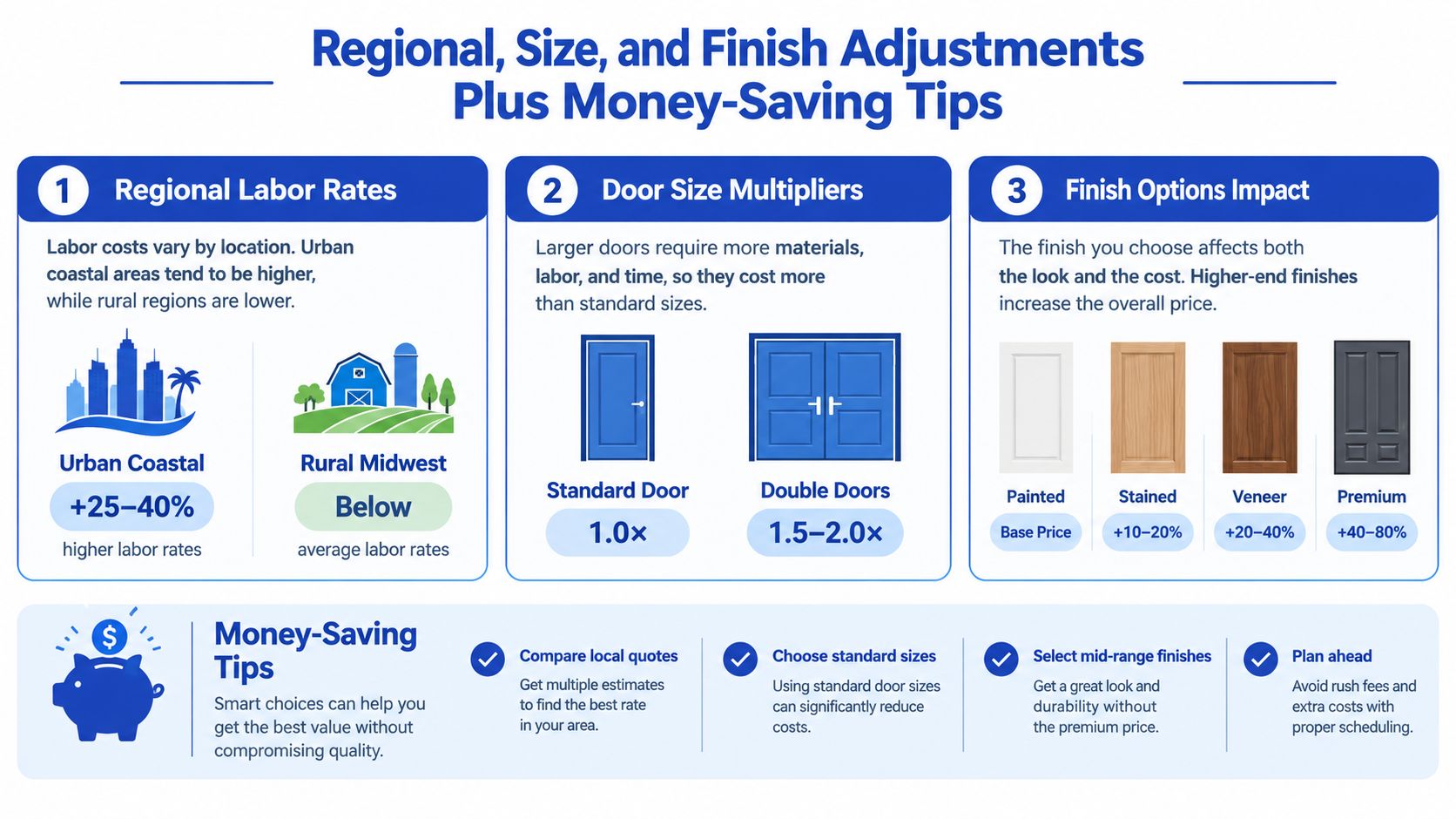
Labor prices vary by market, and the national benchmark won't predict every local quote. Urban coastal markets often cost more than rural markets because labor demand, overhead, access, and scheduling pressures differ. Treat online averages as a starting point, not a promise.
Door size and configuration create another multiplier. Double doors, sidelights, transoms, arched openings, and tall units require more material, more handling, and more finish work than a standard opening. The specialty-project data from CostHelper shows why these jobs need scenario-based budgeting instead of a single average. Garage doors can run $400 to $3,000, while deluxe front doors reach $3,000 to $12,000 or more, according to CostHelper's door pricing guide.
Save money without weakening the installation
Bundle the work: If several interior doors need replacement, request one package price. Home Depot's published installation tiers show lower per-door ranges as the number of doors increases. Keep a sound frame: A slab-only replacement can save work when the existing frame is square, dry, and compatible. Don't preserve a damaged frame just to avoid the cost of a proper system replacement. Choose the middle wisely: Hollow core is adequate for many low-impact interior rooms. Solid core is a more sensible upgrade where sound and durability matter. For exterior work, choose the material that fits the exposure rather than paying for decorative features you don't need. Separate hardware pricing: Ask for the door and hardware as separate lines. That lets you compare locksets and handles without losing visibility into the installation price. Schedule with patience: Custom and specialty products need ordering time. Rushed delivery and rushed installation can narrow your choices and encourage avoidable premiums.The filename above contains a URL mismatch, so the required asset is included here with the exact supplied path:
Don't save money by skipping weatherproofing, permits, or opening repairs. Those shortcuts reduce the invoice by hiding work, not by making the project more efficient.
Vetting Door Pros and Verifying Trust Before You Sign
The right contractor should make the scope easier to understand, not harder. Start by confirming identity, licensing, insurance, and experience with your specific door category. A general remodeler may be capable, but exterior systems, patio units, custom openings, and structural work each demand relevant experience.
Ask for references involving similar doors. A contractor who has installed interior slabs may not be the right choice for a weather-exposed entry system with sidelights. Check the contractor's state licensing records and local business history, then compare those records with the name on the contract and insurance certificate.
Questions every bidder should answer
On arrival, inspect the basic facts before the work starts. The crew should match the contractor's description, the delivered materials should match the written selection, and the installer should verify the rough opening rather than relying only on an old measurement. For exterior work, confirm permit posting where applicable.
Trust signals can reduce hiring risk when they connect a contractor to verifiable work. A profile with identity and background verification, licensing and insurance details, project photos, and reviews tied to real jobs is more useful than a single anonymous rating. Find local contractors through HomeProBadge if you want to compare verified professionals and documented project evidence.
Put the agreement in writing
Your contract should include the complete scope, itemized totals, product selections, exclusions, payment milestones, change-order terms, warranty language, start conditions, and cleanup responsibility. For larger work, request lien waivers as payments are made.
Don't sign a vague proposal because the contractor seems personable. A trustworthy professional won't object to clear measurements, a written scope, documented insurance, and a payment schedule tied to completed work.
HomeProBadge helps homeowners find professionals with verified identity, background, licensing, insurance, real project evidence, and structured reviews. Use HomeProBadge to compare door contractors before signing, then request an itemized quote that separates the door system, installation, opening repairs, hardware, and finish work.