



You finished a job, sent the invoice, and waited. Then the customer replied with a sentence that feels way too technical for a plumbing call, a panel upgrade, or a roof repair: “We can't accept this format.”
That's the moment a lot of small service businesses realize invoicing isn't just about the amount due. It's also about whether the buyer's system, platform, or government portal can read what you sent. A clean PDF may look perfect to a person and still fail for the software that decides whether the invoice gets accepted, routed, or paid.
If you do home service work for property managers, municipalities, larger contractors, public entities, or customers in other countries, this matters fast. The file itself can become part of compliance. What counts as an acceptable invoice in one place may be rejected in another, even if the work was done correctly and the price is right.
Why Your Invoice Format Decides If You Get Paid
A familiar version of this problem goes like this. An HVAC company completes a commercial maintenance job for a customer tied into a procurement system. The office sends a PDF invoice by email, same process they use for homeowners. A few days later, no payment. Then the customer says the invoice must go through Peppol, or must be submitted as XML, or must follow a country-specific standard.
Nothing was wrong with the service. The hold-up came from the e invoicing format.
Rejection usually starts before finance sees the invoice
Many buyers now run invoices through software checks before anyone approves payment. If the document arrives in the wrong structure, the system may reject it automatically, fail to route it, or treat it as noncompliant. That's why this isn't just admin trivia. It affects cash flow.
For busy service pros, the frustrating part is that “format” sounds like a design choice. It isn't. In many cases, it means:
A plain PDF often works for residential jobs. It may not work for a public-sector buyer, a cross-border commercial customer, or a clearance platform that expects structured XML.
Practical rule: If the customer or portal names a standard, a network, or an XML requirement, your invoice format is part of getting paid, not an optional extra.
Why this keeps coming up now
E-invoicing has moved from niche procurement talk into normal operations. One industry assessment reported that more than 80 countries have either implemented or announced mandates for compulsory eInvoicing adoption, and of roughly 90 billion B2B, B2G, and G2B invoices annually, about one third are already electronic. The same assessment found that in Europe's public sector, 82% of supplier invoices received by public entities are e-invoices, 85% of public entities use Peppol for supplier invoices, and 58% use it for outgoing invoices (global eInvoicing shift data).
If you're also tightening up how customers pay once they receive the invoice, this overview of online invoice payment processing helps on the payment side. But payment speed starts with invoice acceptance. If the file gets bounced, the payment link doesn't matter yet.
What an E Invoicing Format Really Is
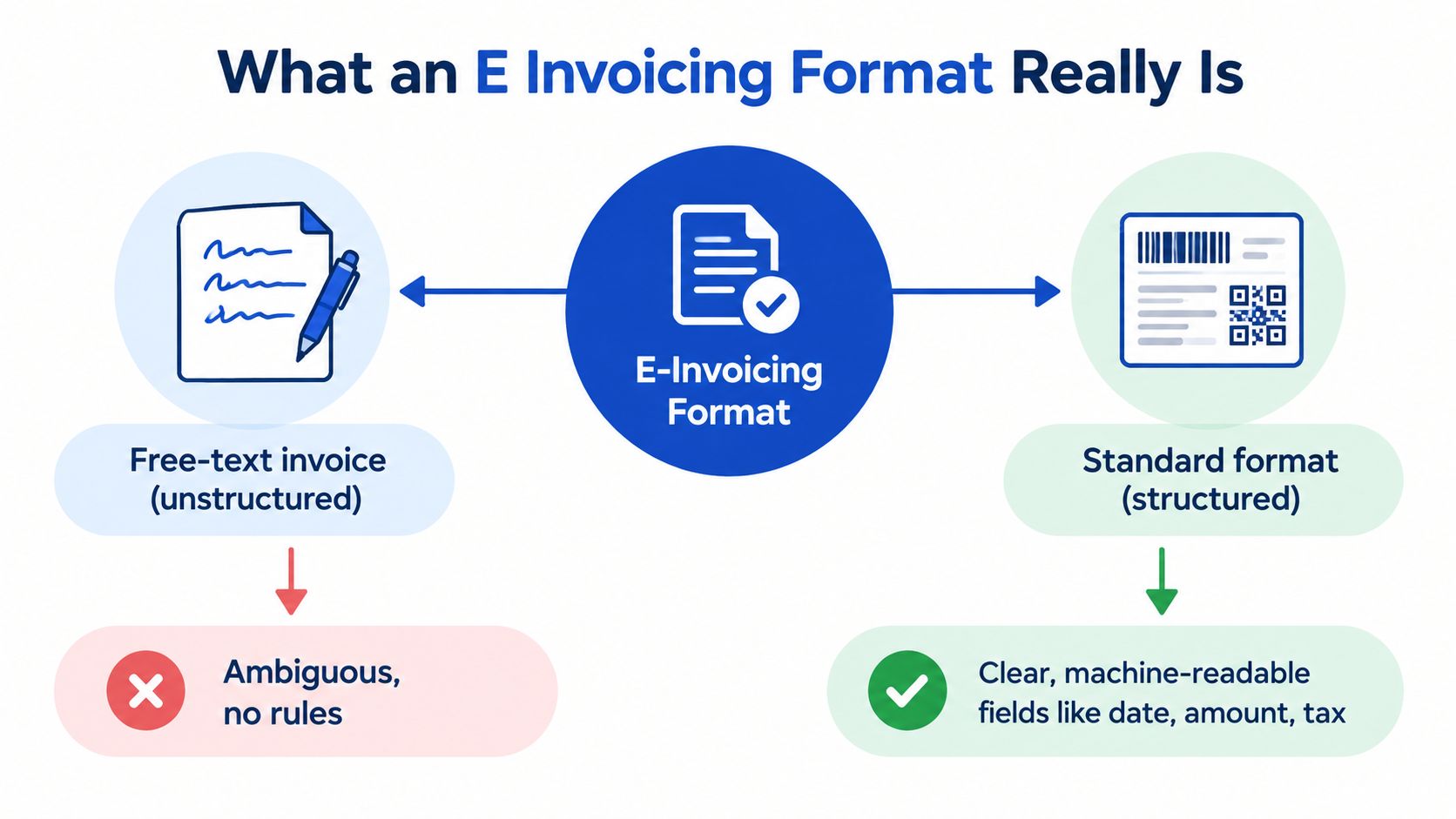
The easiest way to understand an e invoicing format is to stop thinking about it as a document and start thinking about it as a shared data language.
A PDF is like a printed note taped to a box. A structured e-invoice is like a shipping label with fields in fixed spots. A person can read both. Software can reliably process only the one with predictable fields.
Human-readable versus machine-readable
A PDF shows words and numbers on a page. It may include invoice date, tax amount, line items, and payment terms, but software often has to “look” at the page and guess what each piece means.
A structured invoice works differently. It labels each data point clearly. Instead of just showing “Invoice date: May 10,” the file contains a specific machine-readable field for the invoice date. Same for supplier ID, customer ID, tax category, currency, and totals.
That difference is what allows automation:
Format means model plus syntax
People get tangled up in acronyms. A format often includes two layers.
First is the data model, meaning what information the invoice must contain and how that information is defined. Second is the syntax, meaning the technical way that data gets written into a file, often XML.
A major milestone here was the EU's Directive 2014/55/EU on electronic invoicing in public procurement. The European Commission formally referenced the EN 16931 standard and related syntaxes in October 2017. EN 16931 defines the invoice data model, while UBL and UN/CEFACT XML Cross Industry Invoice (CII) are the structured XML syntax families used to carry that data. The practical effect was a common baseline for machine-readable, semantically consistent, interoperable invoices rather than simple PDFs or email attachments (European e-invoicing standard background).
A useful way to think about EN 16931 is this: it tells everyone what the invoice means, while UBL or CII tells systems how to write that meaning into a file.
Why this matters to a small office
If you send mostly homeowner invoices, you might never need to open an XML file. But if you're dealing with larger buyers, it helps to understand the basics so you can ask the right question: “What format and network do you require?”
And if you're also cleaning up collections procedures, this roundup of accounts receivable guidance is useful because payment delays often start with paperwork friction, not disputes about the work itself.
The Main E Invoicing Formats You Will Encounter
Not every invoice file belongs in the same bucket. Some formats are built for interoperability across many systems. Some are tied to a network. Some are hybrids that combine a human-friendly PDF with embedded structured data. Some are still mostly visual documents.
Start with the practical categories
For a small business, it helps to sort formats by job, not by acronym.
UBL is a structured XML syntax used widely for interoperable invoicing. It's one of the core syntax families recognized under EN 16931. UN/CEFACT CII is another structured XML syntax family used for the same broad purpose. It can also carry EN 16931-compliant invoice data. Peppol BIS Billing 3.0 is not just a random file label. It's a Peppol profile that standardizes invoice exchange on UBL 2.1 only, which reduces ambiguity because the network can validate against one XML syntax and a specific customization profile instead of juggling multiple structures (Peppol UBL standardization explanation). Factur-X or ZUGFeRD is a hybrid approach. It typically combines a PDF/A-3 document with embedded XML, so a person can read the visual invoice while a system can extract the structured data. EDI is older and still used in some supply chains. It can work well in established trading relationships, but it's not the same thing as the newer XML-based public standards many mandates now prefer. Plain PDF is easy to send and easy to read. But in many regulated settings, it no longer counts as a compliant e-invoice by itself.Common E Invoicing Formats Compared
| Format | Structure Type | Best For | Interoperability |
|---|---|---|---|
| UBL | Structured XML | Broad standards-based invoicing | High when aligned with required profile |
| UN/CEFACT CII | Structured XML | Markets and systems that support CII | High when accepted by the jurisdiction |
| Peppol BIS Billing 3.0 | Structured UBL 2.1 profile on Peppol | Peppol-based exchange, especially public procurement | High inside the Peppol framework |
| Factur-X / ZUGFeRD | Hybrid PDF/A-3 with embedded XML | Buyers needing both visual and structured invoice data | Medium to high, depends on local acceptance |
| EDI | Structured but often partner-specific | Legacy supply-chain integrations | Medium, often limited by mapping requirements |
| Plain PDF | Unstructured visual file | Basic direct billing where structured compliance is not required | Low for automated or mandated environments |
What confuses people most
The biggest confusion is assuming “structured” means “all structured formats are interchangeable.” They aren't. A customer might accept UBL through Peppol, reject the same business data in another syntax, and completely ignore a plain PDF.
Another common mistake is treating a PDF attachment as the legal invoice everywhere. In some settings, the XML is what counts, and the PDF is only a visual copy.
If the buyer names a profile like Peppol BIS Billing 3.0, don't answer with “we can send XML.” Ask which syntax, which network, and which validation profile they expect.
Why E Invoicing Format Varies by Country and Industry
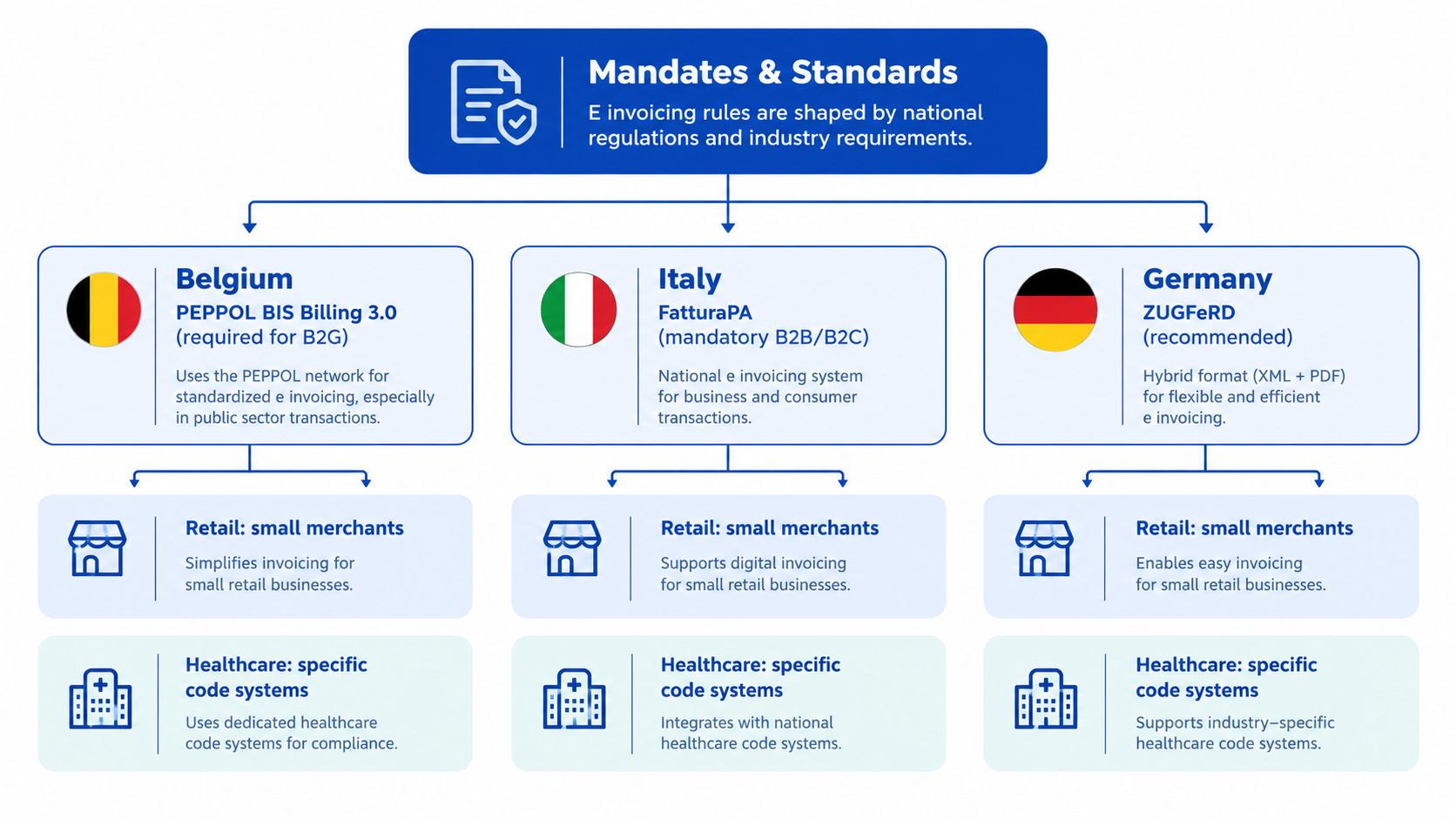
If one format would work everywhere, this topic would be simple. It doesn't, because e-invoicing rules are often written by governments, tax authorities, procurement networks, and industry-specific systems. Each group cares about slightly different things, such as tax reporting, public procurement, routing, validation, archiving, or sector data.
That's why an e invoicing format is often less like choosing between Word and PDF, and more like choosing which permit form a city will accept.
Different countries, different rails
A useful example is Europe. EN 16931 created a shared semantic baseline, but countries still implement invoicing in different ways.
That mix creates a basic business question many owners ask late: which format should I use if I work across borders or serve customers in more than one country? The answer depends on the buyer's jurisdiction and channel, not just on what your accounting system happens to export. The same update also notes that ViDA is pushing the EU toward structured electronic invoices rather than PDFs, and that the EU standard was updated in 2025/2026 to expand B2B coverage and add new data elements for interoperability (multi-country compliance update).
Industry can add another layer
Even inside one country, industry workflows can narrow your options. Public entities may require Peppol. Tax clearance systems may require portal submission before buyer delivery. Larger companies may insist on a format that matches their accounts payable automation.
A small electrical contractor doing local residential work may never face this. The same company servicing a government building, a multinational facilities firm, or a buyer in another country probably will.
A simple way to think about it
Ask these three questions before sending anything:
Those answers usually narrow the format fast.
A PDF is a document. In many countries, a compliant e-invoice is a regulated data submission.
Validation and Compliance Rules That Make or Break Your Invoice
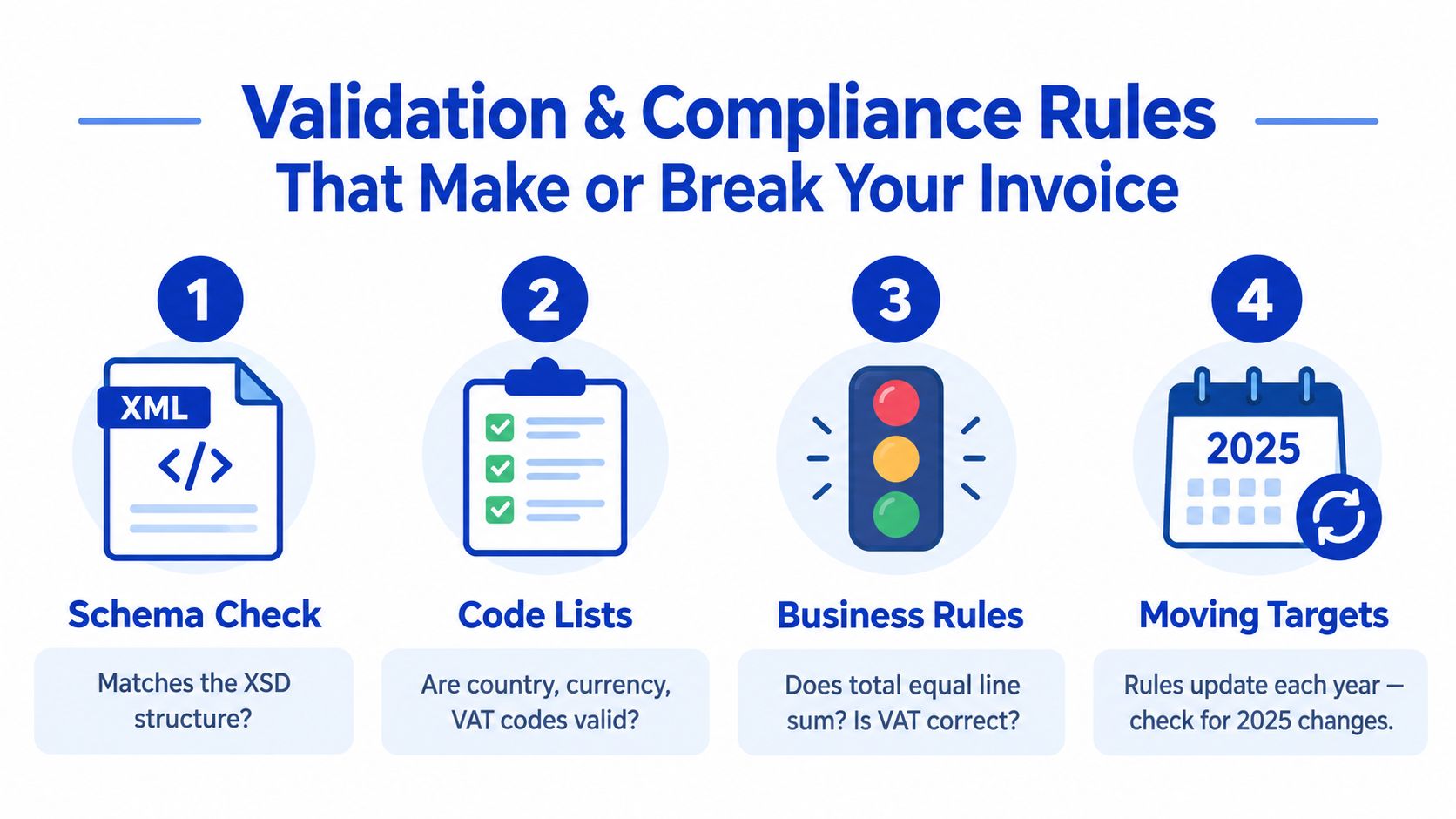
A file can look fine and still fail validation. That's because invoice acceptance usually depends on more than “does this XML open?”
Validation checks whether the invoice follows technical rules, business rules, and local compliance rules. For small businesses, the important point is simple: passing once doesn't mean you're done forever.
What validation usually checks
Think of validation like a four-part inspection.
Does the file match the expected XML schema? If a required element is missing or placed incorrectly, the invoice can fail immediately.
Are the currency, country, tax, and unit codes valid for the current rule set?
Do totals add up? Does the tax logic match the line items? Are mandatory references present?
Does the invoice use the right network profile, customization ID, receiver identifier, or submission path?
For businesses that also deal with tax invoice requirements in other contexts, these GST invoice rules for small business are a useful reminder that invoice validity often comes down to required fields and exact wording, not just whether the bill looks professional.
Clearance systems raise the stakes
In some countries, the invoice format is tied directly to government approval. Saudi Arabia's Phase 2 e-invoicing guidance requires tax invoices to be sent in XML rather than PDF/A-3 for real-time clearance to the FATOORA platform. That means the business system must generate structured XML before buyer delivery to satisfy government validation and integration rules (Saudi XML clearance requirement).
That's a good example of why “we can always email a PDF copy” isn't enough in a clearance model.
Rules keep changing
Another trap is assuming XML compliance is a one-time project. It isn't. In 2026, Germany's Factur-X/ZUGFeRD was updated to align with the latest EN 16931 code lists, the EU published a revised EN 16931 standard to support broader B2B and CTC requirements, and Denmark canceled an earlier OIOUBL 3.0 path after stakeholder feedback on complexity. The practical lesson is that format compliance can become a moving target as overlays, code lists, and business rules change (2026 e-invoicing update summary).
If you're connecting invoicing to card payments or customer-facing payment flows, keep the payment side separate from the compliance side. A tool may make payment easy and still not solve format validation. This guide to Stripe payment integration helps with the payment workflow after invoice acceptance is handled.
What E Invoice Files Actually Look Like With Examples
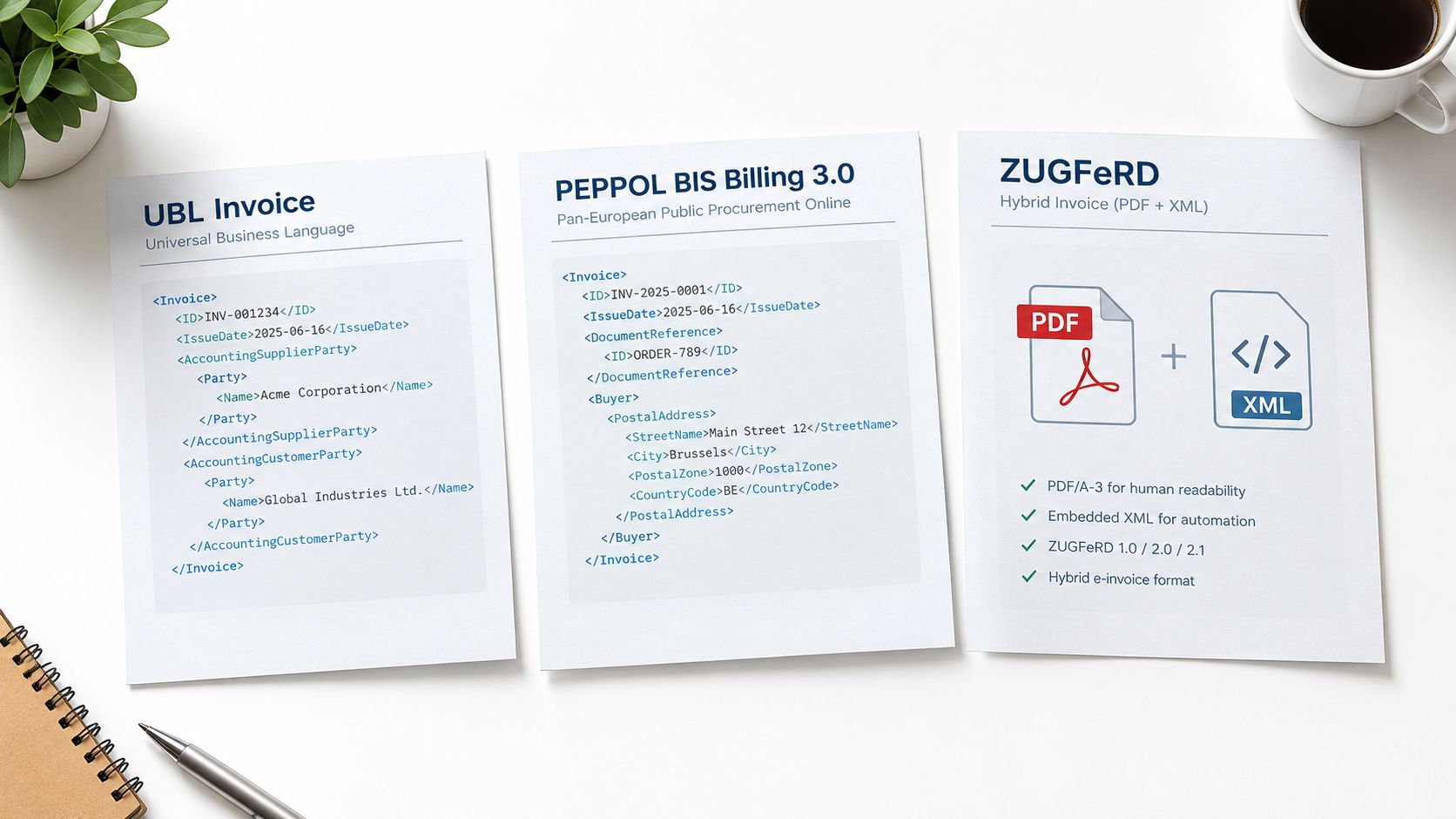
Don't need to write XML by hand. But it helps to recognize the pattern so you know what you're looking at when a customer says, “Send UBL,” or when a provider says, “Your customization ID is wrong.”
Here's the visual side first.
A simplified UBL-style pattern
A UBL invoice usually has a clear header, supplier details, buyer details, tax information, totals, and line items in structured tags. In plain English, it's saying:
A simplified pattern might look like this:
Invoice root
invoice number
issue date
supplier party
customer party
tax total
legal monetary total
invoice lines
You don't need to memorize tag names. You need to understand that every value lives in a named slot. That's what lets software read it without guessing.
What changes in Peppol BIS Billing 3.0
Peppol adds tighter expectations around profile details and validation. Two UBL files can both be structured, but only one may fit the exact Peppol billing profile the buyer accepts.
A common issue is missing identifiers. For example, the invoice may include seller and buyer names but not the network or business identifiers needed for routing. To a person, the invoice looks complete. To the network, it's undeliverable.
Here's a short walkthrough if you want to see these file patterns discussed visually before talking to your software provider:
Hybrid files and common failure points
A hybrid file such as Factur-X or ZUGFeRD often includes a readable PDF plus embedded XML. That makes it easier for humans and systems to work from the same invoice package, but only if both layers match what the local rules expect.
One small mismatch can break the flow. A tax category that doesn't match the totals, a missing buyer reference, or an invalid code can trigger rejection even though the PDF “looks right.”
Check the structured data first. The pretty PDF is often just the front cover.
How to Choose and Implement the Right E Invoicing Format
Small service businesses don't need every standard. They need the right standard for the customers they bill.
The most useful approach is a decision filter, not a glossary.
Use this decision framework
Start with your customer mix.
A standard digital invoice and secure payment flow may be enough if your buyers don't require structured e-invoicing.
Ask whether they accept PDF, EDI, Peppol, or a direct supplier portal submission.
Expect named standards, network routing rules, and stricter validation.
Assume the acceptable format may depend on the buyer's country, not yours.
Then check your systems.
Pick the lightest setup that still meets the rule
If you mainly invoice local homeowners, keep the process simple. If you invoice a mix of residential and commercial customers, use software that can handle ordinary digital invoices well and add structured capability only where needed.
For example, contractor invoice software can help you organize service descriptions, job records, and payment collection for everyday work. If you also need jurisdiction-specific e-invoicing, you may need a separate provider for Peppol access, XML generation, or country-specific submissions. HomeProBadge is one option on the general invoicing side because it ties invoices to completed jobs and payment links, but it isn't a substitute for a country mandate you must satisfy through a specific network or government channel.
Build for change, not just go-live
Don't stop at “we can generate XML.” Set up a simple operating habit:
If you want a broader operations view of what automated invoice handling can remove from back-office work, this guide on how to automate AP costs is worth reading. It helps frame why structured invoice data matters beyond compliance.
The safest mindset is this: choose the format based on who must accept it, then choose tools based on who can produce and validate it reliably.
HomeProBadge gives home service pros a practical way to create invoices from completed jobs, send secure payment links, and keep the invoice tied to real project records. If you want a cleaner billing process for standard service work while you sort out where structured e-invoicing is required, visit HomeProBadge.