



You've measured the driveway, called a gravel supplier, and heard a number that sounds manageable. Then the truck arrives, the load is smaller than expected, the access route causes a delay, and the final invoice bears little resemblance to the original quote. That's how a seemingly simple purchase turns into an expensive lesson.
Cost of a load of gravel depends on what the supplier means by “load,” whether the price includes hauling, and what the driver can do once the truck reaches your property. The figures below show the difference between material and delivery pricing, explain truck capacity and aggregate density, and give you a practical way to compare quotes before you commit.Why Your Gravel Quote Feels Like a Guessing Game
A homeowner in Ohio orders crushed stone for a new driveway. The supplier says the job will cost $400, so the homeowner assumes that number covers a complete load delivered to the property. The truck arrives, but the order is treated as a smaller-than-standard load, the site requires extra maneuvering, and spreading is billed separately. The final total reaches $850.
That example is useful because it exposes the weak point in most gravel quotes. “One load” isn't a standard quantity. A supplier may be talking about a particular truck, a tonnage limit, a cubic-yard capacity, or just the amount requested by the customer. Unless the quote identifies the truck configuration and delivered quantity, the headline price doesn't tell you much.
For standard crushed stone in the United States, a typical residential dump-truck load carries approximately 10–14 tons. At an estimated material price of $30–$45 per ton, the stone itself works out to about $300–$630, while delivery commonly adds $100–$200, creating an estimated delivered total of approximately $400–$800 for a full load, according to this gravel cost breakdown.
What the first quote may leave out
Distance changes the delivery line. Local deliveries under 10 miles may cost $50–$150, while deliveries between 10 and 30 miles can reach $100–$300, based on the same residential gravel pricing guide. A supplier might also price a short load, add a minimum-order charge, or quote dumping only when the homeowner expects spreading and leveling.
Ask for these items in writing:
A supplier who works on fences, driveways, or other exterior improvements may also need to price adjacent work. For a broader comparison of project costs, this FenceScape cost guide provides useful context for how materials and installation are commonly separated.
Practical rule: Never compare “per load” quotes until you know the tonnage, cubic-yard volume, truck type, and complete delivered total.
Material Price Versus Delivered Price Explained
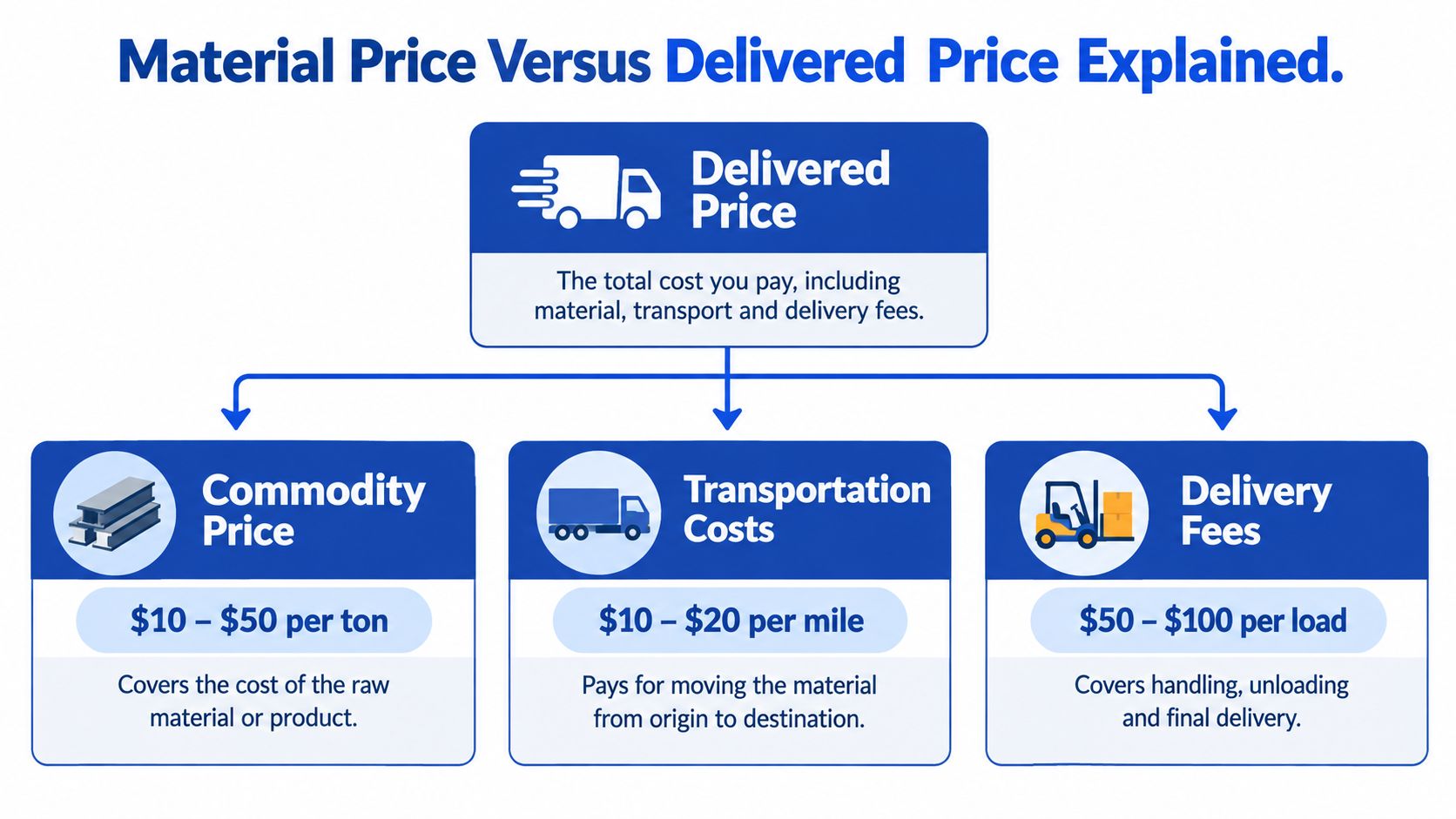
A quarry number and a delivered number are not the same purchase. The first covers raw aggregate at the production level. The second covers getting that stone onto your property with a truck sized for the job, on a route your site can accept.
The U.S. Geological Survey crushed-stone summary lists average U.S. crushed-stone unit values of $12.69, $13.26, $14.31, $15.86, and $17.50 per metric ton across its reported historical series. Those figures are useful for context because they show what crushed stone is worth before local retail markup and jobsite delivery are added. They are not a shortcut to your final bill.
Here is the part many homeowners miss. “Load” is not a standard quantity, and delivered pricing is built around that fact. A small residential order can carry the same dispatch effort as a fuller truck, so the cost per ton rises fast when the truck is underfilled, the haul is longer, or the driver has to work around tight access and awkward dumping conditions.
A practical way to read the gap is this: if stone starts at $14.31 per metric ton at the quarry level, a local retail quote of $30–$45 per ton can still be reasonable once the supplier prices loading, truck time, and delivery into the sale, as shown in this delivered gravel price reference. On a modest order, that spread alone can move the invoice by several hundred dollars before any grading or waiting time is added.
Trace each line on the invoice
If a supplier gives you only one lump sum, ask for the parts behind it. A solid quote should separate:
That breakdown matters because the cheapest stone does not always produce the cheapest job. I have seen higher per-ton material quotes beat lower ones once the closer yard, fuller truck, or easier dump setup cut the delivered total. The number that matters is the effective delivered cost for the quantity you'll receive.
Decoding Truck Capacity and Aggregate Weight
A “load” becomes meaningful only after you identify the truck and the material. A tandem load may contain approximately 15–20 tons, while a tri-axle load may contain about 22–25 tons, according to this dump-truck gravel capacity guide. Those are materially different purchases, even if both suppliers describe them as one load.
Volume creates another problem. Gravel weighs approximately 1.3–1.6 tons per cubic yard, depending on the aggregate's density. That means a 10-yard order can represent significantly different tonnage from one material to another. Wetness, grading, and the aggregate's composition can also affect the actual weight.
Ask for both units
Don't accept a quote that gives only cubic yards when your budget is based on tons, or only tons when your site calculation is based on volume. Ask the supplier to state:
Use this basic check:
Estimated tons = cubic yards × tons per cubic yardThe result remains an estimate until the supplier confirms the material density and truck payload. A fuller truck can also reduce the delivery cost per ton when trucking is charged by trip rather than strictly by weight. A smaller order may look cheaper at first but carry a short-load or minimum-order fee.
| Aggregate Type | Density (tons per cubic yard) | Best Use |
|---|---|---|
| Standard crushed stone | 1.3–1.6 | Driveways, drainage, grading, and general base work |
| Crusher run | Supplier-confirmed density required | Compacted driveway and walkway base |
| Washed aggregate | Supplier-confirmed density required | Drainage and decorative applications |
| Recycled concrete aggregate | Supplier-confirmed density required | Base and fill where approved |
| Decorative stone | Supplier-confirmed density required | Visible landscape surfaces |
The table is a quoting tool, not a substitute for the supplier's material data. Decorative and washed products can behave differently from dense angular base stone, so don't order by a generic online conversion.
Order by the material specification, not the marketing name. “Driveway gravel” can mean different products from different yards.
If you're coordinating several exterior projects, keep the measurement method consistent. A guide to what DG hardscape costs per square foot is useful when comparing decomposed granite with other surface materials. For waste planning around the same project, review the 8-yard dumpster sizing guide separately from your gravel calculation.
How Verified Quotes Prevent Costly Surprises
Bulk gravel purchases create an information imbalance. The supplier knows the truck's capacity, route, minimum charge, and material conversion. The homeowner often sees one rounded number and has to trust that it means what they think it means.
That gap causes predictable disputes. The customer may believe the quote includes spreading, while the supplier intended a dump-only delivery. The invoice may include a short-load fee that wasn't discussed. The driver may bring a visually similar aggregate that performs differently under traffic or drainage conditions.
Put the agreement in a record
A useful quote should preserve the facts that determine what arrives:
| Quote Detail | What It Protects |
|---|---|
| Aggregate name and size | Prevents the wrong material from being delivered |
| Tons and cubic yards | Prevents ambiguity about quantity |
| Truck type | Establishes the expected payload |
| Delivery address and drop point | Reduces access disputes |
| Spreading or dumping scope | Separates delivery from site work |
| Complete price and exclusions | Controls later additions |
| Delivery date and proof | Creates a clear completion record |
Documentation matters most when the job involves a substantial purchase. A delivery photo showing the truck, material, and drop location won't prove exact tonnage by itself, but it creates a useful record of what was delivered. A scale ticket, supplier receipt, timestamped photos, and before-and-after site images provide stronger evidence than a text message containing only “load of gravel.”
Treat proof as part of the purchase
A transparent supplier should be willing to identify the material, explain the capacity, and confirm the charges before dispatch. If a provider avoids basic questions about the truck or changes the price after arrival, the lowest advertised rate may not be the cheapest option.
For homeowners, the practical standard is simple: the quote, delivery, and final invoice should describe the same job. For contractors, preserving that record protects both the customer relationship and the business when a site condition changes.
Delivery Fees, Short-Load Surcharges, and Extras
A load of gravel can look cheap until the truck starts rolling. Twelve tons of stone may price out reasonably on paper, but the driver, fuel, truck time, and return trip are often what change a modest quote into a much larger invoice.
That is why delivery terms deserve the same attention as the material line. Earlier pricing ranges for gravel itself already showed how wide base costs can be. On top of that, suppliers may charge by the ton for hauling, by the trip, or with a minimum delivery charge that makes a partial order expensive.
Compare the cost variables
| Charge Type | Typical Range | When It Applies |
|---|---|---|
| Local trip charge | $50–$150 | The supplier serves your property within its local delivery area |
| Longer-distance delivery | $100–$300 | The route extends beyond the local service area |
| Short-load fee | $25–$100 | The order doesn't fill the truck economically |
| Idle time | $60–$120 per hour | The truck waits because the site isn't ready or access is blocked |
| Per-ton delivery | $10–$25 per ton | The supplier allocates hauling as a variable delivery charge |
Use those figures as comparison points, not promised local rates. One yard may call a half-full truck a short load. Another may quote a low per-ton price, then add a trip charge because your address falls outside the normal route. That is how two quotes for what sounds like the same load end up far apart.
Short-load fees catch homeowners all the time because load is not a standard unit. A small single-axle truck, a tandem, and a triaxle do not haul the same amount, and gravel products do not all weigh the same per yard. If you order “one load” without confirming the truck size and billing method, you are giving the supplier room to define the quantity after the fact.
Spreading is another line item that changes the overall price. Some deliveries are tailgate spread, some are dump only, and some include grading with separate equipment. A bundled quote may be easier to compare if you want the material placed and shaped in one visit. A separate line can be better if the site is already prepped and you only need a clean dump.
Prepare the access route
Access problems are where extra charges become real. Before delivery day, check the route from the road to the drop point. Look for low branches, soft edges, narrow turns, overhead wires, parked vehicles, and any slope that could stop a loaded truck from backing in safely.
Confirm the following:
A cheap gravel quote is only cheap if it covers the truck you need, the access you actually have, and the service you expect when it arrives.
Calculating Gravel for a Driveway Project
Start with the surface area, then convert depth into volume. Consider a driveway that measures 30 feet by 12 feet and needs 4 inches of crushed stone.
Work through the measurement
First calculate the surface:
30 feet × 12 feet = 360 square feetConvert four inches to feet:
4 ÷ 12 = 0.333 feetNow calculate cubic feet:
360 square feet × 0.333 feet = approximately 120 cubic feetConvert cubic feet to cubic yards:
120 ÷ 27 = approximately 4.44 cubic yardsThat gives you the loose volume before accounting for compaction. Gravel settles when placed and driven over, so a contractor may order more than the mathematical minimum. The exact allowance depends on the material, base condition, installation method, and whether the quote includes preparation. Don't add an arbitrary amount without asking the supplier how the product is sold and compacted.
Convert volume to an order
Using the verified density range of 1.3–1.6 tons per cubic yard, the estimated tonnage is:
That range is wide enough to affect the truck and the price. Ask the supplier to confirm the density of the selected stone rather than applying the same conversion to every aggregate.
For this example, request a quote for approximately 4.44 cubic yards and the supplier's corresponding tonnage, then ask whether that quantity triggers a short-load fee. Compare the result with the available truck capacity. Ordering a small truck may cost more per ton than filling a larger truck, but a larger truck may not be safe or practical on a narrow driveway.
If the property also needs concrete or a finished driveway surface, use a specialist directory such as find driveway contractors in Georgia to compare installation scopes separately from aggregate delivery. For a patio project, keep the base calculation distinct from the finish surface, as shown in this brick paver patio planning guide.
Measure the space yourself, then ask the supplier to validate the order. That two-way check catches both homeowner measurement errors and vague contractor assumptions.
Regional Price Ranges Across the United States
A quote that looks fair in one state can look inflated in another, and the word "load" is a big reason why. One yard may send a single-axle truck, another may send a tri-axle, and both may call it a truckload. Add longer hauls, tighter site access, or a short-load fee, and the same gravel order can land hundreds of dollars apart before the stone even hits the ground.
Regional comparisons still help. They show where delivered pricing tends to run higher or lower, as long as you treat them as broad market ranges rather than fixed local rates. The table below uses regional delivered price examples from Angi's gravel price guide.
| Region | Cost Per Ton Delivered | Cost Per Truckload |
|---|---|---|
| West Coast | $60–$90 | $750–$1,200 |
| Midwest | $40–$70 | $500–$900 |
| Northeast | $70–$100 | $900–$1,400 |
Those ranges track with what contractors see on the ground. Quarry-dense Midwest markets often stay closer to the lower end, especially where common base stone is easy to source and truck routes are simple. West Coast pricing can climb faster when suitable aggregate travels farther or local hauling costs run higher. In the Northeast, tight access, imported material in some areas, and smaller practical truck sizes can push delivered rates up even when the raw stone itself is not unusual.
Read regional differences correctly
Use region as a screening tool, not a shortcut.
A rural driveway in a lower-cost region can still price above a suburban job in a higher-cost region if the truck has a long deadhead return, limited turnaround space, or weight restrictions on the route. Ask whether the quote includes geographic surcharge zones, and ask which yard will load the material. The nearest quarry on a map does not always supply your order.
Keep truck capacity in the comparison too. A $500 load and a $900 load may reflect different tonnage, axle setups, materials, or haul distances. When you compare a Midwest quote with a Northeast quote, normalize both to delivered cost per ton after confirming the actual quantity. That shows whether the gap comes from geography or from a smaller, less efficient truck.
Questions to Ask Before Ordering Gravel
A good supplier should answer basic delivery questions without making you chase the details. Ask the same questions to every provider so the quotes describe comparable work.
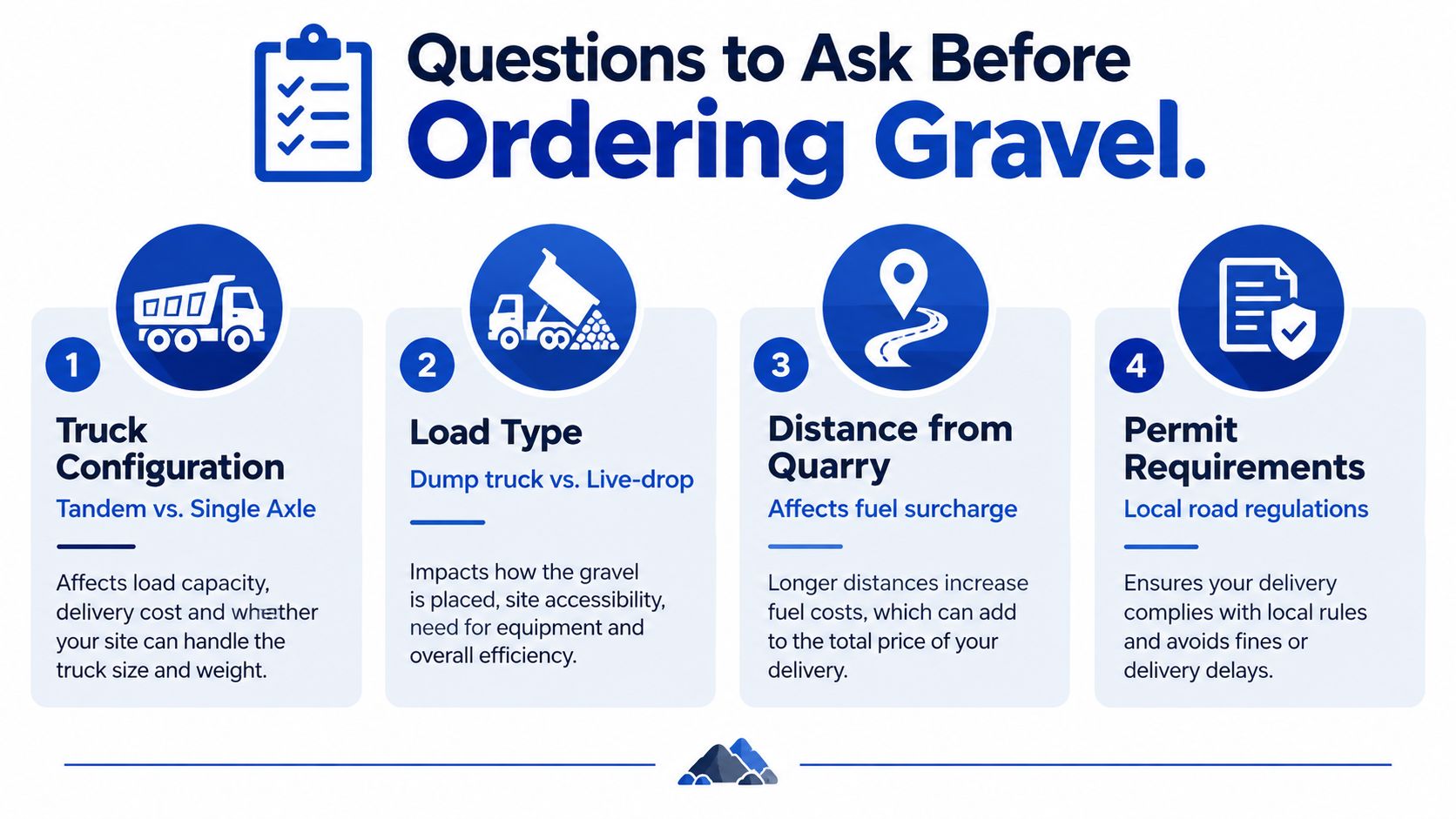
Use this quote checklist
The quote should state the total price, not just the material rate. If the supplier won't identify what is excluded, assume the number isn't final.
Keep the written quote, your access photos, and the delivery receipt together. That record gives you something concrete to compare if the material, quantity, or invoice changes.
Quick Reference - Gravel Pricing at a Glance
Use the figures below as a starting point, not a substitute for a complete local quote. The biggest mistake is treating a truckload range as comparable when the trucks carry different quantities or the suppliers include different services.
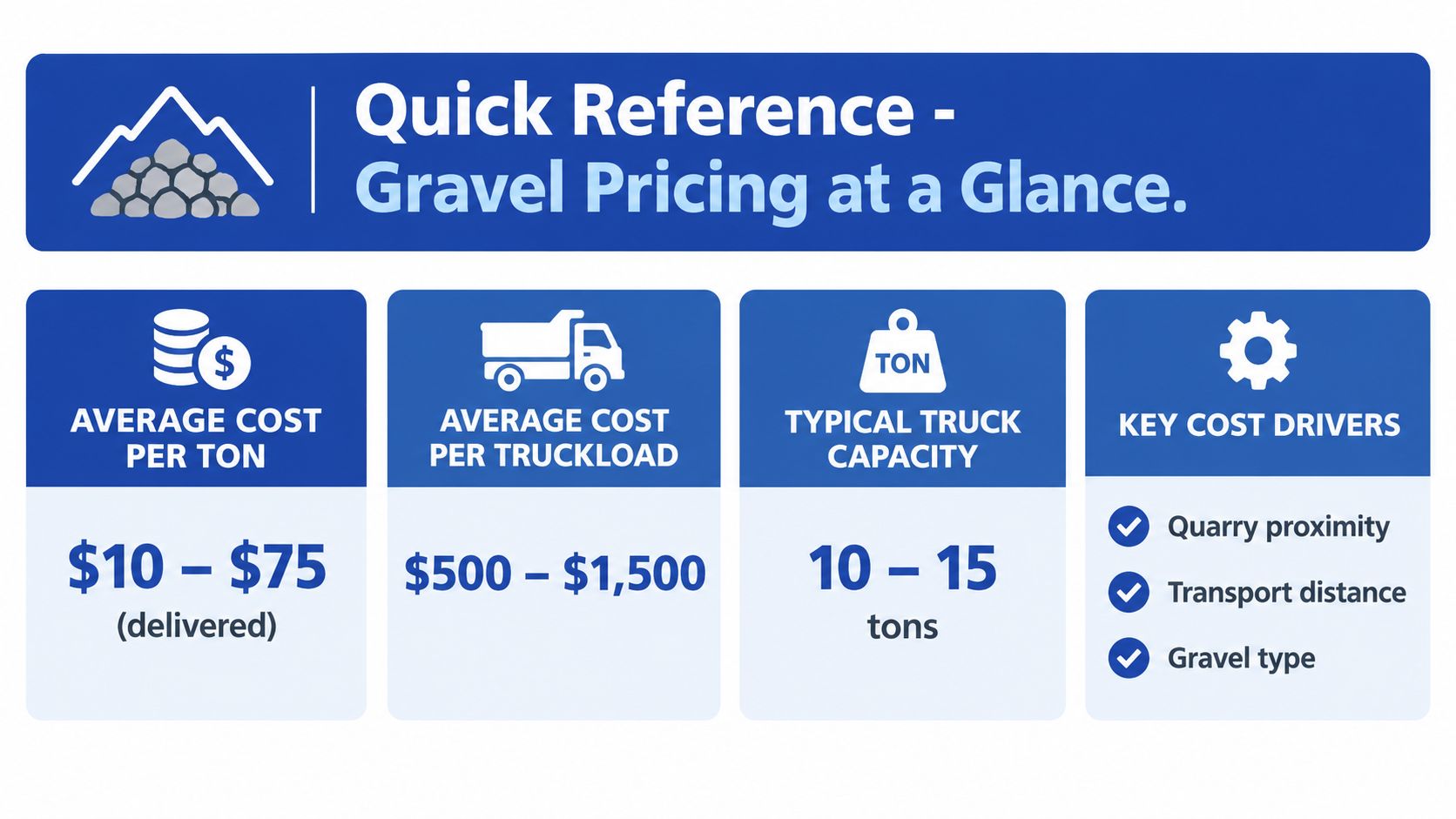
| Cost Factor | Quick Reference |
|---|---|
| Average cost per ton delivered | $10–$75 |
| Average cost per truckload | $500–$1,500 |
| Typical truck capacity | 10–15 tons |
| Key cost drivers | Quarry proximity, transport distance, gravel type |
The assigned summary ranges are broad because “load” varies by truck and market. Earlier figures for standard residential crushed stone describe approximately 10–14 tons and an estimated $400–$800 delivered total for a full load, while other residential load estimates extend from roughly $400–$1,100 depending on capacity, material, and logistics. Compare these numbers only after confirming what the supplier includes.
Before ordering, request three written quotes that identify tons, cubic yards, truck configuration, material, delivery distance, spreading policy, and every surcharge. Ask each supplier for delivery documentation and before-and-after photos, then choose the quote that gives you the clearest complete job, not merely the lowest opening number.
HomeProBadge helps homeowners find verified home service professionals with identity, licensing, insurance, structured reviews, and tamper-proof proof-of-work attached to real jobs. Visit HomeProBadge to compare credible providers and keep clearer records for gravel delivery, driveway work, and other property projects.