



At 6:45 on Monday morning, the owner of a three-truck HVAC company is already behind. A customer is calling about a weekend no-show. One technician is waiting at a supply house because an invoice question has blocked the parts run. The dispatcher needs license proof for a new hire before assigning the first call. On a second monitor, an accounts-receivable tab shows unpaid jobs that someone needs to chase.
None of these interruptions looks large enough to justify a line on the profit-and-loss statement. Together, they form a coordination tax. You pay it whenever information has to be re-entered, verified, forwarded, corrected, or explained between your office, technicians, suppliers, and customers.
The practical way to reduce operational costs in a home-service business isn't to cut every subscription or squeeze every vendor. It's to remove recurring minutes that don't improve the work itself. That means fixing scheduling friction, invoice follow-up, route replanning, credential checks, job documentation, and duplicate data entry without weakening workmanship or customer trust.
The Monday Morning Drain Most Owners Never Add Up
The owner starts by calling the customer with the missed appointment. The dispatcher checks whether the technician was sent to the wrong address or whether the job was never confirmed. Meanwhile, the technician calls from the supply house, the new hire sends another photograph of an insurance certificate, and the owner opens yesterday's job folders to find the information needed for billing.
This is operational cost in its least visible form. Labor, materials, fuel, insurance, and rent appear as recognizable expenses. Coordination overhead hides inside office payroll, unpaid owner time, delayed collections, repeat calls, and jobs that take longer because someone couldn't find the right information.
Practical rule: If a task happens repeatedly because two people or two systems need to exchange information, treat it as a cost center before you treat it as “just admin.”
A plumbing company can lose time when a dispatcher confirms an arrival window, then calls the technician to clarify access details, then calls the homeowner again because the note didn't transfer correctly. A roofing company can lose more time when a crew submits incomplete photos, the office requests replacements, and the customer delays payment while waiting for a clear completion record.
The Bookkeeping and Accounting of Florida insights are useful here because expense management starts with seeing where recurring work lands, not merely reviewing the largest invoices. Owners should apply the same discipline to minutes, handoffs, and corrections.
That perspective changes the question from “Which expense can I cut?” to “Which repeated coordination step can I remove?” A public profile with verified credentials, structured job evidence, AI-assisted reporting, digital invoicing, and listing syndication can address different parts of that problem, provided each feature is tied to a defined workflow rather than purchased as another unused tool.
Your customer-acquisition process deserves the same scrutiny. The guide to customer acquisition costs helps frame lead handling as an operating process, not only a marketing expense. The aim is simple: reclaim the hours that keep the owner acting as dispatcher, document clerk, collections agent, and credential auditor after the field work is finished.
A Three-Bucket Framework for Sorting Operational Costs
Start with one spreadsheet and list every recurring weekly task. Don't begin with software. Begin with the work people perform.
Bucket one is revenue-generating
Put tasks here when they directly create billable work or help a technician complete it. A plumber diagnosing a leak, an HVAC technician completing a maintenance visit, and a roofer installing shingles belong in this bucket. So do a salesperson preparing a specific estimate and a dispatcher assigning a confirmed job to the right technician.
Bucket two is business-critical
These tasks may not create revenue immediately, but skipping them creates compliance, safety, or continuity risk. Checking a technician's license before assigning regulated work is one example. Maintaining insurance records, completing safety logs, filing taxes, and preserving required job documentation are others.
Bucket three is cut or automate
Coordination waste usually appears here. Manual invoice reminders, retyping technician notes, chasing missing completion photos, repeating credential checks that could be stored centrally, and copying the same business details into multiple directories are strong candidates.
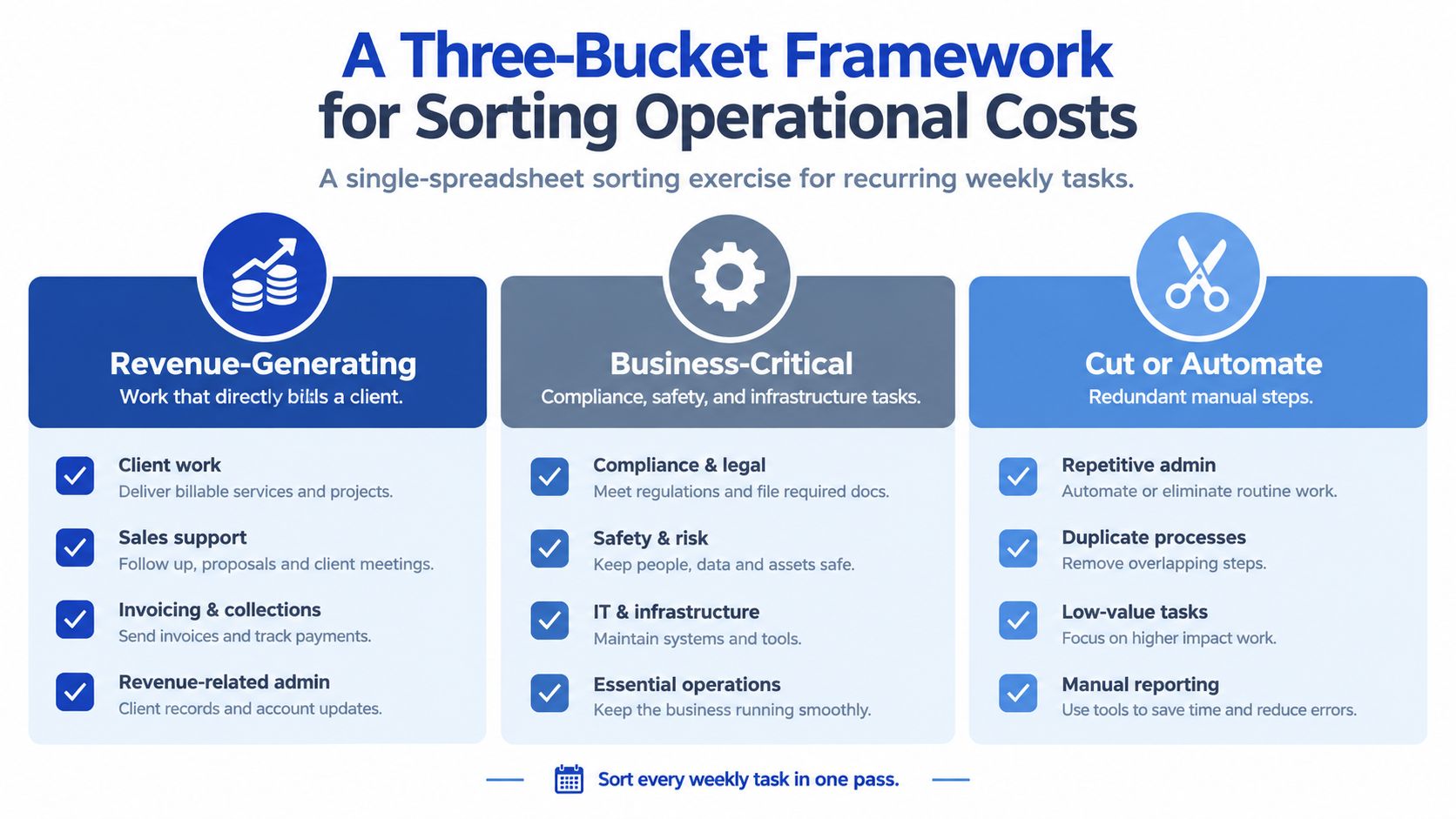
For each task, record the person responsible, how often it occurs, what information they need, and what happens when it goes wrong. A technician's job report might be business-critical, while manually turning that report into an invoice is usually a cut-or-automate task. A license check is critical, but repeatedly searching for the same certificate across email threads is avoidable rework.
Verified profiles can keep credential information available for review. Proof-of-work capture can make photos, signatures, and completion evidence part of the job record. AI job reports can turn technician dictation into structured summaries, reducing the coordinator role the owner often performs after hours.
Don't assume every manual step should disappear. A safety review or final quality check may be worth keeping. The useful question is:
How many hours from last week would a stranger pay you to perform, and how many existed only because information was missing, duplicated, or late?Where Operational Costs Actually Hide in a Service Business
A plumbing, HVAC, or roofing job can be profitable on paper and still lose money between stages. The technician finishes the work, yet dispatch sends the wrong person, the route adds unnecessary miles, paperwork delays payment, or the office reconstructs the job history from scattered messages. These are coordination costs, and they rarely appear as a separate line item.
Scheduling and dispatch friction
Callback loops, no-shows, reassignment, and vague job notes consume paid office time and field capacity. The cost is often a disrupted day rather than one obvious expense. A verified technician profile can reduce repeated credential checks, while clearer job information helps the coordinator assign the right person before the truck leaves.
Routing and vehicle movement
Route-optimization material for startup and mobile-service operations reports fuel-cost reductions of 10% to 30%, daily-stop increases of 15% to 25%, and lower overtime when routes are optimized. FleetOpsClub's route-optimization guidance links those results to geography, technician skills, and appointment windows. Those are the constraints a home-service dispatcher must set up correctly.
A one-truck operator may not need complex routing software immediately. Grouping nearby appointments, confirming the required skills, and avoiding unrealistic time windows can target the same coordination waste at a smaller scale.
Billing and collections
Accounts receivable creates another chain of handoffs. Someone confirms completion, prepares the invoice, sends it, answers questions, resends missing documents, and follows up when payment is late. Billtrust reports that AR automation can reduce cost per invoice from about $15 to under $3 and cut days sales outstanding by an average of 41%. Billtrust's accounts-receivable automation overview attributes those improvements to electronic delivery, reminders, digital payment options, and automated cash application.
Documentation and verification
Missing photos, expired certificates, unclear signatures, and incomplete notes create rework that rarely gets classified correctly. The consequences show up as owner hours, office corrections, delayed invoices, warranty disputes, or return visits to answer questions that should have been settled at completion. AI job reports can turn technician dictation into structured summaries, while proof-of-work capture keeps photos, signatures, and completion evidence with the job record.
| Cost line item | Verified impact | Typical driver |
|---|---|---|
| Scheduling and dispatch | Qualitative cost from callbacks, no-shows, and reassignment | Incomplete notes, poor handoffs, unconfirmed windows |
| Routing and fuel | Fuel reductions of 10% to 30% and daily-stop increases of 15% to 25% when routes are optimized, FleetOpsClub | Geographic spread, skill matching, time windows |
| Billing and collections | Cost per invoice from about $15 to under $3, plus average DSO reduction of 41%, Billtrust | Manual entry, late delivery, payment chasing |
| Documentation and verification | No universal benchmark supplied | Missing evidence, repeated checks, incomplete reports |
Software subscriptions are visible. Coordination waste is spread across people and stages, which makes it harder to spot. Removing a phone line may save a small amount on paper. Preventing a failed handoff can recover capacity, improve response time, and reduce disputes. Keep safety reviews and final quality checks where they protect the customer, and automate the missing, duplicated, or late information around them.
How to Measure Costs Before You Cut Anything
Don't change five workflows at once. First create a before-snapshot that a one-truck operator can maintain without hiring an analyst.
Pull the last 90 days of job records and choose a consistent definition for each metric. For cost per job, add direct labor, materials, and allocated coordination time, then divide by completed jobs. Coordination time can be estimated from dispatch calls, invoice preparation, customer follow-up, and documentation correction. It doesn't need to be perfect. It needs to be calculated the same way next month.
Build four baseline measures
| Metric | Calculation | Healthy benchmark | Data source |
|---|---|---|---|
| Cost per job | Labor + materials + allocated coordination time, divided by completed jobs | Establish your own baseline and look for a downward trend | Job records, payroll, time notes |
| Days sales outstanding | Average days from job completion to payment | Establish your own baseline and look for faster payment | Invoices, payment records |
| Fuel cost per stop | Route miles multiplied by fuel rate, divided by stops | Establish your own baseline by route type | Fuel log, mileage, dispatch schedule |
| Rework rate | Jobs returning within 30 days, divided by completed jobs | Establish your own baseline and look for fewer returns | Job history, warranty records |
For each number, write down the direction of the trend and the most likely driver. If cost per job is rising, the cause might be long routes, repeat visits, or slow documentation. If DSO is rising, check whether invoices are late, incomplete, or difficult for customers to pay.
A Saturday afternoon is enough for a small operator to assemble this first version using a spreadsheet, fuel receipts, calendar records, and payment dates. The business-expense tracking guide can help organize the expense side, but don't let bookkeeping replace operational measurement. A clean ledger won't show that the same invoice is being corrected three times unless you track the workflow around it.
Measure the process, not just the expense. A fuel bill tells you what you spent. Fuel cost per stop tells you whether dispatch is using the fleet productively.
Review the four measures at the end of each week during a change. Keep the definitions fixed, record what you changed, and avoid calling a temporary fluctuation a saving. A cost reduction only counts when the lower expense or recovered capacity persists without raising rework, complaints, or missed appointments.
Comparing the Five Tactics That Move Operational Costs
A plumbing owner can spend Monday morning fixing three separate leaks: a technician waiting for access details, a dispatcher rebuilding the route, and an office worker correcting an invoice. Each task looks minor. Together, they consume capacity that a new subscription may not recover. Choose the tactic that removes the specific coordination failure.
| Tactic | Cost category targeted | Expected savings range | Payback period |
|---|---|---|---|
| Standardize dispatcher-to-technician handoffs | Coordination time, callbacks, rework | Qualitative, measure against baseline | Immediate if the process uses existing tools |
| Route optimization | Fuel, vehicle wear, overtime | Fuel reductions of 10% to 30%, daily-stop increases of 15% to 25%, as noted earlier | Test over the first operating cycle |
| Vendor review and consolidation | Materials, purchasing administration | Qualitative, based on negotiated terms and reduced duplication | Review over a purchasing quarter |
| Scheduling optimization | Waiting, reassignment, missed windows | Qualitative, measure callbacks and completed stops | Test after the first schedule cycle |
| Proof-of-work and billing automation | Documentation, disputes, collections | Invoice-processing cost from about $15 to under $3, plus average DSO reduction of 41%, as noted earlier | Test against payment and rework baselines |
Start with process changes because they use tools already in the business. Create one handoff standard covering the address, access instructions, scope, customer expectations, parts status, photos, and payment terms. Then check whether technicians stop calling the office for information that should have traveled with the job.
Routing software earns consideration when geography is the main leak. Test a proposed route against technician skills, parts availability, time windows, and emergency calls. Fewer miles do not count as savings if the route creates late arrivals, overtime, or another visit. A one-truck operator can begin with a shared calendar and a fixed route review before buying specialized software.
Vendor management requires clean purchasing information first. The small business expense tracking tips from Snyp can help identify recurring charges, supplier patterns, and duplicated purchases. Pair that review with a quality check. A cheaper part or faster payment term can cost more if it increases callbacks.
Documentation and billing automation target a different form of waste: repeated explanations, missing evidence, and invoice corrections. Before adopting software, compare the expected reduction in office handling with setup time, switching cost, and failure risk. Resources on home-service business software can help assess whether one system covers the workflow from job evidence to payment.
Choose two initiatives for the first month. Measure coordination minutes, completed stops, rework, and payment timing before and after the change. A tactic has earned its place when the improvement persists without increasing complaints or missed appointments.
Where HomeProBadge Specifically Attacks Each Cost Line
A platform should earn its place by removing a named task. For a home-service operator, that means connecting each feature to the minutes spent verifying, documenting, invoicing, or publishing business information.
Verification reduces repeated trust checks
HomeProBadge can verify identity, background, licensing, and insurance, then provide a public professional profile and TrustBadge. That addresses the repeated search through email attachments and old folders before dispatch or referral. The operational value isn't a vague claim of efficiency. It's the removal of duplicate credential lookups from lead handling and job assignment.
Proof-of-work reduces disputes and rework
Before-and-after photos, signatures, and job records give the office and customer a shared completion history. When a homeowner questions what was completed, the team can refer to the job evidence instead of asking a technician to reconstruct the visit from memory. That can support cleaner handoffs into billing and reduce the administrative time associated with disputes.
AI reports shorten the path from field notes to invoice
Technicians can dictate what happened and use AI tools to turn before-and-after material into a structured job report. The office doesn't have to transcribe every note manually or turn a pile of photographs into a customer-ready explanation. The owner should still review reports for accuracy, especially for regulated work or complex repairs, but the review is different from creating the document from scratch.
Invoicing supports the cash-conversion workflow
Built-in invoicing and Stripe-secured payments place payment collection closer to job completion. The best process is still the one your team follows consistently: confirm the work, attach the evidence, send the invoice, and offer a simple digital payment path. Automation can't rescue incomplete scope notes or disputed charges, so the business must standardize those inputs first.
Syndication removes duplicate listing maintenance
A contractor who maintains separate directory profiles can spend time copying service areas, descriptions, contact details, and project content across multiple places. Syndication reduces that duplicate-entry tax by distributing content from one source. Before activating it, establish the canonical business information and review each destination for accuracy.
Use the platform as one component of a broader operating system, not as a substitute for dispatch judgment, technician training, or quality control. HomeProBadge is relevant when the cost problem is repeated verification, proof collection, report preparation, invoicing, or profile maintenance. It isn't the answer to every expense category.
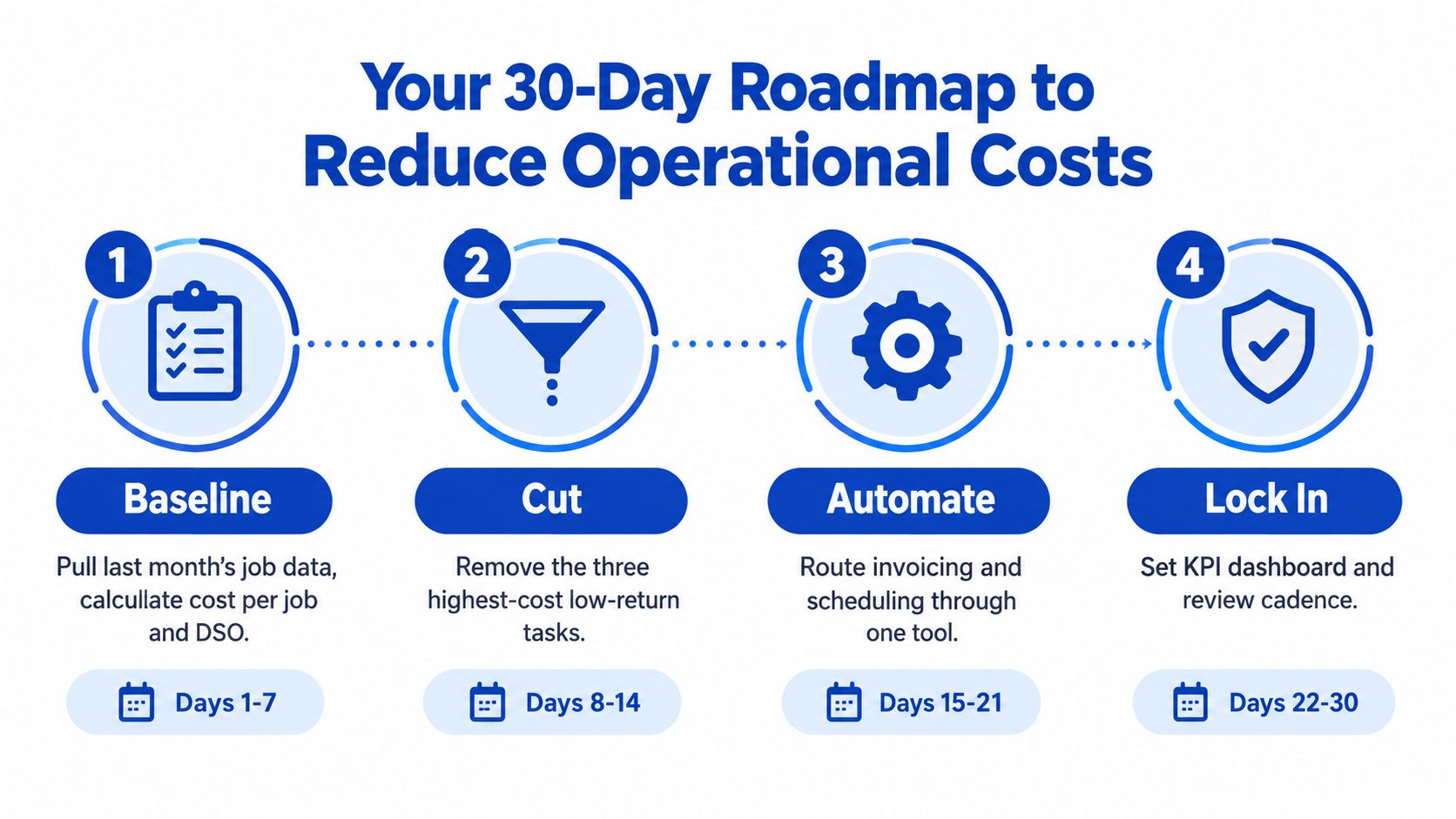
Your 30-Day Roadmap to Reduce Operational Costs
A one-truck operator needs a sequence that fits around active jobs. Use four weekly sprints, keep one owner for each action, and review the baseline before adding another change.
Week one, establish the baseline
Collect the last month's job records, then calculate cost per job, DSO, fuel cost per stop, and rework rate. Mark the single largest leak. Don't choose the most interesting problem. Choose the one that consumes the most time or delays the most cash.
At the day-seven checkpoint, write down the current values, suspected cause, and planned intervention. If you can't explain how a change should affect one of the four measures, it probably isn't ready.
Week two, tighten scheduling and routes
Assign jobs by geographic zone where practical, group compatible appointments, and review the next day's schedule for conflicts. A short daily whiteboard review can expose missing parts, unrealistic travel, and unconfirmed access details before the technician leaves.
Don't force every emergency call into a rigid route. Preserve room for urgent work and skilled-task matching. The objective is fewer unnecessary miles and handoffs, not a schedule that looks efficient but fails in the field.
Week three, improve proof and payment
Move from paper job sheets to consistent photos, customer signatures, and digital invoices. Define the minimum completion record for each job type. A simple HVAC maintenance visit may require different evidence from a roof repair, so don't impose one generic checklist on every crew.
At the day-21 checkpoint, compare invoice timing, payment dates, customer questions, and missing documentation against the baseline. If payment hasn't improved, inspect the actual failure point. The invoice may be late, the scope may be unclear, or the customer may lack a convenient payment option.
Week four, review suppliers and lock in controls
List your highest-volume suppliers and compare pricing, payment terms, delivery reliability, and return handling. Negotiate the top three relationships only after you understand actual purchasing patterns. A small discount isn't a saving if it forces larger orders, ties up cash, or increases stock that sits unused.
At day 30, keep the changes that improved the intended KPI without harming service quality. Assign a weekly owner for route review, documentation completeness, and unpaid invoices. Schedule checkpoints at day 7, day 14, day 21, and day 30, then continue with a simple monthly review.
Operational cost reduction works when it makes the business easier to run, not merely cheaper to operate. Start with one coordination leak, measure the before-and-after result, and protect the customer experience while you remove duplicate work.
HomeProBadge helps home-service professionals organize verified credentials, proof-of-work, AI-assisted job reports, digital invoicing, payments, and syndicated business content in workflows designed for trust and follow-through. Visit HomeProBadge to identify which coordination tasks you can remove from your next 30-day cost-reduction plan.