



You're standing beside a freshly repaired sink, looking at water gathering where it shouldn't. The contractor sounded confident, the profile looked reassuring, and you've already paid. What you need now isn't another promise. It's a clear record of what was done, who did it, and whether the result matches the agreement.
The Moment Every Homeowner Has Lived Through
Consider a hypothetical bathroom repair. You hire someone to replace a leaking connection, tidy the damaged cabinet, and leave the space ready to use. They arrive with tools, explain the problem confidently, and assure you they've handled jobs like yours before.
After they leave, the cabinet still smells damp. You can see a new fitting, but you don't know what happened behind it. When you ask for details, you get a short message saying the repair is complete.
The frustrating part isn't just the unfinished cleanup. It's the gap between a claim about work and evidence of work.
What a promise leaves unanswered
Before hiring, you might have seen attractive photos and enthusiastic reviews. Those materials can help, but they don't necessarily answer the questions that matter for your particular project:
Practical rule: Ask for evidence that answers a specific question, not simply evidence that looks impressive.
A homeowner shouldn't need to become a plumber to make a reasonable hiring decision. But they should be able to inspect something more substantial than a sales pitch.
That's why a term associated with cryptocurrency deserves attention outside it. Proof of work raises a useful question: can someone produce a result that makes their effort independently checkable? The technical meaning is narrower than ordinary job documentation, but the trust problem feels familiar.
What Is Proof of Work in Plain English
A computer tries possible answers until one meets a precise rule. That is the core of proof of work: someone spends computational effort to produce a result that another party can check with much less effort. The Hashcash design and its computational verification process illustrates how this works.
The key idea is asymmetric cost. Finding an acceptable answer takes repeated attempts; checking it does not require repeating the search. Like solving a puzzle that takes time to complete but only a moment to verify, the work falls mainly on the person producing the proof. The comparison has limits: a cryptographic result verifies that a rule was met, not who performed the work or whether they are trustworthy in every other way.
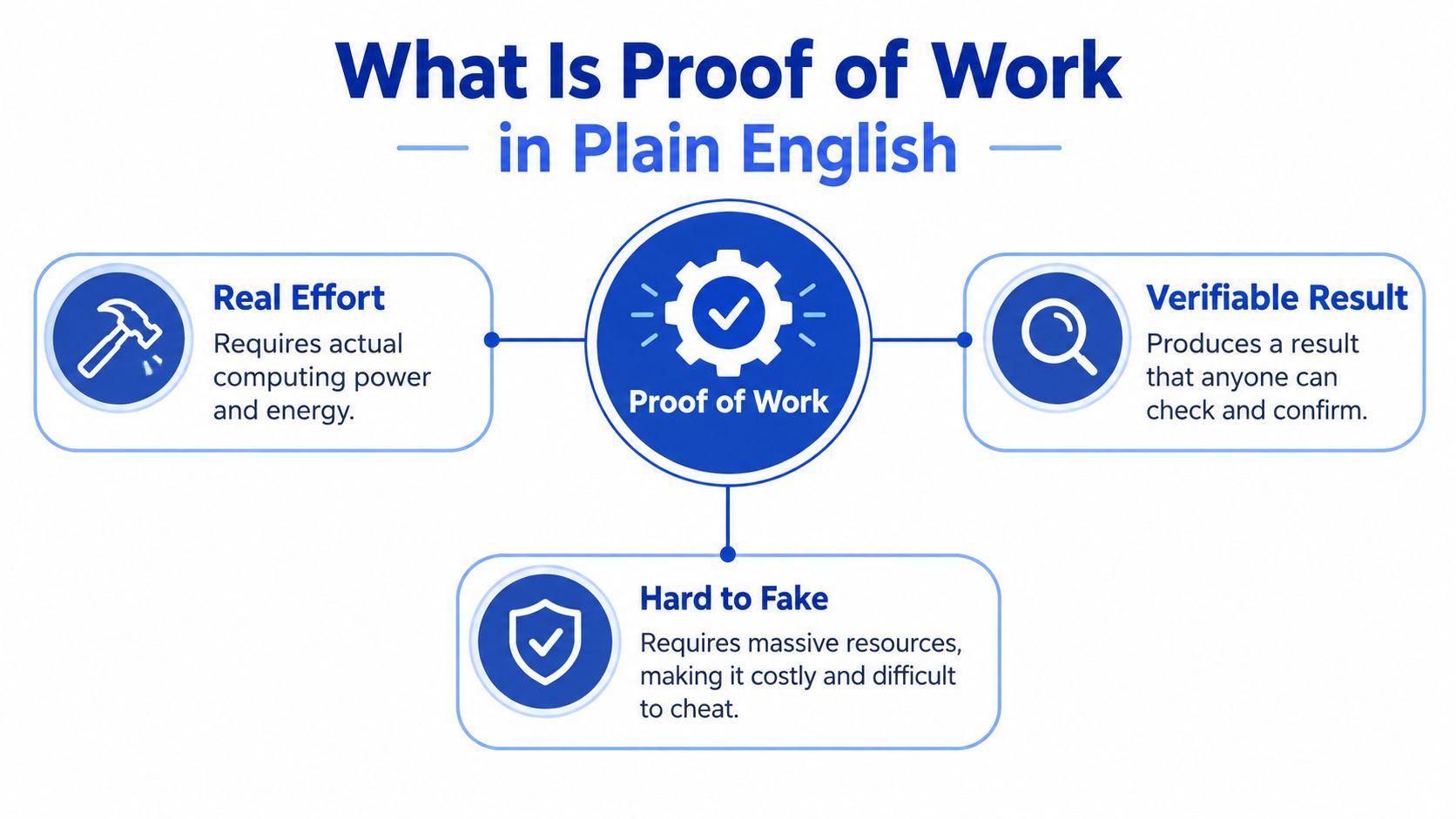
A valid result answers a narrow question: did the participant find an answer that satisfies the system's acceptance rule? It does not certify everything about that participant.
Three properties make the pattern useful:
The term also appears outside cryptography. In home improvement, a job record might include evidence of what was done and what was checked. That documentation can help a homeowner evaluate a completed repair, but it is not a computational proof of work. The shared principle is that evidence should be easier to inspect than the effort it documents.
For readers exploring cryptocurrency applications, the proof of work coins guide offers a coin-focused introduction. Proof of stake is a different mechanism, not another name for computational work.
The broader lesson applies to verified home improvement jobs: connect a claim to evidence that answers a specific question. Proof of work is a general verifiable-effort pattern; its cryptographic form and a documented home repair are related by that pattern, not by identical technical rules.
How Proof of Work Secures Blockchains Like Bitcoin
A payment network without a central recordkeeper needs a way for participants to agree on which transactions to accept. Bitcoin uses computational work to help coordinate that agreement. Its whitepaper appeared on October 31, 2008, and the network began with the genesis block on January 3, 2009. Miners use SHA-256, while the network adjusts mining difficulty approximately every 2,016 blocks to target roughly 10 minutes between blocks. These details are described in the Bitcoin developer reference on mining.
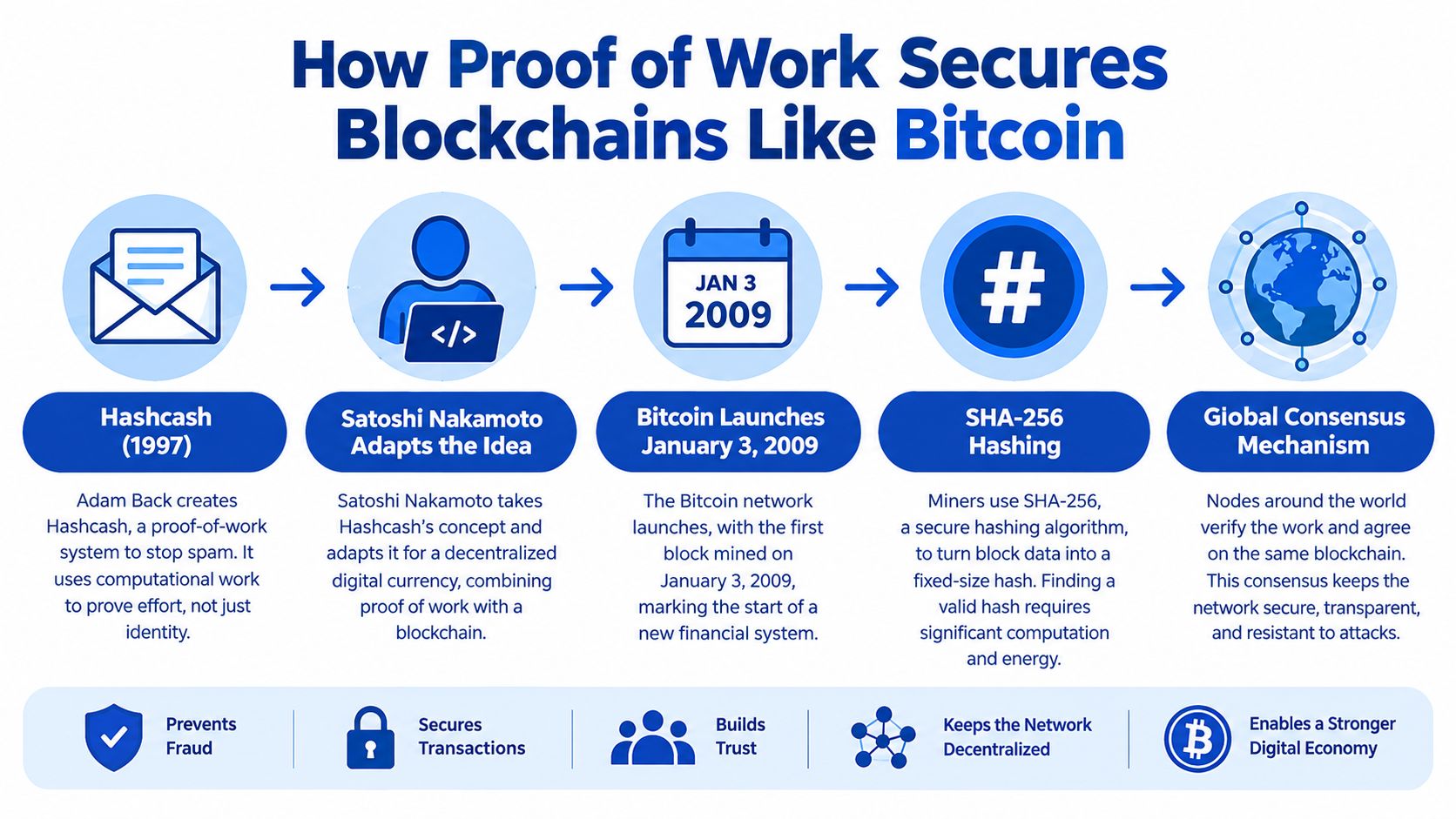
Bitcoin's method has earlier roots. Adam Back proposed Hashcash in May 1997 as a way to discourage email spam and denial-of-service abuse. It built on Cynthia Dwork and Moni Naor's 1992 proposal to impose processing costs. Instead of charging money for every unwanted message, Hashcash required senders to perform computation.
What miners are actually trying to find
A hash is a cryptographic output calculated from input data. Miners repeatedly change block data, including a nonce, a value they can adjust, and calculate new hashes. The search succeeds when a hash falls below the network's target.
This is trial and error, not a puzzle solved through clever reasoning. Hash outputs are unpredictable, so miners test candidates until one meets the rule. Anyone can then check the winning result quickly.
The network publishes its acceptance rule in advance. Miners search for a block hash that meets the target, and participants check that hash before accepting the proposed block.
This video shows the process visually:
A nonce is not a password. It is an input miners vary during the search, not a secret credential. A qualifying hash also does not, by itself, prove that every transaction in a proposed block follows the rules. Participants check the block before accepting it. And because computing power can change, the network adjusts difficulty rather than assuming miners always work at the same speed.
That shared checking process is the point. Participants can assess a common transaction history using the same rules, without asking a central administrator to decide which record to trust.
Costs and Trade-offs of Proof of Work
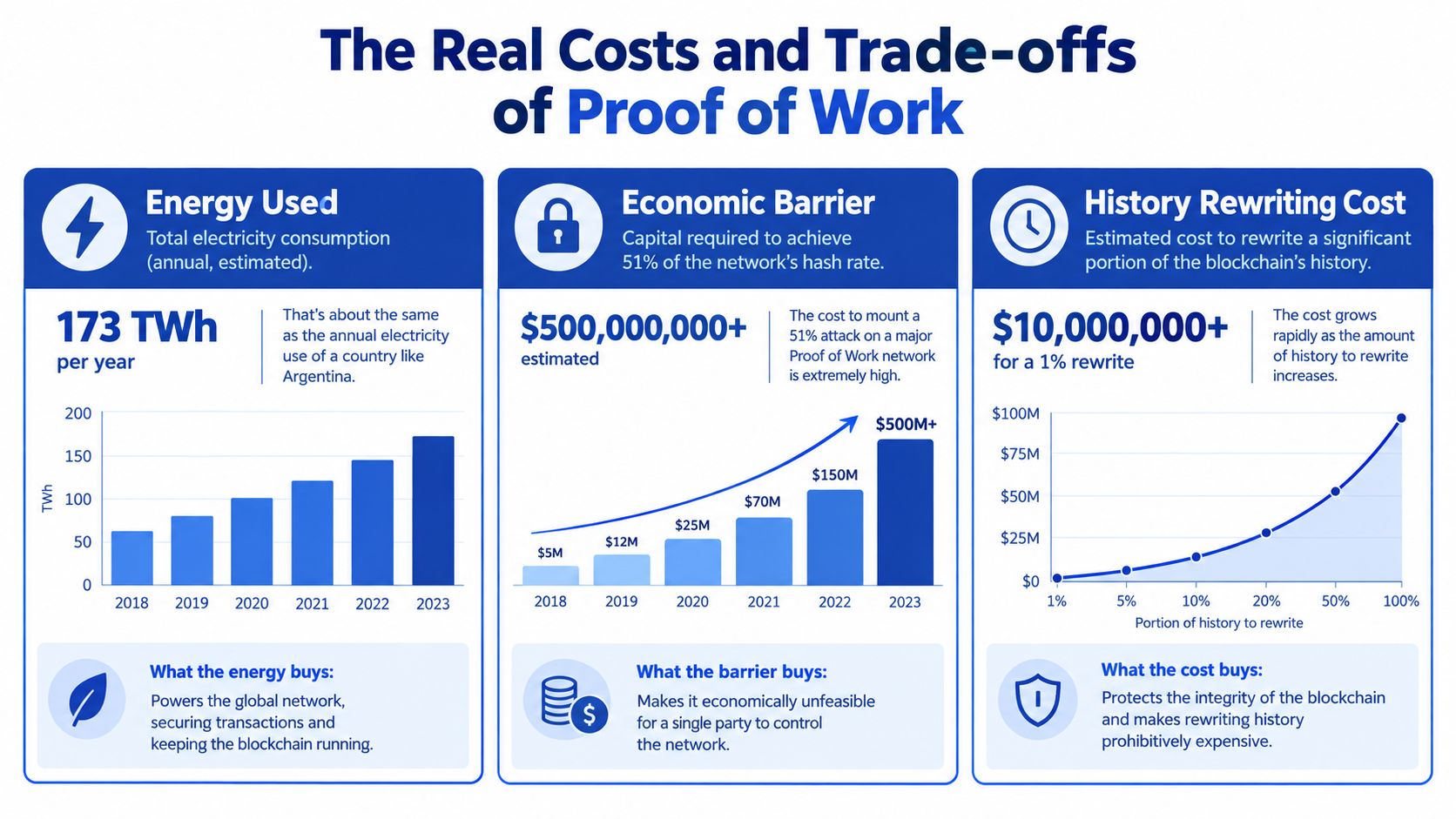
Mining equipment uses electricity. To judge that cost, consider what the energy helps protect: a shared transaction history that would be costly to rewrite. Electricity use alone cannot show whether the security benefit justifies the resources, or whether mining is environmentally responsible.
The Cambridge Centre for Alternative Finance's revised estimate put Bitcoin's electricity consumption at 89.0 terawatt-hours in 2021, down from its earlier estimate of 104.0 TWh. These are historical estimates, not measurements of today's network.
The graphic highlights the relationship between resources and security:
Separate the questions before judging the answer
Rewriting confirmed history requires reproducing the relevant work and overtaking honest miners. That economic barrier helps explain mining's security role. Comparative research on proof-of-work security and decentralization also identifies mining-pool concentration as a distinct governance concern.| Measure | What it helps you evaluate | What it doesn't settle alone |
|---|---|---|
| Energy consumption | The electricity needed to operate mining equipment | Whether mining power is widely distributed |
| Cost of rewriting history | The economic difficulty of replacing confirmed records | The environmental effects of the energy supply |
| Distribution of mining power | Who can acquire or coordinate substantial mining capacity | The network's total electricity consumption |
A network may use substantial electricity even when a limited group coordinates much of its mining. Likewise, knowing the electricity use does not, by itself, show how costly a particular attack would be.
Electricity consumption, attack resistance, and decentralization are related questions, not interchangeable measurements.
Environmental impact depends partly on the energy mix, hardware efficiency, and where mining takes place. Treating every unit of electricity as equally harmful overlooks these conditions.
The practical takeaway is to weigh both sides. A useful judgment considers the costs alongside the specific protections they support. Proof of work can make attacks more expensive, while still raising legitimate questions about environmental burden and concentrated control.
How HomeProBadge Applies Proof of Work to Real Jobs
A plumber repairing a leaking sink can leave more than a completed job and a verbal assurance. They can document the damaged connection, record the repair, and photograph the finished installation. The homeowner then has a record to review, much like a receipt that shows what was done rather than confirming that a payment occurred.
HomeProBadge applies this broader evidence-of-effort pattern to home services. Its described workflow combines professional verification, uploaded job photos, AI-generated reports, and project evidence linked to a public professional profile. Similar records can also live in project folders, inspection documents, or contractor portfolios. The useful idea is the connection between work performed and evidence another person can examine.
The image shows a handoff from a physical repair to a digital record:
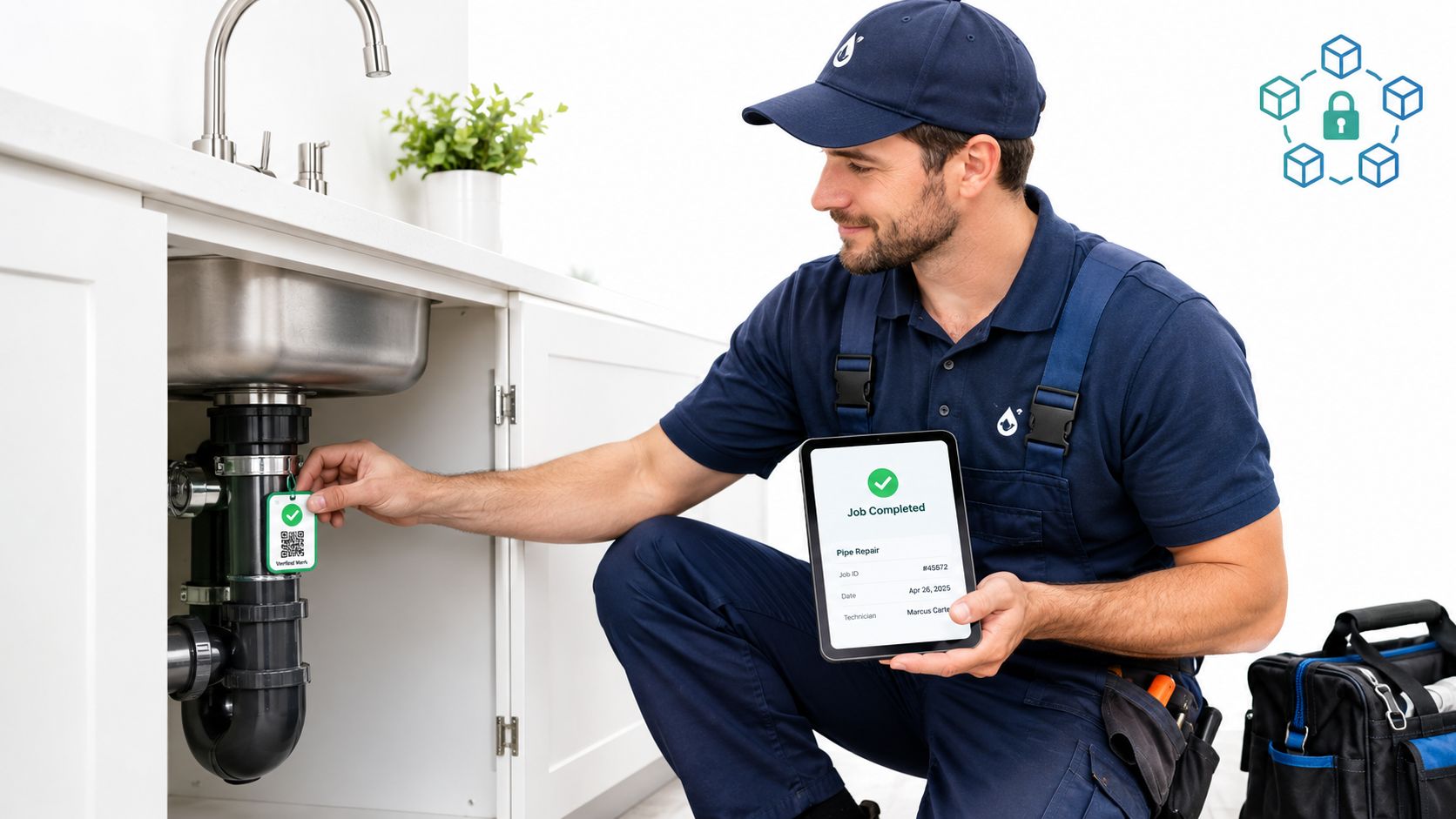
For a plumbing job, a useful record connects the original problem, the work performed, and the result. Homeowners can review the job verification process to see how completed projects become inspectable records.
The evidence may include before-and-after photos that show the relevant area, project details describing the work and naming the professional, and an AI-generated report organizing the uploaded material. The professional should check that report for accuracy. A continuing profile record also lets prospective customers inspect examples of work rather than relying entirely on a detached rating.
HomeProBadge describes its job evidence as tamper-proof and presents a TrustBadge as a visible credibility signal. Those labels describe the record and its presentation, not a guarantee that every repair was done correctly.
A record that resists alteration does not prove that its original contents were true. Even a timestamp would not establish that a hidden pipe was installed properly or that a photo shows work at the claimed address.Documentation makes follow-up questions easier: What was tested? Was an inspection required? Which parts remain concealed? Records can help reduce uncertainty, while contracts, appropriate inspections, and professional judgment remain important when assessing the work.
Verified Proof of Work Versus Anonymous Lead Marketplaces
A homeowner comparing contractors may see a lead listing beside a detailed professional profile. Both can help start a search, but they offer different evidence. A listing connects a customer with a service provider; a profile can also show who the professional is and what work they have documented.
Angi and Thumbtack should not automatically be labeled anonymous or assumed to lack checks. Their policies vary, so examine what a specific listing establishes. The useful distinction is evidence you can inspect versus claims whose supporting records are unclear.
| Trust signal | HomeProBadge verified pros | Lead marketplace listings |
|---|---|---|
| Background checks | HomeProBadge describes background verification | Check what the particular listing establishes |
| License verification | HomeProBadge describes licensing verification | Confirm coverage, applicability, and currency |
| Insurance verification | HomeProBadge describes insurance verification | Request evidence rather than infer coverage |
| Past work | Job-linked photos, reports, and structured reviews | See whether examples connect to identifiable jobs |
| Reputation | A public profile with a permanent URL | Review portability and account-access terms |
| Cost structure | HomeProBadge describes a free homeowner directory and no pay-per-lead model | Check the platform's fees and arrangements |
Each signal has a different job. Identity verification can help establish who a person is, but it does not show whether they can repair a roof well. A license or insurance record addresses another concern, while a project record can show details of completed work.
For example, a homeowner planning a roof repair can look for a documented project with a similar scope, then ask whether it covers the parts of the job that matter. A professional can consider whether completed-work records stay accessible and shareable beyond the channel that introduced the customer.
Reviews and project records answer related but distinct questions. A review may describe communication, punctuality, or the customer's experience. The linked job evidence can show what work the review concerns. Neither guarantees a successful result.
The comparison is not stars against badges. It is unsupported claims versus evidence with a clear identity, scope, and verification process. Checking what each record establishes gives homeowners a more useful basis for questions and decisions.
Common Misconceptions About Proof of Work
The phrase solving puzzles can make mining sound like a contest that ends when someone invents a sufficiently fast machine. That's misleading. Greater speed can give a participant an advantage without automatically giving them control over the network.
Likewise, calling mining wasted electricity skips the distinction between whether computation has a security purpose and whether its costs are acceptable. The earlier trade-off discussion separates those judgments; neither requires treating energy consumption as a complete verdict.
Faster doesn't automatically mean dominant
A technical analysis of quantum mining capacity estimates that an optimistic 100-gigahertz quantum machine would deliver roughly 21 terahashes per second, about one-tenth of a modern ASIC, against a modeled network near 860 exahashes per second, and concludes that achieving 51% would require an implausibly large number of those machines.
Those figures describe the analysis's assumptions, not a live measurement or a guarantee about every future quantum system. They also concern mining capacity, not every cryptographic question that might arise elsewhere in a payment network.
A faster participant generally gains more opportunities to earn mining rewards. The difficulty adjustment already described helps maintain the intended block interval as overall computing power changes.
A better question: Does the new equipment provide an efficiency advantage, or can its operators sustain enough coordinated mining power to threaten the network?
Pay attention to ordinary sources of control
The less dramatic risks deserve scrutiny:
There's a parallel misunderstanding in home services: a polished report doesn't automatically establish a good repair. In both settings, evaluate what the evidence proves, who controls the process, and which assumptions remain outside the proof.
Why Proof of Work Matters Beyond Cryptocurrency
The most useful lesson isn't that every industry needs cryptocurrency. It's that people make better-informed decisions when they can inspect evidence tied to a specific claim.
Bitcoin addresses agreement about transaction history through costly computation. Home-service documentation addresses a different problem: helping people understand what a professional did at a property. The mechanisms aren't interchangeable, and a completed-job report shouldn't be described as blockchain consensus.
Still, the comparison suggests a practical design principle: require evidence appropriate to the claim, and make its limits visible.
Match the evidence to the decision
For a homeowner hiring a roofer, attractive finished-roof photos might establish appearance. They may not answer questions about concealed flashing, preparation, or the work agreed in the contract.
For a professional building a portfolio, a neat summary becomes more useful when the supporting material is available. The construction photo documentation guide provides a relevant starting point for thinking about which stages of a job deserve a record.
What to watch for in 2026
Judge verification tools by observable practices, not by how often they use words such as AI, verified, or tamper-proof. Ask whether you can inspect the underlying evidence, understand the checks, identify corrections, and distinguish a generated summary from independently confirmed information.
Professionals can use that same standard when choosing how to present their work. A record should help a homeowner ask better questions, not discourage questions with an impressive seal.
Verifiable effort supports trust when the verification matches the promise. That's valuable whether you're evaluating a computational record or deciding whom to let into your home.HomeProBadge offers professional verification and project-linked work records so homeowners can inspect more than a sales pitch, while professionals can build a shareable history of completed jobs. Visit HomeProBadge to explore professional profiles or learn how to document your own work with photos and job reports.